
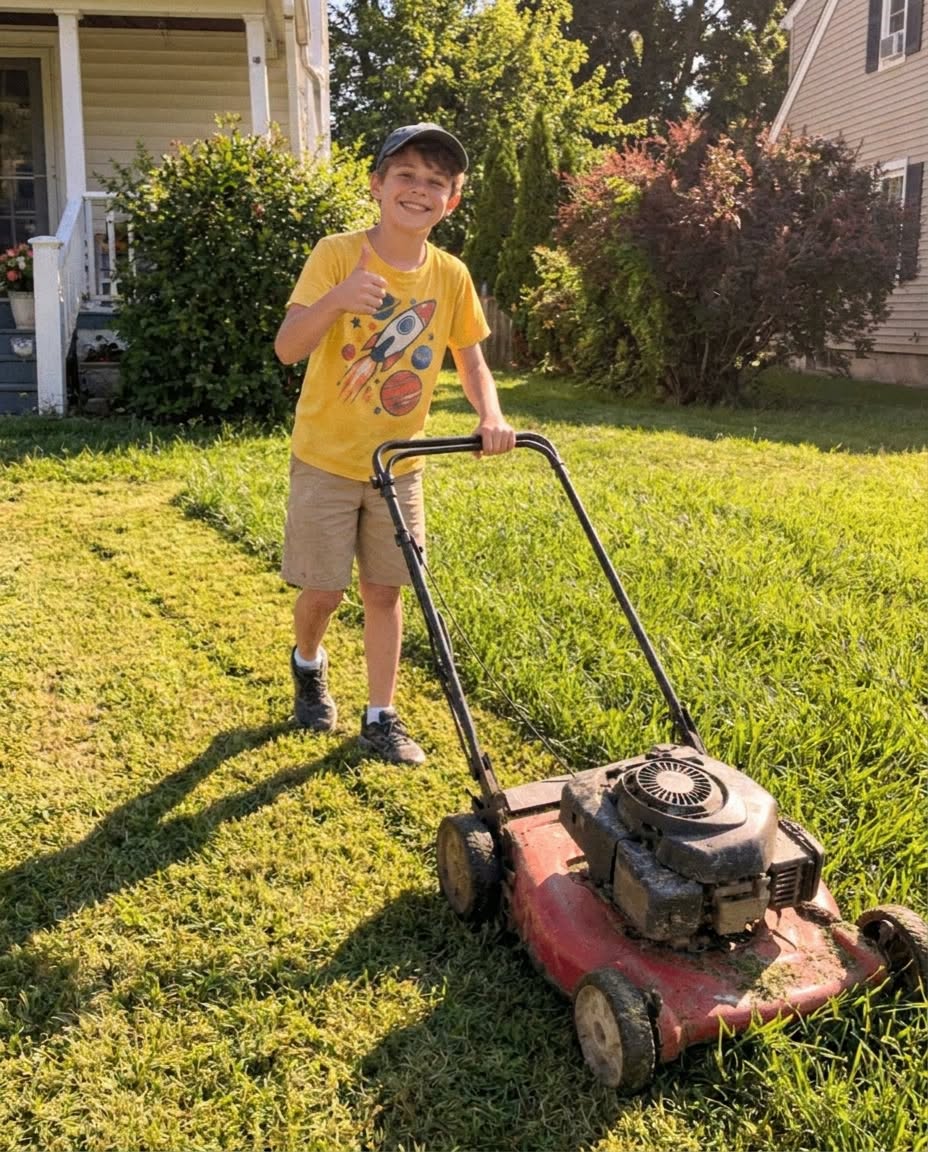
Two patrol cars stopped in front of our house just after lunch, and my hands started shaking before either officer reached the porch. My twelve-year-old son Justin was still at the kitchen table finishing the second grilled-cheese sandwich he had made after mowing one last lawn that morning. When the older officer asked whether he was “the boy who’s been mowing yards around the neighborhood,” every terrible possibility arrived in my head at once. Then he asked specifically about a small blue house near the end of Hawthorne Street. Justin immediately said, “Dorothy’s house?” The officer explained that Dorothy had been found several blocks away that morning, confused and unable to tell anyone where she lived. She was safe, but when police entered her home trying to identify family contacts, they found handwritten notes everywhere—and Justin’s name was on several of them.
Justin had started his summer project after seeing seventy-eight-year-old Mrs. Hall struggling to push a mower through ninety-degree heat. He cut her grass, refused her twenty dollars, and then asked whether other older neighbors might need help. I gave him rules: tell me where he was going, keep his phone charged, and never enter anyone’s house without permission. Within weeks, everyone knew him as “the lawn kid.” Dorothy was simply one more stop, or so I thought. Justin eventually admitted that after mowing her yard several times, she began asking for small favors—bringing in groceries left on the porch, moving flowerpots, rolling the trash bin back, replacing batteries in a lantern, helping her reach a folder of important papers. None of it sounded alarming by itself. What frightened me was hearing all of it together and realizing that my twelve-year-old had quietly become someone Dorothy depended on.
The officers took us back to Dorothy’s house while they continued trying to locate her family. Once inside, I saw the notes Justin had never noticed: TAKE PILLS WITH BREAKFAST. TRASH WEDNESDAY. CAROLINE PHONE NUMBER BESIDE PHONE. JUSTIN COMES TUESDAY. Justin knew where Dorothy kept birdseed, which key opened the garden gate, and that Caroline was her niece. When Caroline finally arrived, she was horrified that a twelve-year-old seemed to know more about Dorothy’s daily routine than the adults around her. Then Justin mentioned things he had dismissed as odd little moments: Dorothy asking his name three times in one afternoon, trying to pay him repeatedly for the same job, and once staring through the window while he mowed before asking why a strange boy was in her yard. Caroline began crying. Dorothy had apparently been having increasing memory problems for months, but she feared that admitting it would mean losing her independence. None of us had understood how serious the pattern might be until the morning she wandered away.
After medical evaluation and discussions with her family and care team, Dorothy did not return to living alone. She needed more supervision and support than her house could safely provide. Justin took the news harder than I expected. His first question was whether she wanted to leave, and his second was whether he could still visit. Then he asked if we could move “part of her yard” with her. With Caroline’s permission and the facility’s approval, we dug up Dorothy’s daisies, rosemary bush, and a small rose plant she had always warned Justin not to mow too close to. Staff cleared a narrow planting bed beneath her window, and Justin replanted everything himself, handling every root as carefully as though it could feel what was happening.
When Dorothy came outside, she looked at Justin without recognition at first. I watched his face fall—the first time all summer he had arrived ready to help and found a problem he could not fix. Then she glanced at the tools and said, “You’re the lawn boy.” Justin smiled immediately and reminded her of his name. He showed her the flowers under the window and said, “I brought part of your yard.” Dorothy rubbed a rosemary leaf between her fingers, lifted it to her nose, and smiled. “Smells like home,” she said. A few weeks later, after school had started, I heard the garage door open on a Saturday morning and saw Justin heading down the driveway with his grandfather’s old work gloves and a watering can. I asked where he was going. He looked back at me as though the answer should have been obvious. “Dorothy’s flowers aren’t going to water themselves.”