
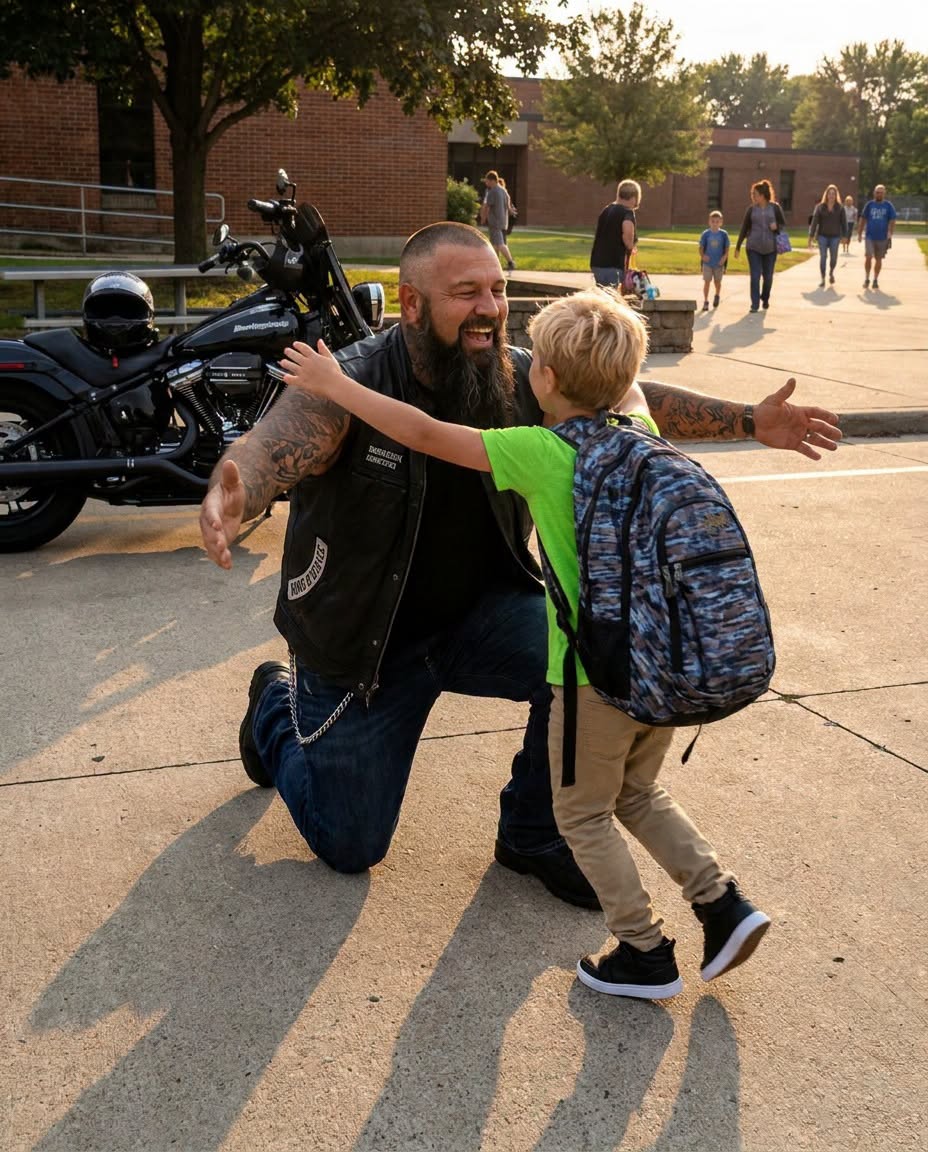
My seven-year-old son was usually shy with strangers, so I froze when he sprinted past me outside school and threw himself into the arms of a huge bearded biker I had never seen before. The man caught Zion easily and hugged him back with the familiarity of someone who had done it many times. I rushed over, pulled my son behind me, and demanded to know who the stranger was. The biker took a step back, kept his hands visible, and introduced himself as Caesar. Then he looked at Zion and asked, almost wearily, “Buddy, you didn’t tell her?” My stomach tightened. When I demanded an explanation, Caesar glanced at my son and said, “Well… I guess this is how you’ll find out.”
I had been raising Zion alone since he was a baby, and I thought I knew every important person in his small world. His father had faded from our lives years earlier, leaving me to handle school runs, bills, scraped knees, Christmas mornings, broken bicycles and every practical task that came with raising a child alone. Lately, however, Zion had begun asking questions about “dad stuff”—cars, tools, ties, repairs—and I had told him there was no such category, only things people learned from whoever happened to know them. I failed to notice how seriously he took that answer. Over the next few weeks, grease appeared beneath his fingernails, he learned to check bicycle-tire pressure, corrected my tape-measure technique and practiced tying one of my scarves around his neck. Outside the school that afternoon, Caesar opened a motorcycle saddlebag and handed me a battered red metal toolbox labeled in Zion’s crooked handwriting: ZION’S STUFF. Inside were child-sized gloves, a wrench, tape measure, tire gauge, sewing kit, pancake spatula and a hopelessly knotted blue necktie.
Zion finally admitted he had been preparing for the school’s Family Skills Day. His classmates kept talking about which practical skill their fathers would demonstrate, and he had overheard me telling another single mother that his questions about dads sometimes made me afraid he would eventually decide one parent had not been enough. He had misunderstood my fear as a burden and decided he should learn those skills himself so I would not have “more homework.” Caesar explained that their relationship had begun when Zion’s bicycle chain slipped while he waited in the supervised pickup area across from Caesar’s repair shop. Rather than fixing it for him, Caesar showed Zion how to repair it himself. Zion returned later asking to learn something else, and Caesar began bringing small lessons outside—tire pressure, measuring, basic tools—while repeatedly telling him he needed to tell me. When I asked why he kept teaching a child he barely knew, Caesar revealed that he had spent twenty-six years teaching vocational classes before the program closed. “Your boy wasn’t the lonely one,” he told me quietly. For the first time, I understood that Zion had not been searching for a replacement father; he had found a retired teacher who missed being needed.
Three days later, Caesar joined us for Family Skills Day—with my knowledge and permission this time. At registration, Zion proudly introduced us as “my mom” and “my Caesar,” a title that made the enormous biker blink back tears. Zion repaired a bicycle chain almost perfectly, while Caesar discovered at the sewing station that his expertise had limits and I had to teach him how to attach a button. The arrangement suddenly felt less like someone filling a missing role and more like what learning was supposed to be: one person knowing something, another asking, and eventually those positions reversing. At the final station, Zion wrote three words on a small wooden board: ASK. LEARN. TEACH. He explained that Caesar had taught him to ask when he did not know something, learn it, and someday teach someone smaller. When the event ended and Zion asked what tomorrow’s lesson would be, Caesar looked at me before answering—a tiny gesture that told me he understood exactly where the boundary now stood.
We walked toward the parking lot together without pretending we had suddenly become some perfect substitute family. Zion already had a mother, and Caesar did not need to become his father. He was simply Caesar: a man with years of knowledge and nowhere meaningful to put enough of it until a curious seven-year-old appeared with a broken bicycle chain. The next afternoon, both Zion and I showed up to learn how to change the oil, because I had finally recognized something I should have understood much earlier. Being enough for my son did not require me to know everything, teach everything or become every person he might ever need. Sometimes being enough means knowing when to protect him—and when to let a good person teach him something you cannot.

