
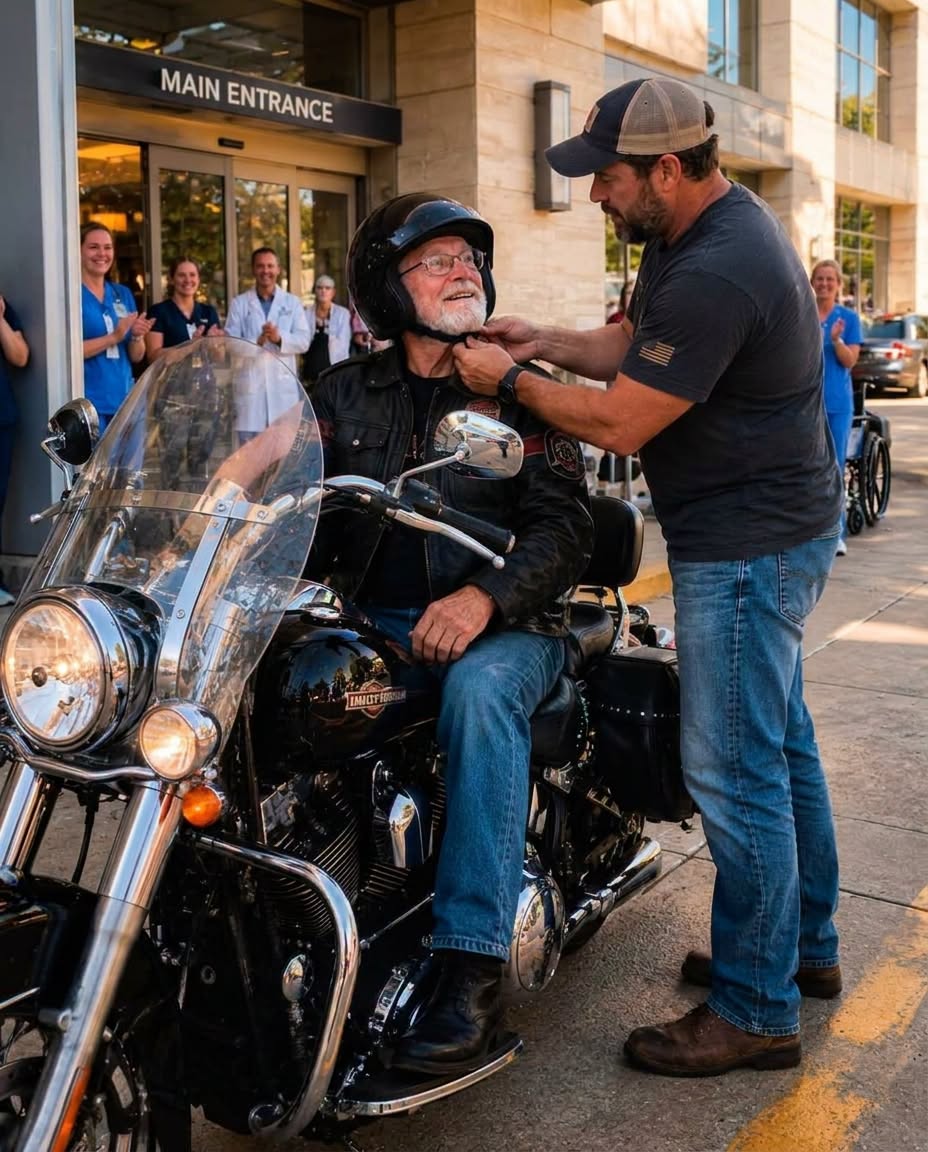
The call came from St. Vincent’s Hospital on a Thursday afternoon: my seventy-nine-year-old father was sitting in the lobby wearing his leather vest, holding two motorcycle helmets, and insisting he was there to take my mother home. Linda had been dead for seventeen years. Dad had been diagnosed with dementia two years earlier, we had taken away his driver’s license and keys, and I had personally removed the battery from his Harley because we were afraid he would try to ride it. Somehow he had walked two miles to an auto-parts store, bought another battery with cash, installed it himself, and ridden sixty miles to the hospital where Mom spent her final days. When I arrived, he was sitting perfectly upright with his hair combed, Mom’s white helmet carefully placed beside his own. “They’re discharging her today,” he told me calmly. Then, when I tried to redirect him, he looked directly into my eyes and said my name—Danny—a name he had not spoken in months.
That hospital had always held another memory I had never forgiven him for. The night Mom died, Dad had disappeared for hours. My sister Karen and I were seventeen and nineteen, sitting beside our mother while her breathing grew weaker and nurses moved quietly around the room, and Dad would not answer his phone. He arrived long after she was gone, smelling of exhaust, and none of us ever asked where he had been because grief had exhausted every question we possessed. Over the years, silence hardened into judgment. I remained polite to him, but never close; every Christmas, birthday, birth, and family gathering carried the same unspoken accusation. Sitting beside him in the hospital lobby seventeen years later, I saw something change in his face. His eyes sharpened. His hand closed firmly around my wrist. “I know she’s dead,” he said. “I know what year it is. I’ve got maybe an hour before this slips away again, so listen to me. I didn’t come here to pick her up. I came because I made her a promise.”
Mom had made that promise when they were twenty-four. Her own mother had died slowly from cancer, and afterward Mom watched her father become unable to remember anything except the hospital bed and the final stages of illness. She told Dad she never wanted that to happen to him. If her own death ever became inevitable, she wanted him to leave before the final moment so his last memory would still contain her laugh, her voice, and the woman she had been before illness took over the room. On the morning she died, after Karen and I went downstairs for lunch, Mom grabbed Dad by the collar and reminded him of that forty-year-old promise. She sent him to the overlook on Route 42 where he had proposed in 1970. He sat on the same flat rock, watched the sun disappear over the valley, and talked to her out loud about their children and grandchildren until darkness covered the little church steeple below. “I knew when she was gone,” he told me. “I felt it.” Mom had also made him promise never to tell us why he left, believing we might need to blame him more than we needed another painful truth. So for seventeen years, he let us.
He was telling me now because dementia had finally threatened the one secret he had refused to surrender. A week earlier, standing at his kitchen sink, he had forgotten Linda’s name for several terrifying seconds. His physician had warned that the lucid periods were becoming shorter and the decline more pronounced. Dad understood enough to know that someday soon he might no longer remember the promise, the overlook, or why his son kept looking at him with seventeen years of distance. So he wrote everything down in case his mind failed during the trip, repaired the Harley in secret, tucked a letter into the saddlebag, and waited for a clear morning. That morning came. Before leaving the hospital, he gave me a worn black-and-white photograph of himself kneeling before Mom at the overlook in 1970, a picture she had kept inside her Bible and he had carried against his chest for every motorcycle ride since her funeral. Then he asked me to ride home with him because he could already feel the clarity fading. I put on Mom’s helmet and climbed behind my father for the first time since I was sixteen.
We took the long road home through the valley. When we passed the Route 42 turnoff, Dad lifted two fingers from the handlebar in a quiet salute, but by the time we reached his driveway the man who had explained everything was already disappearing again. He turned to me with uncertainty and asked who I was and why I had his wife’s helmet. I told him I was a friend returning something I had borrowed a long time ago, and he accepted that answer without suspicion. Later I found the sealed letter in his saddlebag exactly where he said it would be, but I never opened it; I had already received what he had written, spoken aloud during what may have been one of his last fully lucid hours. I called Karen that night and told her everything. Dad is still alive, though some mornings he knows us and some afternoons he does not. I used to tell people that my father abandoned us the night my mother died. I tell the story differently now. He kept a promise for seventeen years, even when keeping it cost him his children’s understanding. And when dementia finally threatened to take that promise too, he rode sixty miles to give me something I thought I had lost long before his memory began to fade: my father.