
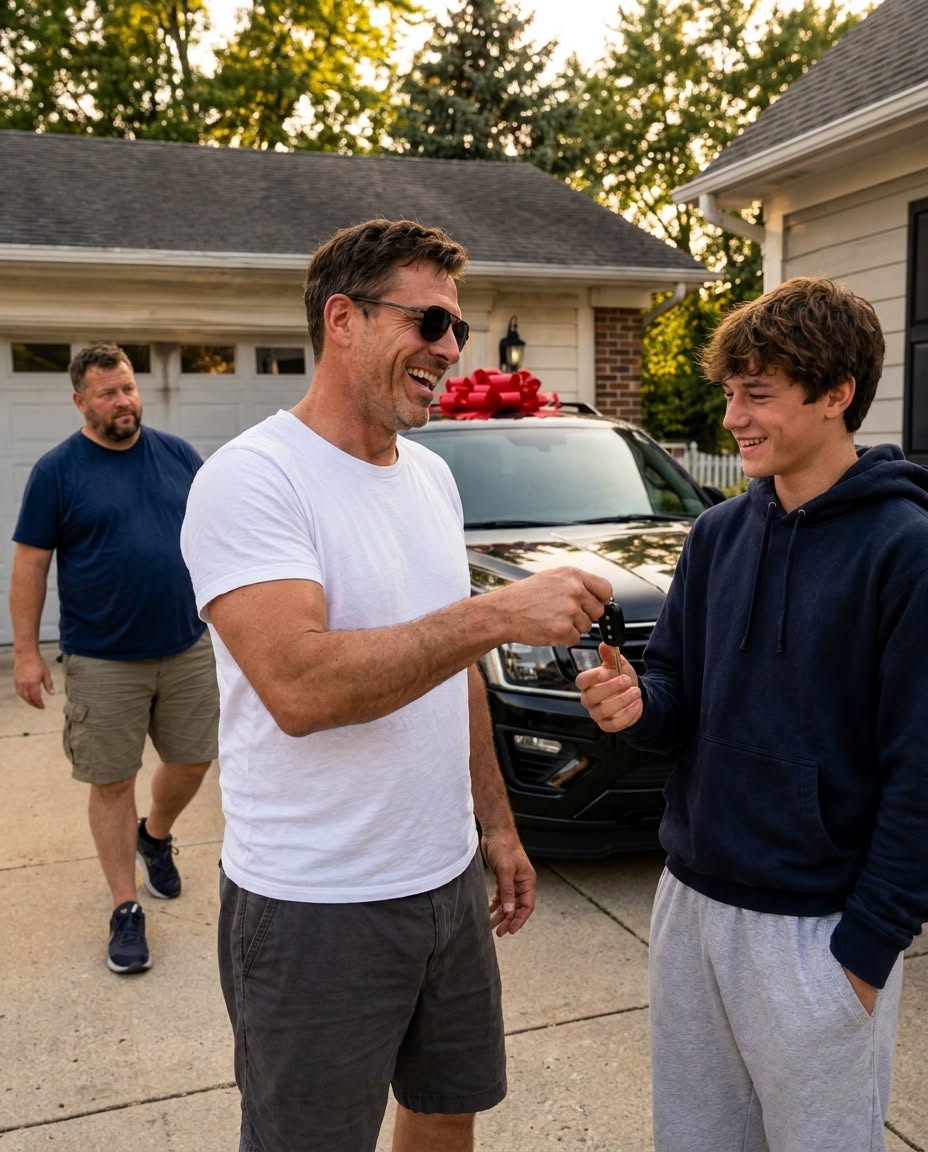
“Come on, son. Your stepdad could never compete with this.” My biological father stood in our driveway holding out the keys to a brand-new black car with a red bow stretched across the hood, smiling as though fourteen missing years could be compressed into one expensive afternoon. I had not seen him since I was three. Behind me, my mother stood on the porch with both arms folded tightly across her chest, while Ray—the man who had spent the last two years showing up to every football game, helping me stumble through chemistry, and quietly calling me his kid—looked down at the pavement. My father jingled the keys again and waited for gratitude. I looked past him through the open front door and saw the wooden box Ray had given me that morning sitting on the kitchen table. Then I walked right past the car and went inside to get it.
Ray entered my life when I was fifteen, after years when Mom and I measured money by what had to wait until next month. He brought two younger children of his own, paid child support, helped with our household bills, and somehow never made me feel like I was competing with anybody for space. A few months after he married Mom, they opened a college account for me. On my seventeenth birthday, Ray gave me the handmade wooden box he had spent six weeks building in the garage, my initials burned unevenly into the lid. Inside were fourteen months of bank statements, each with a note in his handwriting explaining what he had postponed to make that month’s deposit: “Boots can wait: $40.” “Brought lunch all week: $25.” “Truck service next month: $60.” One month showed zero because his son Danny needed new glasses. The next month showed eighty dollars because Ray had quietly made up the difference. At the bottom was a note that read simply: “Kid, it isn’t enough yet. We’ll keep going.”
Back in the driveway, my biological father laughed when he saw the box. So I handed him the statements one at a time. He read the deposits and frowned at amounts that probably looked insignificant beside a new car, until I made him turn them over and read Ray’s notes. Then I asked him three questions: what position I played in football, which college I was applying to, and which subject had nearly kept me from passing the year before. He could not answer any of them. He blamed my mother for keeping him away, but she finally said what she had protected me from hearing for years: he had known where we lived, knew my birthday, and could have written or called. Ray never defended himself. He simply stood there, visibly uncomfortable with being compared to anyone. That was when I understood the difference between money spent in one afternoon and attention accumulated over years.
My father offered the keys again. I took them for a moment, because of course I wanted the car. I had taken the bus for years and imagined the freedom of driving myself to school. Then I closed his hand around the keys and told him, “I’ve wanted a car for two years. I wanted a dad for fourteen.” When he asked whether I was choosing Ray over him, I told him no: Ray had already chosen me. My father drove away with the car, and Ray went straight inside to wash the breakfast dishes because that was the kind of man he was. When I thanked him for the box and the account, he tried to shrug it away. Finally I asked why he had done so much when he did not have to. He stared into the sink for a second and said, “You’re my kid.”
The college account kept growing slowly after that. Ray eventually stopped writing down what he had sacrificed because I told him it made me feel guilty, so he started writing little things about me instead: “Passed chemistry somehow — $50.” “Scored a touchdown — $30.” “Proud of you, kid — $100.” My biological father contacted me again later, without a car and without insulting Ray, and I was willing to hear what he had to say—but hearing him did not erase the years. I still have the wooden box. The most expensive birthday gift anyone ever offered me disappeared down the street before dinner, but Ray’s gift stayed because it was never really the money. It was proof, written month by month, that fatherhood can be built quietly by the person who keeps showing up when nobody is watching.

