
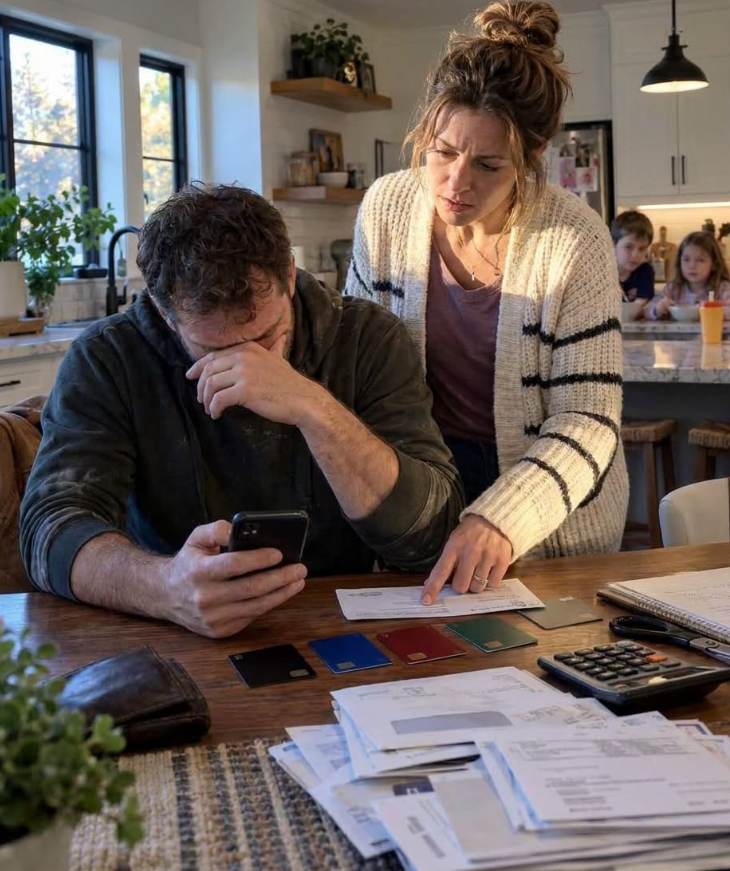
“New rule. No kids at family dinners except mine.” That was the text my younger brother Spencer sent while I sat at my kitchen table after a thirteen-hour search-and-rescue shift, eating chicken and wild rice soup with my wife Clara. I stared at the screen, waiting for the joke that never came. My mother reacted with a thumbs-up. My father wrote, “Finally.” Spencer’s wife added that dinners would be “so much calmer without the extra noise.” I handed the phone to Clara, took a screenshot of the group chat, and forwarded it to my accountant. Then I typed one sentence back: New rule. No family lives on my money except mine. Within minutes I had revoked four authorized credit cards—my mother’s, my father’s, Spencer’s, and his wife’s—and for the first time in seven years, the people excluding my children were going to have to finance their own lives.
The cards had started as emergency help, not a lifestyle. After my father fell from a scaffold and could no longer run his roofing business, I used income from a mortgage-free duplex my grandfather had left me to help my parents avoid foreclosure. I covered part of their mortgage, utilities, and groceries. Later, when Spencer lost his job while his wife was pregnant, I gave him a low-limit emergency card until he got back on his feet. He found a good job. The card stayed. Then his wife received one too. Over time, emergencies became habits and habits became expectations: premium phones, restaurant delivery, gym memberships, a country club fee for my father, boutique shopping, and a $900-a-month Porsche lease Spencer could only afford because I was quietly subsidizing everything else. Meanwhile, my daughter Maya and my son Finn were treated as lesser grandchildren. Maya noticed. One afternoon, sitting beside me while I repaired the lawn mower, she asked, “Dad, do Grandma and Grandpa like my cousins more than us?” I lied and told her of course not, but I knew she had already learned the same lesson I had learned as a child: Spencer came first.
The cutoff exposed how little the arrangement had ever been about need. The next morning I woke to sixty-one missed calls, but the first message from my mother was not an apology—it was, “Your card is not working.” Spencer called demanding to know why Brooke had been humiliated at the grocery store. My mother came to my house crying, then admitted her real concern was that Spencer might lose his Porsche. Extended relatives began accusing me of cruelty. Spencer went further, filing a baseless workplace complaint claiming I was hostile and dangerous around families with children. My supervisor reviewed it and closed it. A week later Spencer brought the entire family to the national preserve where I worked and began recording me on his phone, clearly hoping to provoke an outburst he could use against me. I kept my body camera running and professionally advised them to take a safe paved loop. When Spencer pointed to a closed logging road, I explicitly warned him twice that heavy rain had created severe erosion and that crossing the yellow barricades was prohibited. He ignored me anyway and led our parents, his wife, and his own children past the closure.
Two hours later, dispatch sent us to rescue a stranded group in the exact restricted sector. My mother had injured her ankle. My aunt had locked herself inside a maintenance shed. Spencer had slid down a collapsing embankment and was clinging to a small tree over a ravine. I rappelled down and hauled him back to safety while he threatened to sue me and the park for supposedly sending them into danger. My supervisor pointed at the torn barricade and the large TRAIL CLOSED — EXTREME EROSION HAZARD sign lying beside them, then reminded Spencer that my body camera had recorded every warning. Spencer’s own wife admitted he had told them the closure was merely a recommendation. Days later, he tried to attack the preserve online, only for family photographs to surface showing him posing beside the barricade and my mother ducking underneath it. The story collapsed without me having to defend myself. More importantly, their finances did not collapse either. My parents canceled luxury services, my mother took part-time work at a florist, my father traded his truck for a used sedan, and Spencer returned the Porsche and bought an older Honda. The catastrophe they had predicted turned out to be budgeting.
Months later, my mother asked to meet for coffee. She told me she was not there to ask for money. She wanted to apologize for my children. Maya had stopped answering her calls and eventually texted one sentence: I don’t want to go where people don’t want me. That was what finally broke through. I allowed my parents to rebuild a relationship with Maya and Finn slowly, with one permanent condition: money would never again be part of the relationship. Spencer took longer, but eventually he apologized too. A year after the original text, the four credit cards are still canceled. My parents pay their own bills. Spencer pays for his own car. Our children can sit at the same table without special rules. I still help people for a living—lost hikers, injured visitors, frightened families—but I no longer confuse rescuing someone with carrying them forever. At work, I tell people that a sign saying DO NOT ENTER is a boundary, not a suggestion. It took me much longer to understand that the same principle applies to families.

