
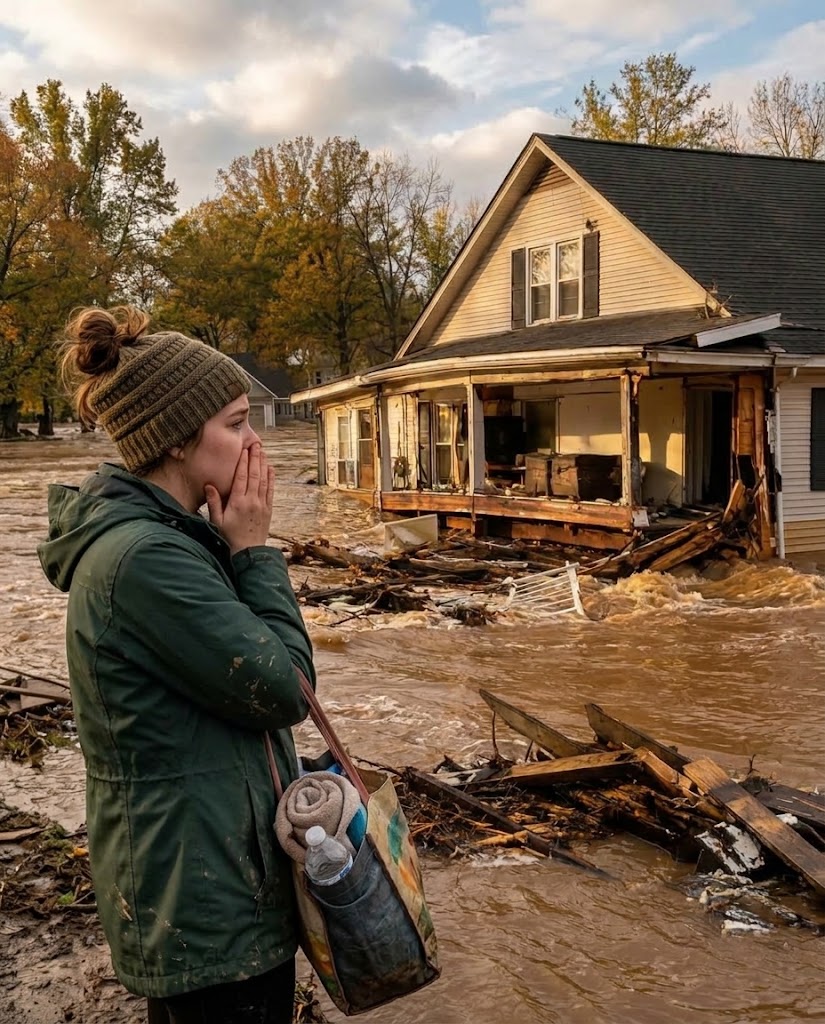
The river was already up to my waist when I crossed the kitchen where I had raised my daughter. I was seventy-two, widowed for five years, standing in the dark in my nightgown with a plastic grocery bag tied around the few things I could save: birth certificates, Ron’s death certificate, our wedding picture, and a little blue bank book with a rubber band around it. By six-thirty that morning, a volunteer firefighter in a johnboat was breaking the window over my sink and pulling me out while brown water climbed past the stovetop. Eleven days later, an insurance adjuster walked through the ruined house, looked at the cracked foundation and black mold, and called it a total loss. My daughter Megan brought me from the Red Cross shelter to the finished basement of the suburban home she shared with her husband, Josh, and their children, Lily and Sam. For one week, it felt like rescue. Then Megan called me upstairs, slid a typed agreement across the kitchen table, and told me I would owe $900 a month in rent, use the laundry only on Tuesdays, stay out of the kitchen until after seven, leave the thermostat alone, and discourage my grandchildren from coming downstairs.
I was hurt enough to remember every unbilled thing Ron and I had ever done for her: the $12,000 toward that house’s down payment, the Honda I had co-signed when Josh’s credit was poor, three years of free childcare while Megan finished nursing school, every meal and emergency and ride nobody had ever totaled on paper. But when I looked across the table, I saw something else. Megan’s hands were shaking. She had dark circles under her eyes, bitten nails, and the look of a woman trying desperately to keep a wall from falling while pretending it was solid. Josh would not meet my eyes; he stood at the counter scrolling his phone as if something on the screen mattered more than the room. So I signed. For two years I paid nine crisp hundred-dollar bills on the first of every month, slept in sweaters when the basement was cold, bought a hot plate so I would not violate the kitchen rule, and took the city bus three mornings a week. Megan thought I was going to the senior center. In fact, I had taken a job doing alterations at Pham’s Tailoring. Meanwhile Lily crept downstairs almost every night with a book because her parents were fighting upstairs. One evening she asked me what a “parlay” was. From then on, I knew enough to wait.
The truth surfaced after Josh lost his job. Megan finally discovered that he had been fired after gambling on a company computer, had secretly burned through hundreds of thousands of dollars in sports bets, forged her signature on a $65,000 home-equity loan, cashed out her retirement account, and let the mortgage fall four months behind. A pink foreclosure notice showed a past-due amount of $14,860.42 and warned that proceedings would begin in six weeks. At one in the morning, I found Megan sitting at the kitchen table surrounded by bills, crying into the sleeve of the same pink robe she had worn through nursing school. That was when I went downstairs and brought up the little blue bank book I had carried through the flood. The account bore her maiden name—Megan Rose Dawes—and had been opened by Ron on June 3, 1983, the day she was born, with a $25 deposit and a note in his handwriting: For our girl. For her first house. Love, Dad. Over forty-two years we had added birthdays, Christmas money, my quilt sales, part of Megan’s first Dairy Queen paycheck, and eventually $131,500 from the insurance settlement on my destroyed Water Street house. I had also deposited every paycheck from Pham’s Tailoring while paying Megan rent from my Social Security. The balance was $187,412.36.
Josh appeared in the doorway the moment he heard the number. His first instinct was to start calculating how “we” could use it, and that was where Megan finally stopped being afraid. She told him exactly what she had found: roughly $312,000 wagered in four years, the forged loan, the liquidated retirement funds, the job loss, and the rent agreement he had drafted because he wanted more cash and less scrutiny from Lily. Then Josh broke. He admitted he could not stop gambling, that every loss made him chase the next bet, and that he had lied so often he no longer recognized himself. The money was not handed over. Megan and I went to the bank together and paid the mortgage arrears and fraudulent second mortgage directly, by certified funds, while preserving the remaining money in her sole name. She met with counsel about the forged documents and title, and Josh agreed that her name alone would remain on the deed if the marriage continued. He surrendered passwords, began Gamblers Anonymous, accepted that relapse would have consequences, and later took a lower-paying job while he and Megan entered counseling. None of it produced a miracle. Recovery came in the less cinematic form of disclosure, accountability, two relapses he confessed himself, and Megan refusing to promise that the marriage would survive simply because he was trying.
That night after the bank, Megan came downstairs carrying the original rent agreement and tore it into pieces. Then she replaced every rule: no rent, laundry whenever I pleased, the thermostat mine to touch, the kitchen always open, and the grandchildren welcome downstairs anytime. Months later we wrote a second agreement together, this one ending with Megan’s own correction to the sentence she had once thrown back at me: Nothing’s free, because somebody who loves you is always paying for it. Quietly. For years. Without ever sending you a bill. I stayed because I wanted to, not because I was afraid to leave. Megan now drives me to Pham’s Tailoring, and on Lily’s twelfth birthday we opened another passbook with twenty-five dollars for her first house someday. The little ceramic bluebird Megan bought me for $1.50 when she was seven—the one I pulled from the mud after the flood—sits repaired on her kitchen windowsill, its broken tail still showing the crack. People sometimes ask why I signed that first agreement when I had enough money to leave the next morning. The answer is simple. I knew the difference between my daughter being cruel and my daughter being scared. Sometimes when someone you love is drowning, you do not jump in shouting. You stand on the bank, hold out your hand, and wait until they are ready to reach for it. Ron started that bank book the day Megan was born because he wanted her to have a home someday. What I finally taught her was not that nothing is free. It was that love has already been paid for—you just have to be patient enough to wait until they are ready to open the book.

