
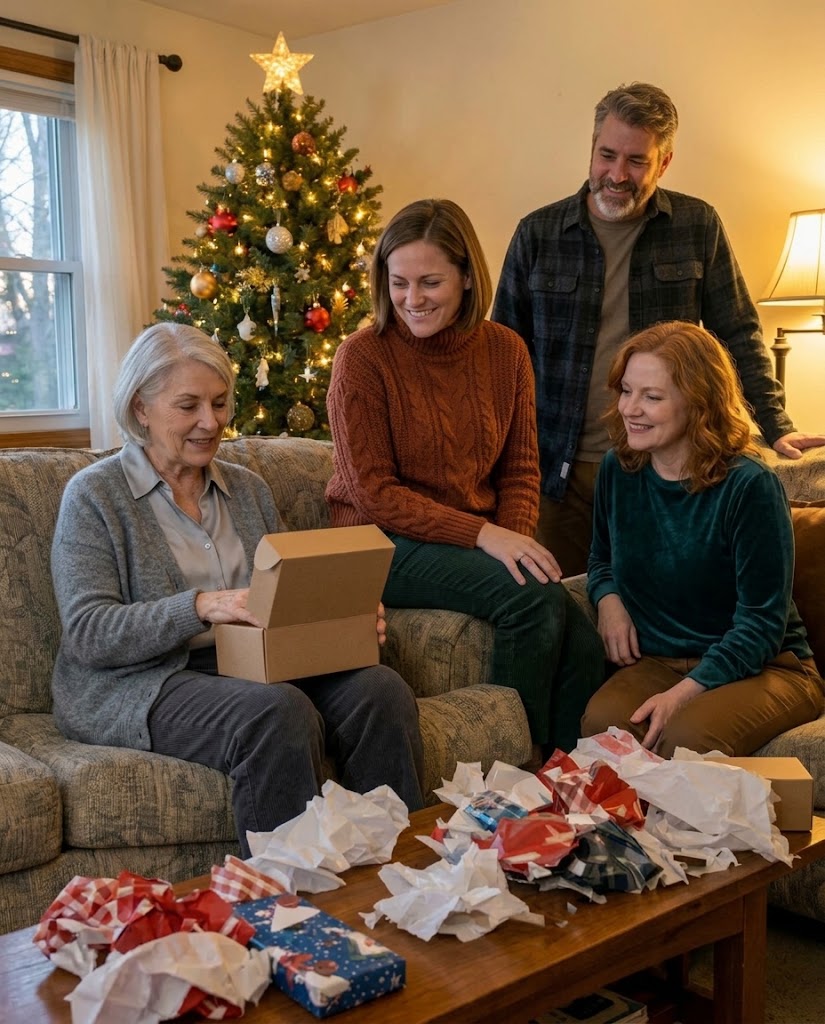
“This is not a forty-dollar gift,” my daughter-in-law announced, raising a small wooden box above her head as though she’d caught someone cheating. Christmas lights glimmered on its polished surface, and beyond the living room windows, snow was gathering along the porch railing. Fourteen relatives sat crowded around the tree, suddenly silent as Shay looked from one face to another and declared that some people simply couldn’t follow the rules. I sat on her couch in my red cardigan, my hands folded tightly in my lap, while my fifteen-year-old granddaughter, Emma, stared at the gift that had just been taken from her. I could have explained what the box meant, but the words were already catching in my throat, and I refused to let my husband’s memory become an argument over money. My son Brett was in the kitchen tending the Christmas ham, and nobody else seemed certain whether to intervene. So I stayed quiet, knowing something Shay didn’t: beneath the green velvet lining of that box was a letter, a photograph, and the story of forty-six years of marriage. All Emma had to do was look a little closer.
My name is Carol Ann Mink, and at sixty-seven, I’ve spent my entire life in Harlow, Ohio, a town where people still recognize one another’s trucks and the Methodist church basement smells of the same familiar casseroles every Wednesday. I raised my only son, Brett, there with my husband, Wendell, a quiet man who believed almost anything could be repaired if you were patient enough. He fixed church furnaces, neighbors’ lawn mowers, broken farm equipment, and the elementary school’s swing set without expecting anything in return. Fourteen months before that Christmas Eve, he died of a heart attack near our hay barn, before the ambulance could reach him. We’d been married forty-six years, and after losing him, I found that the hardest things weren’t always the anniversaries or the holidays. Sometimes it was seeing his reading glasses on the dresser or opening the garage and finding his tools exactly where he’d left them. Our family had established a Christmas spending limit three years earlier, after an extravagant gift exchange left some relatives embarrassed by the difference between what they could afford and what others had spent. One cousin had presented Brett and Shay with an expensive espresso machine, while my sister-in-law Linda brought a scarf she’d knitted herself. Linda later cried in my kitchen, feeling that her gift looked insignificant beside the costly appliance. The following year, Shay proposed a sensible arrangement: everyone would draw one name from a hat and spend no more than forty dollars. I supported the rule wholeheartedly. Shay had grown up with very little after her father left when she was nine, and she’d told me about Christmas mornings when her mother managed only one present per child and then slipped away to cry because she couldn’t provide more. For Shay, the spending limit was a way to protect people from feeling inadequate in a room full of expensive gifts. I respected that. What she didn’t know was that the present I’d prepared for Emma had cost considerably less than the permitted amount, despite looking like an antique worth far more. It was Wendell’s old wooden cigar box, the one that had sat beside his wallet and pocketknife throughout our marriage. His father had given it to him when Wendell was fourteen, after gradually emptying it of cigars over years of Sunday dinners. As a boy, Wendell kept his lawn-mowing earnings inside, folding each dollar carefully and hiding the box beneath his bed. For three summers, he mowed eleven lawns and saved thirty-one dollars toward buying me my first engagement ring. We were teenagers then, impatient enough that he slipped the ring onto my finger in his mother’s kitchen before formally asking my father. The ring was inexpensive and later replaced by finer ones, but I never forgot where the money had come from. On our fortieth anniversary, sitting together on the back porch while our coffee cooled, Wendell finally told me the whole story of the box. He remembered the neighbors whose lawns he’d cut, the smell of fresh grass on his clothes, and the temptation to spend his savings on a baseball glove. He said he’d already decided what the money was for before he earned the first dollar. After his death, I couldn’t bear to open that box for months. Then one sleepless autumn night, I took it from the dresser and saw how badly the years had worn it. The brass hinge was corroded, the green felt lining had crumbled, and the wood had gone dry and gray around the edges. I decided to restore it myself, using sandpaper Wendell had left in the garage, a small can of Danish oil, and a replacement hinge from the hardware store. I spent four evenings working at my kitchen table, sanding carefully, rubbing oil into the wood with one of his old shirts, and lining the interior with a scrap of green velvet from my sewing basket. My materials cost about twenty-two dollars. Before attaching the velvet beneath the lid, I hid a handwritten letter and a black-and-white photograph of Wendell at fourteen, standing proudly beside a push mower. Emma had drawn my name in the Christmas exchange, and because she was the grandchild who still asked genuine questions about her grandfather, I knew she was the person I wanted to have it.
The gift exchange took place on Christmas Eve afternoon at Brett and Shay’s house, while snow continued falling outside and the younger children grew impatient for their presents. Emma opened mine last, carefully peeling away the wrapping paper and lifting the lid of the cardboard package. Inside, resting in tissue paper, was the restored cigar box, its dark wood shining softly beneath the Christmas tree lights. Before she could examine it, Shay reached over, lifted it from her hands, and turned it in the light as if trying to determine its market value. She immediately declared that I’d exceeded the spending limit, then raised the box for everyone to see. Her accusation wasn’t shouted, but the certainty in her voice made it worse. I knew she believed she was protecting the fairness of the exchange, yet I felt the sting of having something so personal treated like evidence of dishonesty. I managed to say her name once, then stopped because I knew I’d cry if I tried to explain. For a few uncomfortable seconds, nobody spoke. Then Emma quietly took the box back from her mother and settled it in her lap. She examined the hinge, tracing the brass with her thumb in the same absentminded way Wendell used to inspect anything he’d repaired. When she opened the lid, she noticed the green velvet lining wasn’t perfectly smooth. She pressed lightly against one corner, found the concealed edge, and carefully peeled it back. “There’s something under here,” she said. Everyone leaned forward as she removed a folded letter and a small photograph, yellowed around the edges. She unfolded the paper and began reading aloud. It told her that the box had belonged to her grandfather since he was fourteen, that he’d saved his earnings from mowing lawns inside it, and that those savings helped purchase the first ring he ever gave me. It described the forty-six years the box spent on his dresser and the four nights I’d spent restoring it because it was one of the few things he left behind that I could still repair. Then Emma reached the final lines: “It didn’t cost forty dollars. It cost twenty-two dollars and four nights of missing him. I wanted you to have it because you’re the one who still asks about him. Love, Grandma.” Her voice trembled, but she finished. She held up the old photograph, showing a young Wendell grinning beside his mower, and whispered that she’d never seen her grandfather at her own age before. My sister-in-law Linda covered her mouth. Wendell’s elderly cousin Ray quietly remembered the original cigar box and confirmed that his father had given it to him. Shay lowered her gaze, suddenly understanding that she’d mistaken a family’s history for an expensive purchase. Just then, Brett returned from the kitchen wearing oven mitts and stopped when he saw the room. Emma showed him the photograph, and he recognized the box that had stood on his father’s dresser throughout his childhood. He’d known he wasn’t supposed to touch it but had never understood its significance. When I told him it had once held the savings that bought my first ring, his expression changed. He went to Shay and gently explained that I hadn’t been trying to break her rule; I’d been trying to pass on something his father had treasured. Shay looked at the box, then at Emma, and apologized. She didn’t make excuses or challenge the story. I accepted her apology because I hadn’t wanted to embarrass her, but rather to let the gift reach the person it was meant for. Later, after the ham and pie had been served and the children were occupied with their new toys, Shay found me washing dishes in the kitchen. She picked up a towel and began drying beside me, then apologized again without an audience. I told her the box had never cost her anything; I’d only wished she’d understood its worth before deciding it was inappropriate. She listened, then admitted that she’d been trying so hard to prevent Christmas from becoming a competition over money that she hadn’t noticed another way of making someone feel small. Watching her mother struggle to afford gifts had left her determined never to repeat that pain, but in her eagerness to enforce the rule, she’d overlooked what the present actually meant. I told her I understood why the spending limit mattered, and that I still believed it was a good idea. We finished washing the dishes together, speaking little but feeling less like strangers than we had an hour earlier. At the candlelight service that evening, Emma carried the little box in her coat pocket, holding it close as we sang the carols Wendell and I had sung together for decades. When she whispered that she wished her grandfather could see what she’d received, I looked at her face in the candlelight and told her I thought he would have been very pleased with where his box had ended up.
In the months that followed, Emma kept the cigar box on her dresser, just as Wendell had done throughout our marriage. She began asking me for stories about him whenever we were together, sometimes about his childhood and sometimes about the ordinary things that made him the man I loved. She wanted to know how he smelled when he came home from work, what music he listened to while repairing things, and whether he had always been so quiet. I told her about the scent of cut hay, WD-40, and the orange hand soap he kept beside the garage sink. She wrote it all down in a notebook devoted to her grandfather, including the names of the neighbors whose lawns he’d mowed and how carefully he’d saved his money before proposing to me. I found myself remembering details I hadn’t thought about for years, and telling those stories made it easier to speak of Wendell without feeling as though I was reopening a wound. About a month after Christmas, Shay visited my house on a Sunday afternoon carrying a plate of store-bought cookies. She looked embarrassed that she hadn’t baked them herself, but I invited her in and put on the coffee. We’d never been the sort of mother-in-law and daughter-in-law who dropped by for casual visits, and I could tell she was nervous. After a while, she asked me to tell her more about Wendell. She admitted that she’d mostly known him as the quiet man working in the garage and had never really asked about his life. So I told her how he’d repaired the church furnace when the congregation couldn’t afford a new one, rebuilt the elementary school swing set after a storm, and fixed Brett’s truck so many times that our son was still calling him for advice well into adulthood. I told her about the summer evenings on our porch, the coffee growing cold, and the story of the thirty-one dollars. Shay listened without interrupting, and when I finished, she said she wished she’d known him better. I told her Wendell would have understood why she’d introduced the gift limit, because he had always been sensitive to people who didn’t have much. He’d admired practical kindness, the kind that protected someone’s dignity without making a performance of generosity. Shay’s eyes filled with tears, and for the first time I saw how much her own childhood still influenced the way she approached family gatherings. We didn’t become close overnight, but she began visiting more often, and sometimes she asked another question about Wendell. I welcomed those conversations, knowing they gave me a chance to share parts of him that might otherwise have remained only in my memory. The following Thanksgiving, when the family drew names for Christmas, Shay stood up to explain the forty-dollar rule as she always did. This time, she added something new: the limit applied to what a person spent, not to what a gift was allowed to mean. Nobody disagreed. I looked across the table at her, and she gave me a small, almost shy smile. I smiled back. It was the same rule, but I sensed that she understood it differently now. I still think about the moment she raised Wendell’s box above her head, and I remember how humiliated I felt sitting on that couch while relatives looked away. But I also remember Emma taking the box back, opening it carefully, and finding the story I’d hidden beneath the velvet. I had spent four quiet evenings restoring that old piece of wood because I wanted my granddaughter to hold something her grandfather had once cherished. The gift was never meant to impress anyone or prove that I could spend more than the rest of the family. It was simply a way of placing a little of Wendell’s life into Emma’s hands. Now she has the box, the photograph, and the growing notebook of stories beside it. Whenever she asks me another question, I can picture him as he was at fourteen, saving dollar bills beneath his bed for a ring he hadn’t yet found the courage to give me. I can hear his quiet laugh and remember the way he held my hand when we sat together on the porch. I still miss him every day, especially when Christmas comes around and the snow settles across the fields. But when I visit Emma and see that little box resting on her dresser, I know that something of the boy who became my husband is still being cared for, one memory at a time.

