
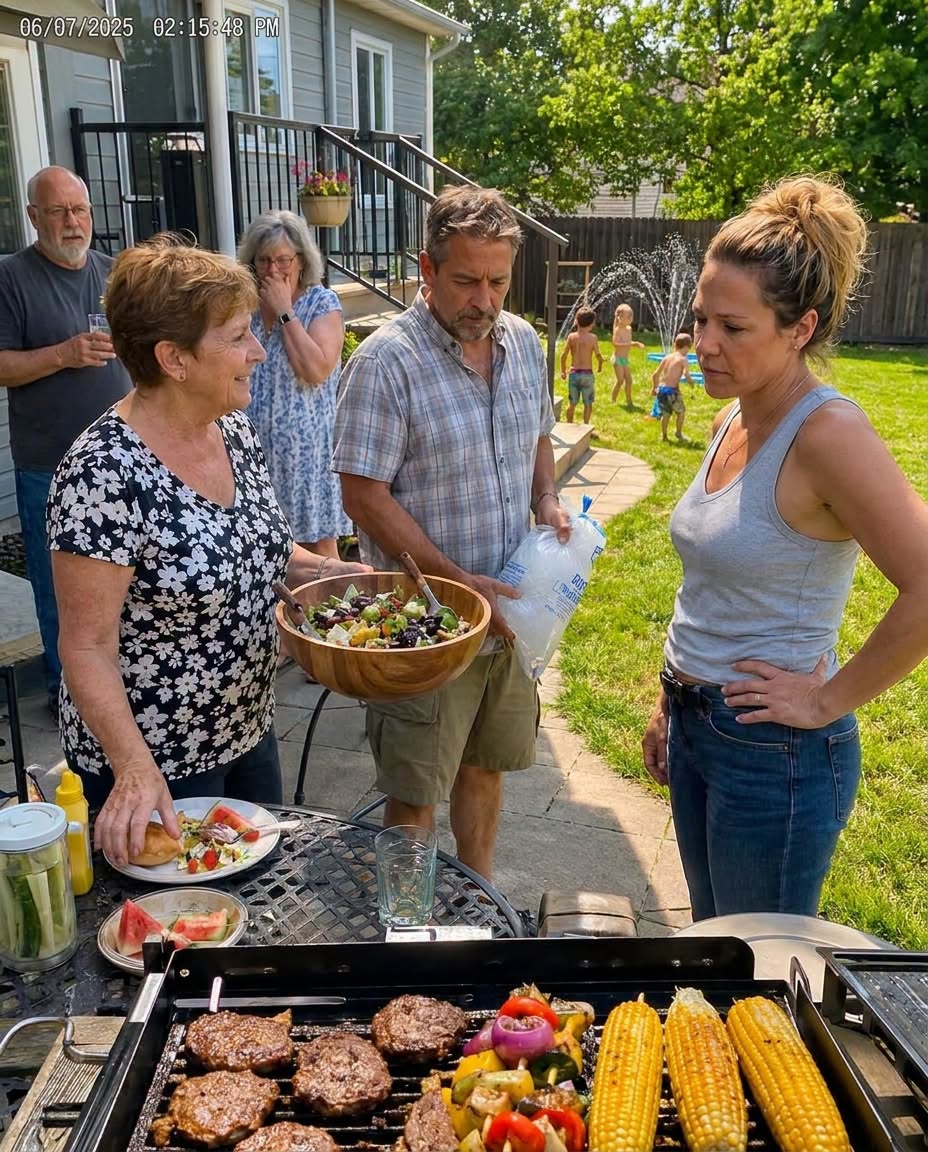
The words reached me just as I was carrying a salad bowl toward the patio. “She’s been the plague that ruined our lives,” Susan said, apparently unaware that I was standing only a few feet away. The backyard smelled of grilled burgers and sweet corn, my grandchildren were laughing beneath the sprinkler, and suddenly every familiar sound seemed far away. My son Michael saw me first and went pale. Susan turned, startled but not exactly ashamed, while the rest of the family stared at their plates. I set the bowl down and looked directly at her. “The plague that ruined your lives has been paying the mortgage on your house for eight years,” I said. “But don’t worry. I won’t be ruining your lives much longer.”
I was sixty-two, a widow, and had spent most of Michael’s life making sacrifice look effortless. After my husband Jim died when Michael was twenty, I worked extra nursing shifts to keep him in college and later put $50,000 toward the down payment on the house he and Susan wanted but could not qualify for on their own. Because their credit was poor, I became the primary borrower and had personally paid more than $150,000 toward that mortgage over eight years. That was only part of it. I had funded a $30,000 kitchen renovation, car repairs, braces, school activities, landscaping, vacations, and countless “emergencies.” When Michael finally called three days after the barbecue, it was not to defend me or apologize for standing silent while his wife insulted me. Instead, he explained that Susan was stressed about money and then asked me for another $8,000 to cover urgent bills. By then, something in the pattern had become impossible to ignore: every conflict eventually turned into a financial request.
For the first time, I began examining the relationship the way I would have examined a patient chart—through facts rather than hope. A financial adviser showed me that if I continued supporting Michael and Susan at the same rate, my retirement savings could be exhausted within five years. My records revealed that I had given them more than $300,000 over the previous decade, excluding the mortgage. Then I discovered the supposed emergency was not what Michael had described. Susan had just put $15,000 down on a swimming pool and told relatives it was an anniversary present from me. When I consulted a real-estate attorney, I learned that because I remained the primary name on both the mortgage and deed, simply stopping payments would damage my own credit, but I had other legal options: they could refinance without me, or the jointly held property could potentially be forced into a sale. Michael and Susan could not qualify for refinancing. That meant the house they had treated as unquestionably theirs was suddenly attached to a decision only I could afford to make.
A week later, I invited them over and placed a decade of bank statements, mortgage records, retirement projections, and legal documents on the coffee table. Michael admitted they carried another $30,000 in credit-card debt, while Susan dismissed the barbecue insult as a misunderstanding and then discovered that Michael had not even known about the pool deposit. I told them the financial support was over and that, after taking legal advice, I was moving forward with selling the house rather than continuing to drain my retirement to sustain their lifestyle. Susan exploded that I was throwing them into the street; Michael begged for another chance. I reminded them that I was not abandoning two helpless children—I was withdrawing financial support from two adults who had spent years treating my generosity as permanent infrastructure. When the property sold, I gave Michael and Susan twenty percent of the proceeds to help them secure housing and returned the remainder to my retirement savings. It was not revenge. It was the first financially responsible decision I had made for myself in years.
A year later, I was living in a small coastal cottage with enough savings to retire securely and enough quiet to begin painting again, something I had abandoned decades earlier. Michael and Susan eventually separated, and Michael slowly rebuilt his life without asking me to finance it. He took on extra work, opened a savings account, learned to live within his income, and began visiting simply because he wanted to see me. Our relationship did not return to what it had been; it became healthier precisely because it could not. I also began seeing more of my grandchildren, and one afternoon my granddaughter asked why I had stopped painting for so many years. I told her I had become so busy taking care of everyone else that I forgot taking care of myself was allowed too. She accepted that answer, dipped her brush into blue paint, and went back to her picture. Watching her, I understood that the greatest thing I recovered was not the house money or even my retirement. It was the part of my life I had spent giving away without realizing I was allowed to keep some of it.

