
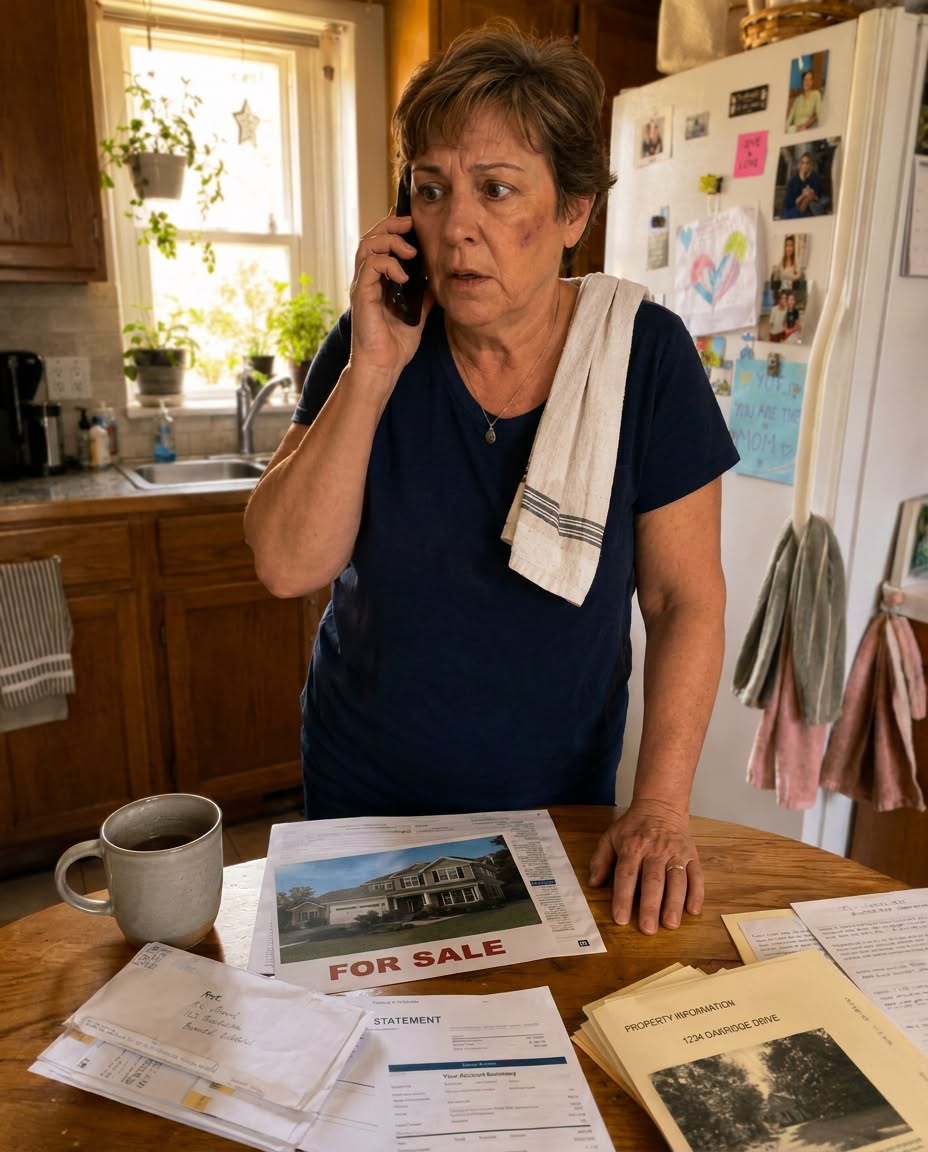
My daughter’s hands struck my chest before I understood she intended to push me. I stumbled backward, hit the coffee table, and fell hard onto the polished floor of the Maple Heights house I had purchased for her family three years earlier. Pain flashed through my hip, the back of my head struck the wood, and I tasted blood where my teeth cut my tongue. Sarah stood over me shouting that I should leave and never return, while her husband Mark rushed forward to help me sit up. Upstairs, my grandchildren continued playing, unaware that their mother had just injured the woman paying for nearly every room around them. Sarah turned toward the window without asking whether I was hurt. As I gathered my purse and walked toward the door, I quietly told her I would go—though neither of us yet understood what I was taking with me.
At fifty-eight, I had spent three years making the $2,400 monthly mortgage payment on the four-bedroom colonial where Sarah, Mark, seven-year-old Jake, and four-year-old Lily lived. I had provided the $65,000 down payment and closing costs, paid for an $8,000 roof, $12,000 in kitchen appliances, landscaping, furniture, painting, and repairs, bringing my total contribution to approximately $193,000. The property remained in my name because Mark’s damaged credit had prevented him from qualifying, while my own retirement savings and modest teacher’s pension absorbed the cost. Sarah had asked me to visit that Tuesday because she and Mark wanted me to transfer the deed to them without payment. She argued that I already owned my own smaller house and therefore did not need a $400,000 asset, even though that property represented nearly all the financial security I had left. When I refused to surrender it, she said my future was not their problem and accused me of using generosity to control them.
After returning to my neglected home, I photographed my injuries, reviewed three years of banking records, and saw the full cost of what I had mistaken for support. I canceled the automatic mortgage payments, contacted real estate agent Patricia Chen, and arranged to list the Maple Heights property while consulting an attorney about ownership, notice requirements, and the assault. Sarah sent messages accusing me of creating drama, then began calling repeatedly when the sale sign appeared in the yard. Within four days, the house received three offers above asking price, and I accepted a $420,000 cash offer with a twenty-one-day escrow period. Sarah’s apologies arrived only after she realized the property was truly being sold, and when I asked whether she and Mark were prepared to assume the mortgage themselves, she hesitated and returned to blaming me. That pause revealed the truth: she did not want independence—she wanted ownership without responsibility.
My attorney confirmed that the deed, mortgage obligation, insurance, and sales authority belonged solely to me, while the documented injuries and Mark’s account preserved evidence of what had occurred inside the house. The transaction closed without legal interference, and after the mortgage balance, commission, and closing expenses were paid, I retained approximately $287,000. I used the proceeds to rebuild my retirement savings, repair my own home, reduce my remaining debt, and establish a proper emergency fund. Sarah and Mark moved in with his parents, found additional employment, and began living within the income they actually earned. I did not pursue criminal charges, but I preserved the medical records, photographs, financial statements, and messages in case Sarah attempted to challenge the sale or misrepresent my condition. For the first time in years, my estate planning and financial decisions were built around my own security rather than the next emergency in my daughter’s household.
A drawing from Jake arrived after the sale, showing the two children holding my hands beneath the words, “I miss you Grandma.” I cried for the grandchildren I loved, the daughter I remembered, and the family relationship I had hoped my sacrifices would create. Yet I also remembered lying on the floor while Sarah turned away from my blood and treated my refusal to surrender everything as betrayal. Six months later, she contacted me only when the family needed money, while Mark worked overtime and Sarah accepted a part-time job. They survived, just as adults often do when someone stops protecting them from every financial consequence. I still love my daughter, but love no longer requires me to finance her contempt or abandon my own future. When Sarah ordered me to go away, I finally understood that leaving did not mean surrendering—it meant taking my dignity, security, and remaining years with me.

