
“Mom, I think it would be better if you didn’t come Thursday.” Those words stopped me cold on the Sunday evening before Thanksgiving, while I stood in my kitchen tearing bread for dressing, just as I had done for more than 40 years. My daughter, Stephanie, explained that her new mother-in-law, Arlene Lindquist, was bringing relatives from Holdrege, while other family members were traveling from Lincoln, Nebraska. There would be twelve guests, she said, and they needed the large dining table. What Stephanie seemed to forget was that the nearly ten-foot oak table, its two extension leaves, and all twelve chairs belonged to me. I had lent them to her in June, after she married Curt and moved into a house with an empty dining room. The table had cost my late husband, Don, and me just $85 at a farm auction in 1981, and he had spent an entire spring stripping away its ugly green paint to reveal the beautiful oak underneath. Now, at 66, I was being told there was no place for me at the Thanksgiving dinner I had spent decades helping make special.
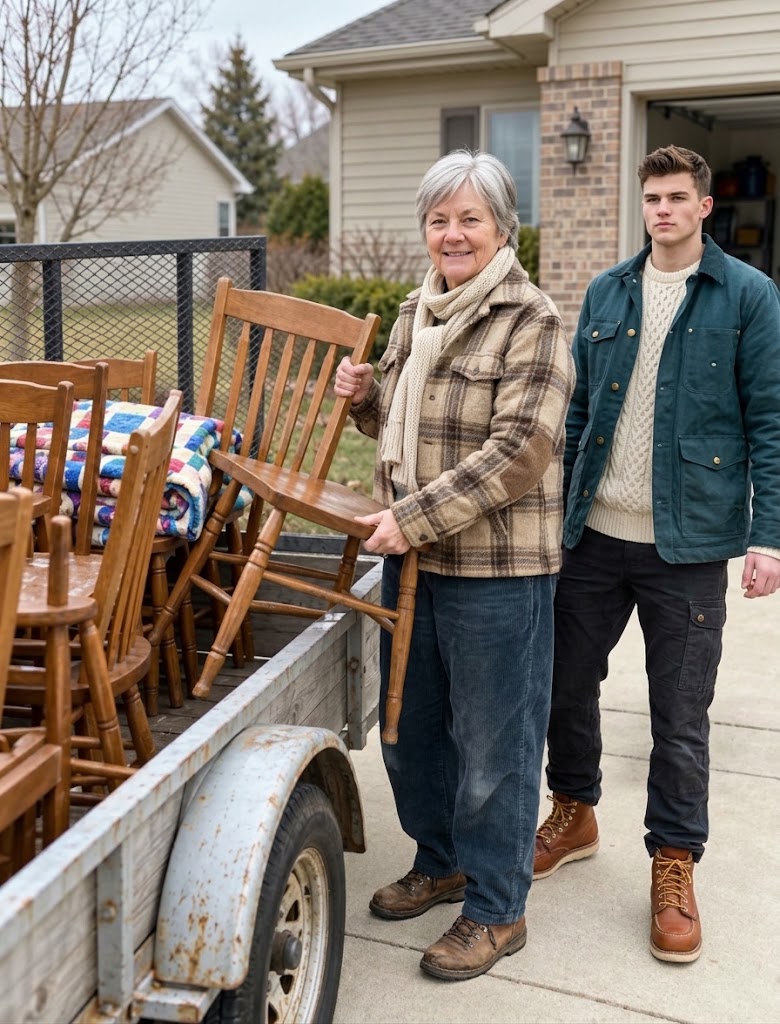
I could have argued, reminded Stephanie that the turkey waiting in her garage refrigerator was mine, or demanded that she reconsider. Instead, I calmly wished her a good dinner and hung up, refusing to beg for a place at my own table. That night, I remembered Harold, a widower from my Methodist church whose wife had died in March after 51 years together. He had mentioned that he planned to eat alone at a highway cafe, and I realized I could invite him to share the 22-pound turkey I had already bought. By Monday morning, I had called him, then asked my neighbors Wayne and Donna to help bring my furniture home. Word spread, and soon other people who faced a lonely holiday began joining the plan. When I arrived at Stephanie’s house on Tuesday with Wayne’s pickup and stock trailer, my grandson Dylan helped wrap the chairs and carry the table outside. Then he discovered his late grandfather’s handwritten notes beneath the seats, including one that read, “Dylan. Reglued 2019. So does he.” The boy who rarely spoke about losing Don suddenly understood something precious—and when Stephanie arrived to find her dining room empty, she realized this was about far more than furniture.
I took only what belonged to me: the oak table, its two leaves, twelve chairs, and my turkey. Before leaving, I told Stephanie that my door remained open to her, Curt, and every relative she had invited. On Thanksgiving, fourteen people gathered at my house, including Harold, several neighbors, two young children, a college student stranded by closed roads, and a 91-year-old former teacher. We squeezed onto the chairs and a piano bench, passed dishes around, and laughed when Harold’s attempt at saying grace ended with a little boy shouting “Amen!” The meal reminded me that a home’s real value has little to do with its furniture, mortgage, insurance, or estate. Still, the situation had consequences for everyone. Stephanie had to improvise with borrowed card tables, and when her new mother-in-law asked where my beautiful oak table had gone, my daughter finally admitted she had uninvited me because she wanted to prove she could manage Thanksgiving herself. Arlene was stunned. She had never demanded my table or asked for me to be excluded; she had only mentioned missing the one she had sold after leaving her farmhouse.
That evening, Stephanie arrived at my house with Curt and Arlene, carrying two untouched pies and apologies. She admitted she had mistaken her mother-in-law’s wistful comment for a demand and had pushed me aside because she wanted to demonstrate her independence. I acknowledged that I had sometimes taken over her kitchen without giving her room to do things her own way. We agreed that the table would stay with me, while I promised to help her find one of her own. In December, Arlene spotted a round oak table at an estate sale for $160, and Curt and Wayne hauled it home in the same trailer. Since then, Arlene and I have searched for matching chairs, while Stephanie has begun making the gravy at my house as I sit quietly on a stool. Harold now joins us for Sunday dinners, and the people who once faced the holidays alone have become familiar guests. I even wrote a note beneath Arlene’s chair: “Brought the pies.” My husband’s old table had started as a bargain at a farm auction, but after years of family dinners, heartbreak, and one difficult Thanksgiving, it had taught us something no price tag could capture: there is always room for someone who needs a place to belong.

