
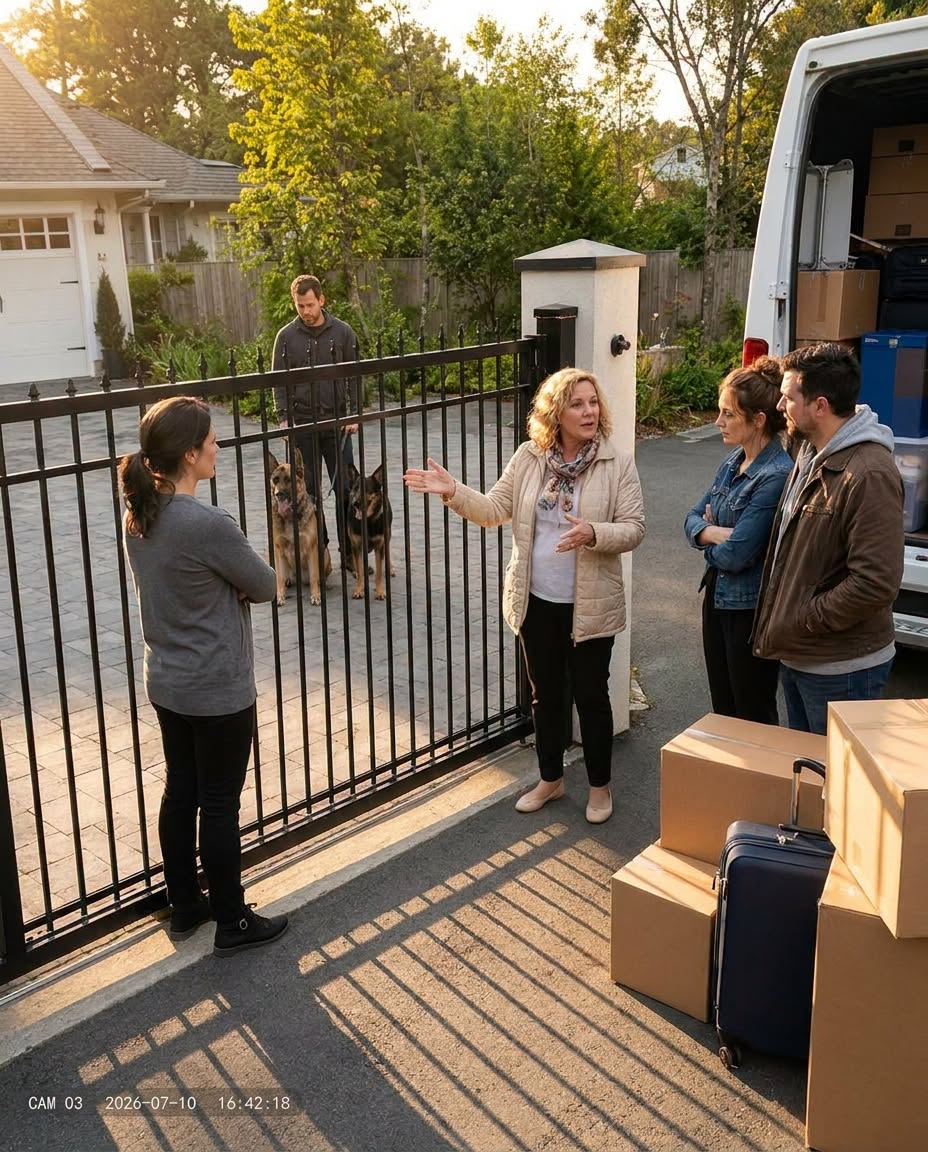
At thirty-one, I watched my mother, twin sister, brother-in-law, and their three children unload suitcases beside a moving truck parked outside my locked gate. My mother did not greet me or ask whether they could stay; she ordered me to open the entrance because the children were tired. Mallerie pointed toward my downstairs suite and announced that it would be perfect for her family, while Grant studied my workshop and asked whether the garage was heated. Twelve years earlier, those same people had forced me out of our family home with two garbage bags and nowhere safe to sleep. Now they saw my brick house, restoration business, company vans, and fenced property as resources they had a right to claim. I looked at the security cameras recording every word and told them they were not entering. For the first time in my life, my family was standing outside—and I controlled the door.
Growing up in central Pennsylvania, I learned that being the capable twin meant receiving whatever Mallerie no longer wanted. Our mother, Diane, bought her new clothes, excused her responsibilities, and described my neglect as independence. The only person who recognized the imbalance was Grandma Elaine, who left me $900 hidden inside an old cookbook and taught me that repaired cracks reveal where pressure was applied. After Elaine died, Mallerie became pregnant, and Diane gave my bedroom to her, invited Grant to move in, and told me at nineteen that I was no longer her responsibility. I spent weeks sleeping on friends’ floors and eventually lived in a tent behind a closed flea market while working and attending community college. Years later, Arthur Bell hired me for restoration work, taught me insurance documentation and construction estimates, and helped me build Whitaker Restoration and Finish into a twelve-person company with four vans, a workshop, and property outside Harrisburg.
My relatives claimed Mallerie’s lease was ending and announced that her family would occupy my guest suite while Grant used my tools to launch a furniture-resale business. Diane reminded me that I knew what homelessness felt like, carefully ignoring that she had caused mine. When I refused, they left—but returned days later and tried to force open a side delivery gate with a pry bar while directing one of the children toward the damaged entrance. My operations manager, Rachel, preserved the camera footage, moved trained security dogs into view, and contacted police while I watched remotely from a job site forty miles away. Diane told officers that I had invited them, Mallerie claimed I had changed my mind, and Grant insisted the gate was already damaged. Then Rachel played the recording of my original refusal—and every lie they had prepared fell apart on camera.
Grant faced restitution, probation, and a court order barring him from my home, employees, and company property after repairs and emergency security upgrades reached $2,800. Mallerie received a formal no-trespass order and mandatory parenting classes, while my attorney documented that none of them held any lease, ownership interest, mortgage claim, investment right, or authority over my estate. Business insurance records, property deeds, security footage, and written access policies made the case impossible to reframe as a family misunderstanding. Soon afterward, Diane risked eviction from her own apartment because she had secretly moved Mallerie’s family into a two-bedroom unit in violation of the lease. She returned to my gate asking for a temporary room and argued that she was still my mother. I told her the consequences had been settled when she gave away my bedroom, ignored me while I was homeless, and later tried to break into the life I had built.
Through my attorney, I filed permanent trespass notices, changed every access code, removed Diane as my emergency contact, and instructed my employees to contact police if any relative refused to leave. I restored Grandma Elaine’s kitchen table and placed her old cookbook on a shelf in the home no one could take from me. My family later told people I had chosen property over blood, but that was never the choice. I chose safety over invasion, records over manipulation, and a boundary that did not depend on anyone respecting my feelings. The locked gate was not revenge for the night I left home carrying garbage bags. It was proof that the frightened nineteen-year-old behind the flea market had survived long enough to build a door strong enough to protect her.