
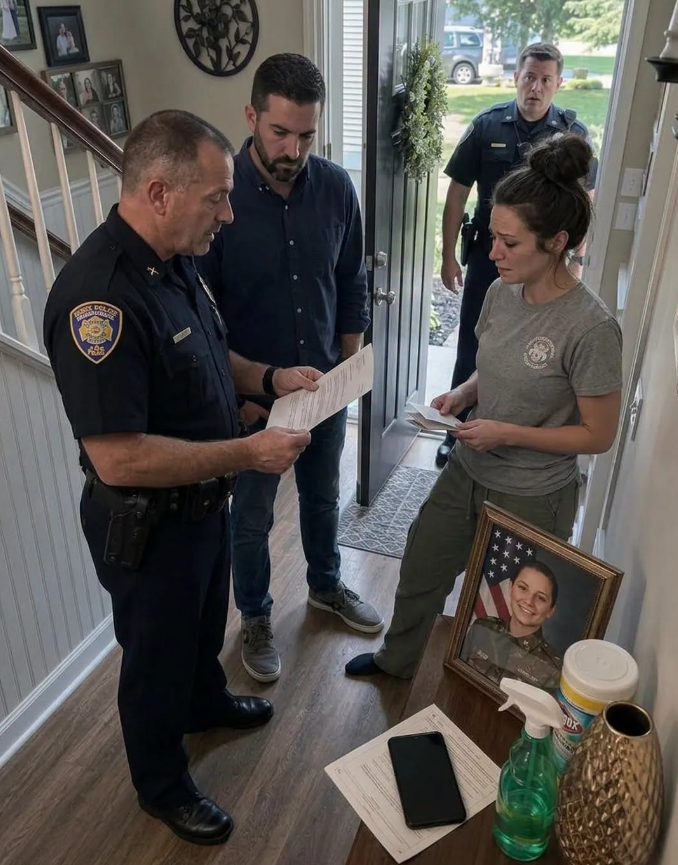
The police officer stood three feet from my front door while my father shouted through the speaker on my phone that part of my house belonged to him. My husband remained quietly beside me, close enough to offer support without speaking for me. On the entryway table, my basic-training graduation photograph caught a strip of afternoon light—the same photograph in which I stood alone because no one from my family had attended. Dad claimed he had belongings inside the house and a financial stake in the property, insisting I had changed the locks illegally. I could hear the confidence in his voice, the same confidence he had always used when turning ordinary parental responsibilities into lifelong debts. The officer asked whether I felt safe, and for a moment I remembered every year I had mistaken obedience for peace. Then I opened the cabinet beside the door, removed a thick folder, and said, “Everything you need is documented right here.”
My parents had always treated my younger sister, Emily, as the center of the family and me as the person responsible for keeping that center comfortable. When I worked weekends at a diner at 16, Dad demanded half my paycheck for Emily’s cheerleading expenses; when I saved for a car at 19, he co-signed one form and reminded me for years that I owed him. I enlisted partly because I wanted structure, independence, and a future that did not depend on their approval. Before graduation, I sent my parents the date, directions, gate instructions, and a map with the correct entrance circled, but they answered only that they would “see what happened.” On the morning of the ceremony, families filled the bleachers with signs and flowers while I searched every row until the field was nearly empty. A friend’s mother finally hugged me and whispered that she was proud, three simple words my own parents never offered. Several weeks later, Dad broke his silence with a text demanding $8,000 for Emily’s wedding—not asking whether I was well, not apologizing for missing graduation, simply announcing how much money he expected.
For a few seconds, the old habit nearly won, and I considered transferring the money before resentment could catch up with obedience. Instead, I opened the payment app, sent exactly $8, and wrote “Best wishes” in the memo line. My husband read the confirmation without telling me what I should do, then changed the locks when I quietly asked him to. Dad called the following morning, furious that Emily had deposits due and accusing me of embarrassing the family over money. When guilt failed, he claimed he had helped purchase my home and therefore had a right to enter whenever he wished, although I had repaid every dollar he had once loaned me. His voice lowered before he warned that I would regret challenging him, and I knew he would try to turn his anger into an official-looking accusation. I printed the deed, repayment receipts, bank statements, locksmith invoice, threatening messages, and the original demand for $8,000, placing every page in chronological order. Three weeks later, when the officers appeared at my door and Dad confidently repeated his ownership claim, I handed them the folder—and the first document made one officer stop writing.
The deed listed only my husband and me, while the mortgage records showed every payment had come from our account and remained current. The repayment ledger proved that Dad’s old loan had been returned in full, including the last $1,750 transfer made two years earlier. He had no insurance interest, no investment agreement, no attorney-prepared lien, and no claim against my property or future estate. When the officer asked him to identify one belonging supposedly inside, Dad mentioned a tool chest, but our garage-camera footage showed that no such item had ever been stored there. He then claimed he received mail at the address, so I produced the current stack showing only our names. The officer explained that being my father did not create ownership and that any legitimate dispute would require evidence presented through civil court, not a police call designed to pressure me. Dad began shouting that family should count for something, but the officer calmly replied that family status was not a property document. The officers closed the matter, issued an incident number, and advised us to preserve every future message in case Dad appeared again.
Emily called before the officers had even left the neighborhood, demanding to know why I had humiliated our father and ruined her wedding plans. I reminded her that he had called the police because I refused to provide $8,000, then told her the wedding was her responsibility, not mine. The ceremony happened without my money, and the photographs showed the same flowers, cake, and smiling relatives they had insisted would be impossible without my savings. Dad never apologized, but he never returned to my house, and Mom’s guilt-filled messages ended whenever I replied with copies of the incident report. Months later, I placed a new photograph beside the graduation portrait—my husband and me standing on our porch in front of the changed lock, smiling into bright sunlight. The first picture still shows a young soldier standing alone, but it no longer feels like evidence that nobody came. It reminds me that I learned to build a home where love is welcomed, entitlement stays outside, and the key belongs only to the people I choose.