
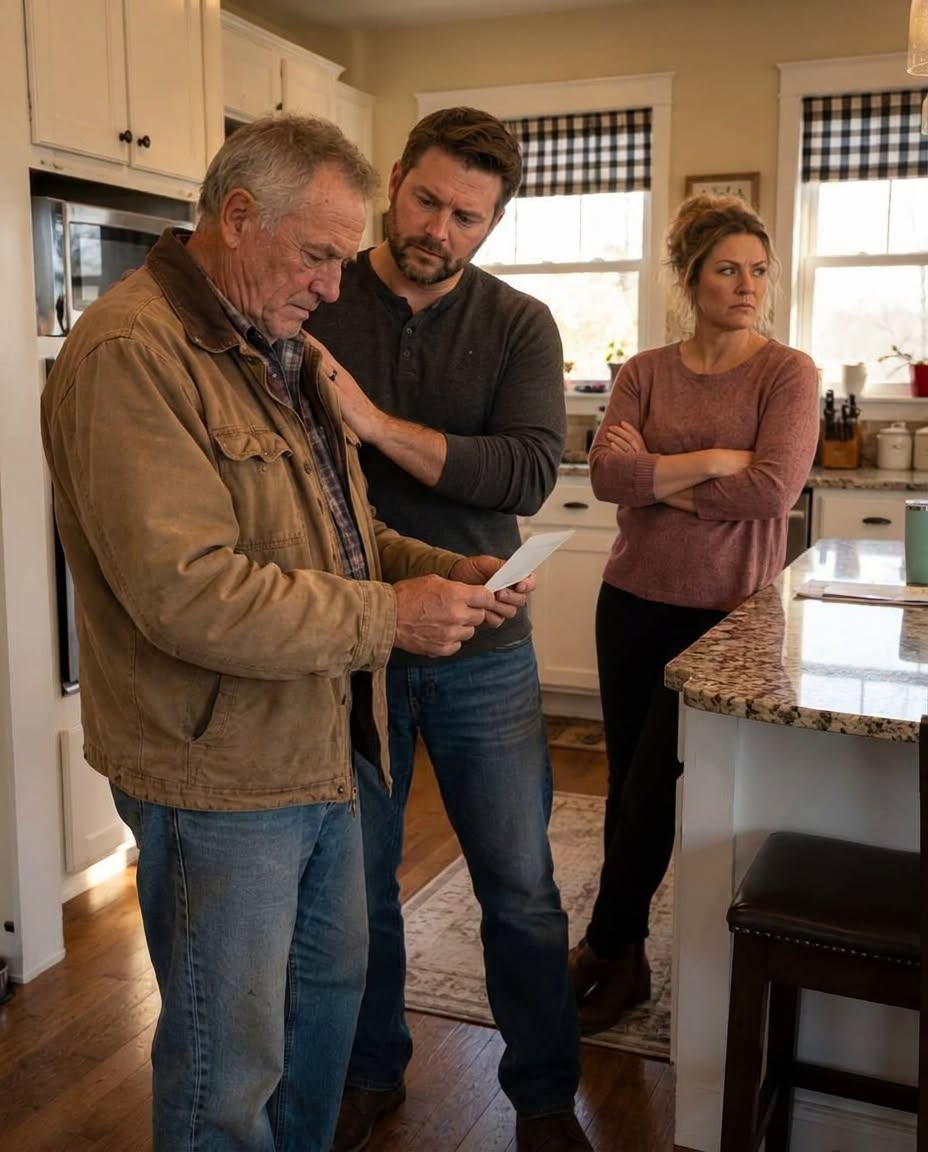
“Tell him to get a job. We aren’t a bank.” My wife Rachel said it loudly enough for my sixty-three-year-old father to hear every word, and for the first time in my life I watched Samuel Wright lower his eyes to the floor. This was the man who had worked construction before sunrise, sold his motorcycle to help put me through college, and spent my childhood quietly giving me things while pretending they had cost him nothing. Now he stood in our kitchen asking me for $1,000 and refusing to explain much beyond saying he needed certified adoption records, legal advice, and one final test before he could tell me the truth. Rachel called the request irresponsible. I gave him the money anyway. Three days later, a hospital called to tell me my father had undergone emergency surgery for an aortic aneurysm—and that an attorney was waiting with a sealed envelope he had insisted I read before discussing anything with my wife.
The attorney, Elena Rostova, told me the $1,000 had paid for certified records and DNA testing connected to the adoption that made Samuel my father when I was two. For thirty-five years, I had believed my biological mother voluntarily surrendered me and wanted no future contact. Samuel had believed the same thing. The records now suggested something very different: my nineteen-year-old birth mother, Carol Prentiss, had been pressured by her family into an adoption and had asked that information be preserved so I could find her someday. Samuel had never been told about those conditions. Carol, meanwhile, had been told the adoptive parent knew everything. She had spent decades searching for me while Samuel unknowingly raised me believing she had deliberately disappeared. Eight months earlier, Carol finally found him. Instead of rushing to me with an extraordinary claim, my father hired counsel, reconstructed the records, and obtained DNA confirmation because, as he later wrote, he wanted to give me proof rather than another story somebody could challenge.
Then I opened Samuel’s letter and found the detail he had been most afraid to tell me. Years after losing me, Carol married and had another child—a daughter named Rachel. My wife. Samuel did not know whether Rachel knew any of this; neither did Carol, who had been estranged from that side of the family since Rachel was very young. Suddenly my four-year marriage required questions far larger than betrayal or secrecy. If the records and DNA established that Carol was biologically related to both of us, Rachel and I shared a biological parent, and Elena was careful not to make casual promises about what that meant legally. Marriage validity, family status, and any related consequences would have to be reviewed by qualified family-law counsel using the actual records and jurisdiction involved. Before I could even begin processing that, Elena told me Carol was sitting in the hospital waiting room. She had driven there when she heard Samuel was in surgery because, after thirty-three years of searching for me, she did not want me receiving this news alone.
Carol did not rush toward me when we met. She simply stood and let me decide the distance between us. She told me she had spent most of her adult life building a file—old agreements, correspondence, names, dates—because she believed documentation might someday give me the choice she had been denied. She also told me she had not raised Rachel and had not known Rachel had married me until Samuel discovered the connection. That evening I went home and asked my wife one question: what was her mother’s name? Rachel gave me the name she had always been told and said her mother abandoned her when she was two. When I explained what Samuel and Carol had uncovered, the anger disappeared from her face. She had not known. The same family history that had kept Carol from me had apparently left Rachel with her own false version of why her mother vanished. Hours later, Rachel and I returned to the hospital together. Across the waiting room, Carol looked at the daughter she had not seen since toddlerhood, and Rachel said “Mom” for the first time.
Samuel survived the surgery. When I finally sat beside his bed, he apologized for not questioning the adoption story harder thirty-five years earlier. I told him there was nothing to forgive. He had been twenty-eight, alone, working with his hands for a living, and he saw the file of a two-year-old boy and decided, somehow, “this one.” Then he spent the rest of his life making that decision true—packing lunches, checking homework, selling things he loved, and finally borrowing $1,000 so he could return a history that had been taken from me before I was old enough to remember it. Nothing was neatly resolved that night. Rachel and I still faced legal advice, painful family questions, and decisions neither of us could make in a hospital corridor. Carol had two children whose lives had crossed before either knew the truth. But Samuel had done what he had always done: he showed up, gathered what I needed, and placed it in my hands without asking for credit. He named me Caleb because he wanted my name to mean faithful. Lying there exhausted after surgery, he proved the word had described him all along.

