
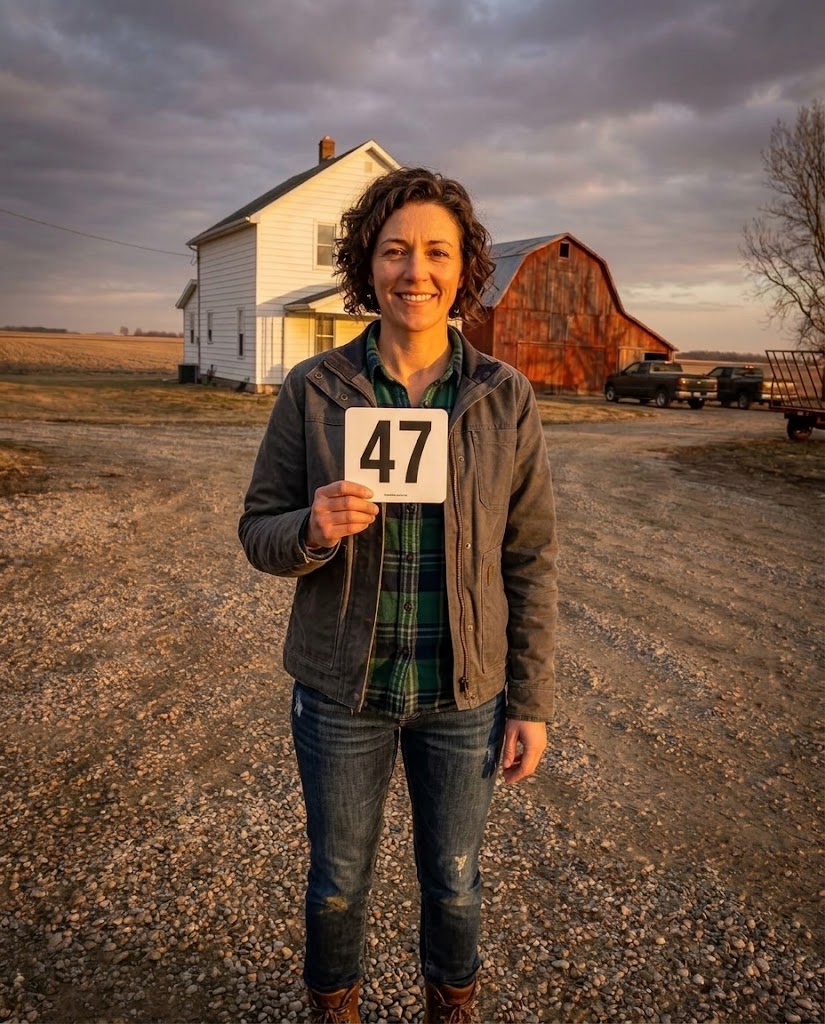
“Three hundred and one thousand, five hundred dollars,” the auctioneer called, his voice crackling through a loudspeaker as sleet swept across the gravel yard. I stood beneath the gray Nebraska sky with a white bidder’s card trembling in my hand and my husband, Luke, beside me, staring toward the farmhouse where he’d spent his childhood. Across the crowd, a representative from a land investment company studied me, deciding whether the eighty acres were worth another bid. Four years earlier, Luke’s father had sold this very property to a stranger for $286,000 rather than allow us to buy it, telling people at the local farmers’ cooperative that his son had married a town girl who would carve the family farm into building lots. Now the red barn, the cottonwood windbreak, and the lilac bushes planted by my late mother-in-law stood before us, waiting for the auctioneer’s final decision. In my coat pocket was a yellow slip of paper bearing the maximum figure our banker would allow us to spend: $305,000. I raised bidder card 47 one last time, offering $301,500, and watched the other bidder slowly shake his head. When the auctioneer declared the property sold, I thought the hardest part of bringing Luke home was over, but the truth his father finally told us behind the barn would change how I understood the previous four years.
My name is Amy Brandt, and I was thirty-six when I learned why my father-in-law had refused to sell us the homeplace. I grew up in Kearney, Nebraska, where my father operated a gas station on Second Avenue for thirty years. I was a town girl by every traditional definition: sidewalks outside our house, a streetlight beyond my bedroom window, and a high school only four blocks away. Farmers stopped at Dad’s station to fill their pickups and discuss cattle prices while I did my homework near the cash register, but I didn’t learn the difference between a heifer and a steer until I was nineteen. By the time I married Luke, though, I understood enough about farming families to recognize that land was rarely just land. Luke had grown up eleven miles north of Kearney on eighty acres that had belonged to the Brandts since 1938. His grandfather built the red barn with his own hands, and the white two-story farmhouse stood behind a row of cottonwoods planted to break the prairie wind. There was a covered porch, a machine shed, a pasture running toward the creek, and a kitchen where Luke’s mother, June, served Sunday dinner at an oilcloth-covered table. Luke loved that place, although he earned his living operating a motor grader for the Buffalo County road department rather than farming. His father, Walt, had worked the land for decades before renting the cropland to a neighbor and keeping a small herd of cattle on the pasture. Our children, Hailey and Cody, knew the farm as Grandma and Grandpa’s house, a place where summer afternoons smelled of cut grass and lilacs, and where Cody had a little room for Sunday naps. June made everyone feel welcome. She kept peppermints near the back door for the mailman, remembered the children’s shoe sizes without needing to ask, and always seemed to know when someone was hungry before they mentioned it. She died suddenly that January from a heart condition, leaving Walt, then sixty-eight, moving through the rooms as though he’d misplaced something essential and couldn’t remember where to look. A month after her funeral, Walt told Luke he intended to sell the homeplace. We drove out on a Sunday and sat with him at the kitchen table. Luke offered to buy the farm through an installment land contract, making regular payments directly to his father rather than seeking a conventional mortgage for the entire price. It was the same general arrangement Walt’s father had once used when transferring the property to him. We promised to preserve the house, barn, and acreage rather than subdivide the land, and Luke explained how much he wanted Hailey and Cody to grow up knowing the place their grandparents had cared for. Walt turned his chipped brown coffee cup slowly against the oilcloth and said he’d think about it. He barely looked at me. At the time, I assumed his distance came from grief. In April, he telephoned Luke at work and announced that he’d sold the property to Grant Ostrander, a man from Denver who wanted land for pheasant hunting. The price was $286,000, with closing scheduled for May. The conversation lasted less than two minutes. That evening, Luke told me over supper, then went into our garage and sharpened every lawn mower blade we owned, including two that didn’t need attention. He was the sort of man who did something useful with his hands when he couldn’t find words for what he felt. Two weeks later, an eighty-one-year-old patient named Merle Hansen came for his regular dental cleaning. I’d been his hygienist for nine years, and he was a retired farmer who believed people deserved to know what others were saying about them. As I removed the suction tube from his mouth, he quietly told me Walt had been discussing the sale at the co-op. According to Merle, Walt said he hadn’t wanted to sell the farm to Luke because his son had married a town girl who would divide the land into residential lots before the year was over. I set down my scaler and fixed the clip on Merle’s dental bib because I needed a moment to compose myself. The co-op coffee table was a gathering place where local men discussed weather, grain markets, football, and nearly everyone else’s business. By lunchtime, anything said there could reach half the county. Walt hadn’t simply rejected our offer; he’d given people a reason that made me sound untrustworthy and ignorant of the family’s history. I finished Merle’s cleaning, scheduled his next appointment, and shut myself inside the supply closet until I could stop feeling the humiliation in my face. That night, after Hailey and Cody were asleep, I told Luke what Merle had said. He listened with his hands resting on the kitchen counter and admitted he didn’t know how to confront his father so soon after June’s death. I didn’t push him. He was grieving too, and I understood that a fight wouldn’t bring the property back. But later, lying awake as the furnace clicked on and off, I made a decision. Grant Ostrander had purchased the farm as a recreational property, and there was a reasonable chance he might someday sell it. Perhaps not for years, but someday. If that happened, Luke and I would be ready with enough money to compete. I didn’t want to spend the intervening years resenting Walt, because I knew resentment wouldn’t help us save a dollar. At Easter dinner, held at Luke’s sister Karen’s house in Gibbon, I stood before the meal and thanked Walt for giving Luke the childhood he’d had on the farm. I mentioned the barn, the creek, the tractors, and the Sunday dinners, and told him that even if the property belonged to someone else, the memories couldn’t be sold. Walt looked down at his plate and nodded once. He said nothing. On the drive home, with both children asleep in the back of our minivan, Luke asked why I’d thanked his father after everything he’d said about me. I told him I intended to buy the farm back one day, and I didn’t want the effort to be driven by anger. He reached over and rested his hand on my knee. The following Monday, I called a dental office in Hastings and accepted a Saturday hygienist position that no one else wanted. It meant leaving home at six-thirty every Saturday morning, driving forty minutes each way, and cleaning teeth for eight hours after already working a full week in Kearney. I took the job anyway, and every paycheck went into a separate savings account at our bank on Central Avenue.
For four years, our household operated around that account. Luke added the overtime he earned plowing snow and clearing county roads, sometimes working through the night during storms and returning home long enough to eat cereal before leaving again. We skipped vacations, kept our aging minivan until its odometer reached 214,000 miles, and repaired appliances instead of replacing them whenever possible. Hailey wore school clothes bought at church rummage sales without complaint, and Cody learned that family plans sometimes meant waiting rather than buying something immediately. We told the children what we were saving for, though we didn’t promise we’d succeed. Hailey drew a large thermometer on poster board and taped it inside the pantry door, coloring it a little higher each month with a red marker. Cody, who was five when the farm was sold, asked whether he might someday sleep again in the small room where he’d taken his Sunday naps at Grandma June’s house. I told him we’d see. I also wrote to Grant Ostrander at the Denver address listed in the county property records. I explained that Luke had grown up on the farm and that June had planted the lilacs beside the porch. I asked permission to water them during the summer. Ostrander telephoned a week later, sounding surprised but pleasant. He said he rarely visited except during hunting season and didn’t mind if we cared for the plants. From May through September, the four of us drove to the homeplace about once a month with buckets and a garden hose. We watered the lilacs, mowed the roadside ditch along the driveway, and picked up windblown debris. When a snowplow knocked down the mailbox during our second winter, Luke replaced the post on his own time, setting it firmly in concrete. We never entered the house or barn without permission. The property belonged to someone else, and we respected that. Walt continued attending Cody’s baseball games, Hailey’s band concerts, and family holidays. He was polite to me, and I was polite to him. We didn’t discuss the farm. It remained an unspoken subject at every family gathering, present even when nobody mentioned it. Then, in February of the fourth year, an auction notice appeared in the Kearney Hub and on the co-op bulletin board. Ostrander had purchased a larger hunting property in South Dakota and planned to sell the Nebraska farm. The notice described the Brandt homeplace, approximately eighty acres with the farmhouse, barn, machine shed, well, and septic system, to be offered at public auction on the final Saturday in March. I called Ostrander immediately and offered to negotiate a purchase before the sale. He declined because he’d already contracted with the auction company and wanted the property sold through an open, competitive process. He wished me luck, and I appreciated his fairness even though it meant we couldn’t avoid the uncertainty of bidding. The sale terms required prospective buyers to register, provide a bank letter showing financial capacity, and pay a ten-percent deposit on auction day. The balance would be due at closing, scheduled no later than April 30, and the agreement allowed no financing contingencies. I brought four years of savings records to our agricultural loan officer, Tom Riley, who reviewed our earnings, employment histories, credit, and the likely value of the land. We’d accumulated $71,400. Tom considered the amount we could safely borrow without creating monthly payments beyond our means, then wrote $305,000 on a yellow sticky note. That was our absolute bidding limit, he told me, and he meant it. He issued the required bank letter, and I carried both documents home. On auction morning, the wind blew hard from the north, and sleet swept across the gravel yard. About sixty people gathered near the machine shed, some to bid and others simply to witness the sale of a familiar property. I registered with the auctioneer’s wife, showed my identification and bank letter, and received bidder card 47. Luke and I had agreed that he would raise the card because it was his family’s homeplace, but when the bidding began, he became fixed on the porch and the place where his mother used to ring the dinner bell. The auctioneer opened at $300,000, then lowered his request until a neighboring farmer offered $200,000. Bids climbed through $230,000, $250,000, and $270,000. A young couple with a baby eventually dropped out, followed by the neighbor who’d rented the cropland for years. The remaining competitor was a representative of a land investment firm from Grand Island, a man in a quilted vest who answered the auctioneer with small nods rather than raising his hand. At $275,000, Luke still hadn’t moved. I could see how much the moment meant to him and how difficult it was to imagine losing the farm twice. I quietly took over, raising card 47 while he stood beside me. We bid $285,000, then $295,000, with the investor continuing to respond. At $300,000, I knew we were approaching our limit. The investor offered $301,000. The auctioneer asked me for $302,000, but I requested a smaller increment and offered $301,500. The investor studied us, looked toward the farmhouse, and finally shook his head. The auctioneer called the price once, then again, before striking the table and declaring bidder 47 the winner. Hailey ran across the yard and threw her arms around me. Luke stood with one hand against my back, his eyes wet. I saw Walt at the far end of the driveway, near the mailbox Luke had repaired, watching us without moving. When the sale ended, he disappeared from view. Inside the machine shed, I signed the purchase agreement and paid the ten-percent earnest-money deposit of $30,150, which would be credited toward the $301,500 purchase price at closing. The remaining amount would be financed through the bank under the arrangements Tom Riley had reviewed with us. I was still studying the paperwork when Denny Kruse, the auctioneer and an old school friend of Walt’s, asked to speak privately. He told me Walt had driven past the farm once a month during the four years it belonged to Ostrander. Sometimes he parked at the end of the lane and simply looked at the house before stopping at Denny’s place for coffee. He’d noticed the lilacs being watered, the ditch mowed, the damaged mailbox repaired, and the loose shingles collected after storms. Walt knew our family was doing those things, Denny said, but he hadn’t known how to tell us what seeing them meant to him. Then Denny told me Walt was standing behind the barn, waiting. I walked around the corner with Luke a few steps behind me, unsure whether the man who’d once called me a town girl who would ruin his farm had finally found something he wanted to say.
Walt stood on the sheltered side of the red barn, where June used to hang the washing. He held his old seed cap in both hands, turning it slowly by the brim. When he saw us, he looked first at Luke and then at me. He said quietly that we’d bought the homeplace back. I told him we had. After a long pause, he began explaining why he’d sold it four years earlier. He and June had carried debt on the property for thirty-one years, renewing the bank note whenever the harvest income couldn’t cover the payment. Each November, the proceeds from the corn crop went directly toward the loan, and some years they barely managed to keep up. June had maintained a green ledger recording every payment in her careful handwriting. When she died, there was still $11,000 owing on the farm. Walt said he’d sat at that same kitchen table after her funeral, looking through the ledger, overwhelmed by the thought of continuing payments without her beside him. Then Luke and I arrived, offering to buy the property through an installment land contract. Instead of seeing an opportunity for his son to preserve the homeplace, Walt saw the beginning of another generation spending decades obligated to a bank or family creditor. He imagined Luke, Amy, and the children counting every dollar, making payments year after year, and inheriting the same uncertainty he’d carried through much of his marriage. He couldn’t bear the thought of handing his son that burden, so he’d sold the farm to Ostrander, used the proceeds to satisfy the outstanding debt, and separated himself from the property that reminded him of June. Luke asked why he hadn’t explained any of this. Walt admitted he hadn’t known how. June had always been the one who understood how to talk through difficult feelings, and after losing her he’d retreated into silence. Then he looked directly at me and addressed the remark that had humiliated me four years earlier. When men at the co-op asked why he hadn’t sold the farm to his son, Walt didn’t want to say he doubted Luke could afford it. In his mind, admitting that would embarrass Luke in front of men who’d watched him grow up. So Walt blamed me. He said his son’s town-born wife would subdivide the acreage and destroy what generations of Brandts had built, even though he knew I’d cared for the land and respected its history. He’d chosen an accusation he thought would protect his son’s pride, never considering what it would do to mine. Walt said it was the cruelest thing he’d ever said about someone who hadn’t deserved it, and he was ashamed. He remembered my Easter speech thanking him for the farm and admitted he’d been unable to answer because he knew what he’d already said behind my back. I listened, thinking of Merle Hansen’s words in the dental office, the supply closet where I’d stood trying not to cry, and the four years of Saturday work that followed. I thought of Hailey’s savings chart, our old minivan, and Luke coming home before dawn after snowplow shifts. I also imagined Walt sitting alone in his pickup at the end of the lane, watching his daughter-in-law water his late wife’s lilacs without knowing how to approach her. I told him I appreciated hearing the truth. His apology couldn’t change the years we’d spent feeling rejected, but it mattered that he acknowledged what he’d done without asking me to pretend it hadn’t happened. Walt nodded, visibly relieved, and Luke stepped forward to embrace his father. For a long moment they stood together beside the barn, the older man’s seed cap crushed between them. I walked back toward the yard and left them to talk. We completed the property purchase on April 22 at a title company in Kearney, signing the closing documents and finalizing the mortgage financing secured by the property. Tom Riley congratulated us afterward, reminding me that he’d rarely seen someone win a land auction by asking for such a small final bid increment. That afternoon, Luke and I returned to the farm with Hailey and Cody, carrying the keys to a house we’d visited only from outside for four years. Walt followed in his pickup because I’d asked him to come, although he telephoned twice to make sure I meant it. Ostrander had left the farmhouse clean and empty. During his ownership, he’d painted the downstairs rooms white, giving the interior a fresh appearance, but covering details that had mattered to the family who lived there before. In the kitchen, the door frame leading to the back porch was smooth and white from top to bottom. For years, June had measured Luke’s height against that frame every April, marking his birthdays in pencil, adding dates and occasional notes in her small slanted handwriting. After her funeral, while relatives gathered in the living room, I’d photographed those measurements with my phone, holding a ruler beside each one. I hadn’t told anyone because I didn’t know whether the marks would survive the sale. Now I took out the photographs, found a carpenter’s pencil and tape measure in Luke’s toolbox, and asked Walt to help me restore them. He read each measurement aloud while I measured from the floor and drew the marks as carefully as I could. We began with Luke’s third birthday in 1988 and worked upward year by year. Walt recalled June writing about a missing tooth at six and teasing Luke for standing on tiptoe at nine. By the time we reached the final measurement from his eighteenth birthday, I had to stand on a chair. Walt removed his glasses and wiped them slowly before asking for the pencil. He called Hailey to the door frame and measured her height, then did the same for Cody, who immediately tried to stand on tiptoe. Walt looked down and called him a cheater, exactly as June once had with Luke. My husband laughed, a full unguarded laugh I hadn’t heard from him in years, then stepped outside for a moment to be alone. In late May, Merle Hansen returned to the dental office for his regular cleaning. Before I clipped his bib in place, he told me Walt had spoken at the co-op again. This time, Walt stood at the head of the coffee table and told everyone the story he’d spread about me four years earlier was a lie. He said he’d been ashamed of the way he’d treated me and that Luke had married a woman who understood the value of the Brandt homeplace better than he’d allowed himself to admit. Merle wanted me to know because he’d been the one who told me the original rumor. I thanked him and went back to my work, blinking against tears while I adjusted the chair. A few weeks later, in the second week of May, we moved into the farmhouse. The lilacs were blooming heavily beside the porch, and the yard smelled like the springs June had loved. Cody settled into the small room where he’d once taken his Sunday naps, while Hailey chose the bedroom overlooking the barn and hung her completed savings chart inside the closet. On our first Sunday in the house, I made a roast and set the table for five. Walt arrived at a quarter past noon and knocked on the back door he’d once entered without thinking for fifty years. He stood on the mat with his seed cap in his hand, waiting for an invitation. I opened the screen door and told him he’d never needed to knock at that entrance. He wiped his boots carefully and came inside. When I poured coffee, I set his familiar chipped brown stoneware cup on the oilcloth in front of him. I’d rescued it from a box of kitchen items destined for a church rummage sale after June’s death and kept it in my cupboard for four years, though I couldn’t have explained why. Walt looked at the cup for a long time, turned it once against the table, and finally took a drink.
I sometimes think about how close we came to losing the homeplace forever. When Walt sold it to Grant Ostrander, I had no assurance we’d ever have another chance to buy it. Ostrander could have kept the property for the rest of his life, sold it privately, or accepted an offer far beyond anything we could afford. The auction might have ended differently too. Another bidder needed only to increase the price by a small amount before our bank’s limit would have forced us to walk away. We had agreed beforehand that we wouldn’t risk our family’s financial stability simply because we loved the land. Tom Riley’s $305,000 ceiling reflected our income, savings, existing obligations, and what the property could reasonably support as collateral. We had accumulated $71,400 through years of additional work, and much of that money would be consumed by the earnest-money deposit, closing costs, and the down payment required by our mortgage arrangement. Winning the auction didn’t mean we’d suddenly become wealthy. It meant we’d accepted a serious long-term financial responsibility for a house and acreage we intended to care for. I sometimes look at Hailey’s savings chart, its red thermometer filled all the way to the top, and remember the Saturday mornings I drove to Hastings before sunrise. I remember Luke coming home after snowstorms with road salt on his boots and exhaustion in his face. I remember the transmission repair that nearly emptied our ordinary checking account and the winter when we couldn’t afford a family vacation. We made choices together, and not all of them were easy. The children sacrificed too, especially Hailey, who accepted secondhand clothes and fewer extras without complaining because she understood what the family was working toward. Cody was too young to remember every detail, but he never forgot the little bedroom at his grandparents’ house or the hope that it might be his again someday. When he moved back into that room, he seemed pleased by the simplest things: the familiar view from the window, the sound of gravel beneath the tires when someone drove up the lane, and the knowledge that his grandfather might stop by for supper. Those moments made the years of preparation feel worthwhile in a way the purchase price never could. My relationship with Walt has changed, though not because the disagreement disappeared from memory. He said something unfair about me, repeated it among people who knew us, and allowed the story to circulate for years. I can’t pretend that didn’t hurt. But I also know more now about the grief and fear behind his decision. He’d spent three decades paying a farm mortgage, renewing obligations when harvests were poor and depending on June’s careful bookkeeping to keep the household afloat. When she died, the remaining debt seemed larger than its balance. It represented years of worry he’d shared with her, and the prospect of watching Luke carry similar obligations was more than he could bear. He believed selling the property outright would spare his son that burden. I can understand the fear without agreeing with the way he handled it. If he’d explained himself when Luke first offered to buy the farm, we might have worked toward a different arrangement or accepted his decision with less pain. Instead, he chose silence and then invented a reason that made me seem unworthy of the family property. The apology behind the barn mattered because he finally acknowledged that choice. His later statement at the co-op mattered because he corrected the story in the same place where he’d spread it. But what matters most to me now is that he comes to Sunday dinner, helps Cody with small jobs around the yard, and sits beside Hailey while she plays music for him. He is slowly learning how to speak about June without retreating into silence. Sometimes he tells the children stories about their grandmother, explaining where she planted flowers or how she kept the household running when the harvest checks arrived late. He points out the old lilacs by the porch and tells Hailey which color June liked best. He shows Cody how to oil a hinge or straighten a gate, explaining that his own father taught him those things when he was a boy. Luke and Walt have begun talking more freely too. They still aren’t men who fill every quiet moment with words, but their silences no longer feel like punishment. They can stand together in the machine shed discussing repairs or watch the sunset from the porch without the unspoken sale sitting between them. One afternoon I found them examining the barn doors, debating whether to replace a weathered board or patch it. Luke wanted the repair done properly, and Walt insisted the existing wood would last another season. They argued mildly, then laughed, and I went back inside feeling grateful for a disagreement that had nothing to do with the past. The kitchen door frame remains one of my favorite parts of the house. Beneath the new pencil marks for Hailey and Cody are the measurements we recreated from June’s photographs, a record of Luke growing from a small boy into the man I married. I know the restored lines aren’t the originals. They’re our attempt to preserve something paint had hidden, and their meaning comes partly from the afternoon Walt read the dates aloud while I held the tape measure. I like thinking that future birthdays will add more marks, leaving a record of children growing up in rooms that have already held generations of family life. The house itself has begun to feel like ours rather than simply a place we’re preserving for Luke’s memories. We’ve arranged furniture, repaired small problems, and made decisions about the property that reflect how we live now. I still take pride in June’s lilacs and the old barn, but I also want our children to see that we aren’t frozen in an earlier generation’s story. We’re adding our own years to it. Sometimes, when I come home from the dental office and turn onto the gravel road, I see the farmhouse beyond the cottonwoods and remember the afternoon I first learned Walt had sold it to a stranger. I remember how humiliated I felt standing in the supply closet after Merle told me what was being said at the co-op. I could have spent the following years confronting Walt at every holiday or trying to prove I belonged on a farm. Instead, Luke and I saved money, made plans, and remained ready for an opportunity we couldn’t guarantee would come. I don’t believe every family conflict can be solved through hard work or patience, and I know ours ended more fortunately than many do. We had steady employment, a bank willing to finance the purchase, a seller who chose a public auction, and enough luck to win at a price we could afford. Those things mattered. But so did the way we treated one another after the sale. I thanked Walt for giving Luke a childhood on the farm even when I was hurt by his words. He eventually found the courage to apologize, not privately alone but before the men who’d heard his original accusation. And when we brought him back into the house, we didn’t ask him to pretend the intervening years had never happened. We simply made room at the table. The first time Walt sat down with us after we moved in, he lifted his old brown stoneware cup and took a sip of coffee while the children argued over who would get the last dinner roll. The lilacs were blooming outside, the barn stood red against the afternoon sky, and Luke was watching his father with an expression I hadn’t seen since June was alive. Nobody said anything about the auction, the co-op, or the four years we’d spent saving. Walt turned his cup once against the oilcloth, the familiar motion he’d made for decades, and asked Cody how his baseball game had gone. I passed the potatoes, Hailey began describing something she’d learned at school, and the conversation moved on. For the first time in a long while, the homeplace sounded like a family home again.

