
This is a fictional story.
I was twenty-two when Henry left me at the altar.
We’d been sweethearts since high school. I sewed my wedding dress by hand, every inch of lace. Henry worked double shifts at the mill for a year to buy my ring. I truly believed we’d grow old together.
“I Don’t!”
Everything was perfect until the minister asked if he took me as his wife.
Henry looked at me. His face was white. His hands were shaking.
“I don’t!” he shouted.
Before I could reach for his hand, he turned and ran down the aisle and out of the church, leaving me standing at the altar in front of eighty stunned guests.
I kept waiting for him to come back. After the last guest had gone home, I sat on the church steps in my wedding dress until the sun went down, praying he’d come running back with an explanation.
He never did.
The Whispers
In our small town, the rumors started by Monday. Some people said I’d pushed him into marriage. Others whispered that he must have found out some shameful secret about me.
Even my own Aunt June hinted that I must have done something to deserve it. “A man doesn’t run from a girl for no reason,” she said.
So I packed one suitcase and moved to Chicago, where nobody knew my name.
Robert
The first months were awful. Long shifts at a diner. Crying myself to sleep more nights than I can count. But slowly, the pain got lighter.
Then I met Robert. He was gentle and patient, and he loved me even when I couldn’t trust anyone. We married and had three wonderful children. Now I have six grandchildren who fill my little house with noise and joy.
Robert passed away four years ago. I miss him every single day. He gave me a beautiful life, and I wouldn’t trade it for anything.
But Henry never completely left my mind. Some heartbreaks leave scars that time can’t fully erase.
Fifty Years Later
Today would have been our fiftieth wedding anniversary.
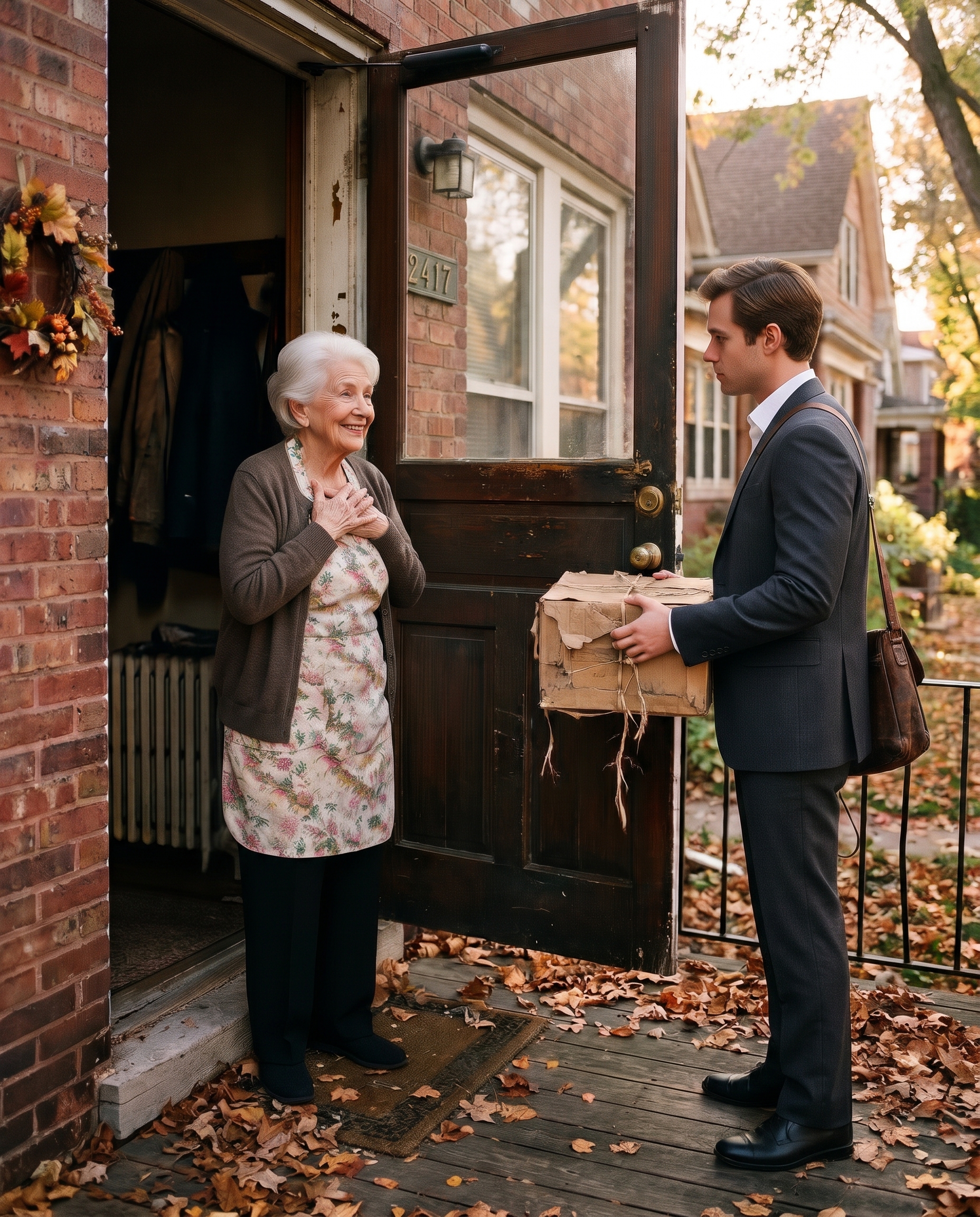
I was baking cookies for my grandchildren when someone knocked on the front door. I wiped my hands and hurried to open it, expecting little faces.
Instead, a young man in a dark suit stood on my porch. In his hands was an old cardboard box, soft at the corners, tied shut with faded twine.
“Mrs. Ellen Parker?” he asked. “My name is Daniel Marsh. I’m an attorney. I represent the estate of Henry Collins.”
My knees nearly gave out. I hadn’t heard that name spoken out loud in fifty years.
“He passed away three weeks ago,” he said gently. “He left very specific instructions. This box was to be delivered to you on this exact date. And he wanted you to know what really happened that day.”
On the lid, in handwriting I’d have known anywhere, were three words: For Ellen. Finally.
What was inside Henry’s box, why did he really run from the altar, and what part did Aunt June play in it all?
The Box
I asked Daniel to come in. I couldn’t open it alone.
We sat at my kitchen table, cookies cooling on the rack. My fingers shook so badly he had to untie the twine for me.
On top was a small velvet pouch. Inside was my engagement ring. The one I’d thrown at his mother’s door the week after the wedding. He’d kept it for fifty years.
Under it were envelopes. Dozens of them, bundled in rubber bands, each with my name and a year on the front. 1977. 1978. 1979. All the way to this year.
“Fifty letters,” Daniel said quietly. “One every anniversary. He wrote them all. He never mailed a single one.”
At the very bottom was a yellowed envelope from a hospital, dated the morning of our wedding. And one last letter, thicker than the others, marked: Read this one first.
The Morning of the Wedding
“Ellen,
You never knew how my father really died. Everyone in town thought it was a bad heart. It wasn’t. It was Huntington’s disease. He was forty-one. I watched it take him piece by piece, and I swore I would never put anyone I loved through that.
A month before our wedding, I went to a doctor in the city and gave blood for a test. It was new back then, and not very good. The results came the morning of our wedding. The doctor said I almost certainly had it. That I’d likely be sick by forty. That any child we had might inherit it.
I stood at that altar and looked at you in the dress you made with your own hands, and I couldn’t promise you ‘until death.’ Because I knew exactly what death would look like, and I couldn’t make you watch it.
I meant to explain. I swear I did.”
Aunt June
I had to stop reading. Daniel poured me a glass of water and waited.
“Your Aunt June was the nurse who took the call from that doctor. She found me behind the church after I ran. I told her everything. I told her I was going to find you and tell you the truth.
She told me not to. She said if Ellen knows, she’ll stay. She’ll marry you anyway, and she’ll spend her whole life nursing a dying man instead of having one. If you love her, she said, let her hate you. Hate will heal. Pity won’t.
God forgive me, I believed her. And she was right that you would have stayed. You always were the bravest person I knew.”
Aunt June. The woman who told me I must have done something to deserve it. She had known. For the rest of her life, she had known, and she let me carry the shame of it alone.
1995
Daniel slid the hospital envelope toward me. It wasn’t one letter. There were two. The first, from 1976, said what Henry had written. The second was dated 1995.
A new, accurate genetic test. Henry had taken it at forty-one, the age his father died, still waiting for the symptoms that never came.
Negative. He had never carried the disease at all. The first test had been wrong.
“The day I got that letter, I drove to Chicago,” his last letter went on. “I found the diner where you used to work. You weren’t there anymore, but a waitress told me where you lived. I parked across the street. You were in the front yard with a man raking leaves, and three children jumping in the pile. You were laughing, Ellen. The way you used to laugh at the county fair.
I sat in that car for an hour. Then I drove home. I had already taken one day of your life away. I wasn’t going to take the rest.”
“He Never Married”
“Did he ever marry?” I asked.
Daniel shook his head. “No. He taught high school shop for thirty-five years. Coached Little League. The kids called him Mr. C. He left most of his estate to the town’s scholarship fund.” He hesitated. “In your name. The Ellen Parker Scholarship. For girls who leave home to start over.”
I covered my face with my hands and cried for the first time in fifty years over Henry Collins. Not because he broke my heart. Because he never stopped protecting it.
The Last Line
The final page of his last letter was only a few lines long.
“I hope Robert was good to you. I hope your children know how strong their mother is. I said ‘I don’t’ because I couldn’t say the truth.
Here it is, fifty years late:
I did. I always did.
— Henry”
The Dress
After Daniel left, I went up to the attic and opened the cedar trunk I hadn’t touched in decades.
My wedding dress was still there. The lace I’d stitched by hand at twenty-two had yellowed a little, but every seam held.
I don’t know why, but I put it on. It still fit, more or less. I stood in front of the mirror, a seventy-two-year-old woman in a fifty-year-old dress, with Robert’s photo on the dresser beside me and Henry’s ring in my palm.
Two good men. One who stayed, and one who left so I could find him.
That’s how my grandchildren found me when they burst through the door ten minutes later, yelling about cookies.
“Grandma,” my granddaughter whispered, staring. “You look like a bride.”
I smiled and took her hand.
“Sit down, sweetheart. Grandma has a story to tell you. And for once, it has a true ending.”
This story is a work of fiction. Names, characters, and events are products of the author’s imagination. Any resemblance to real people or events is purely coincidental.