
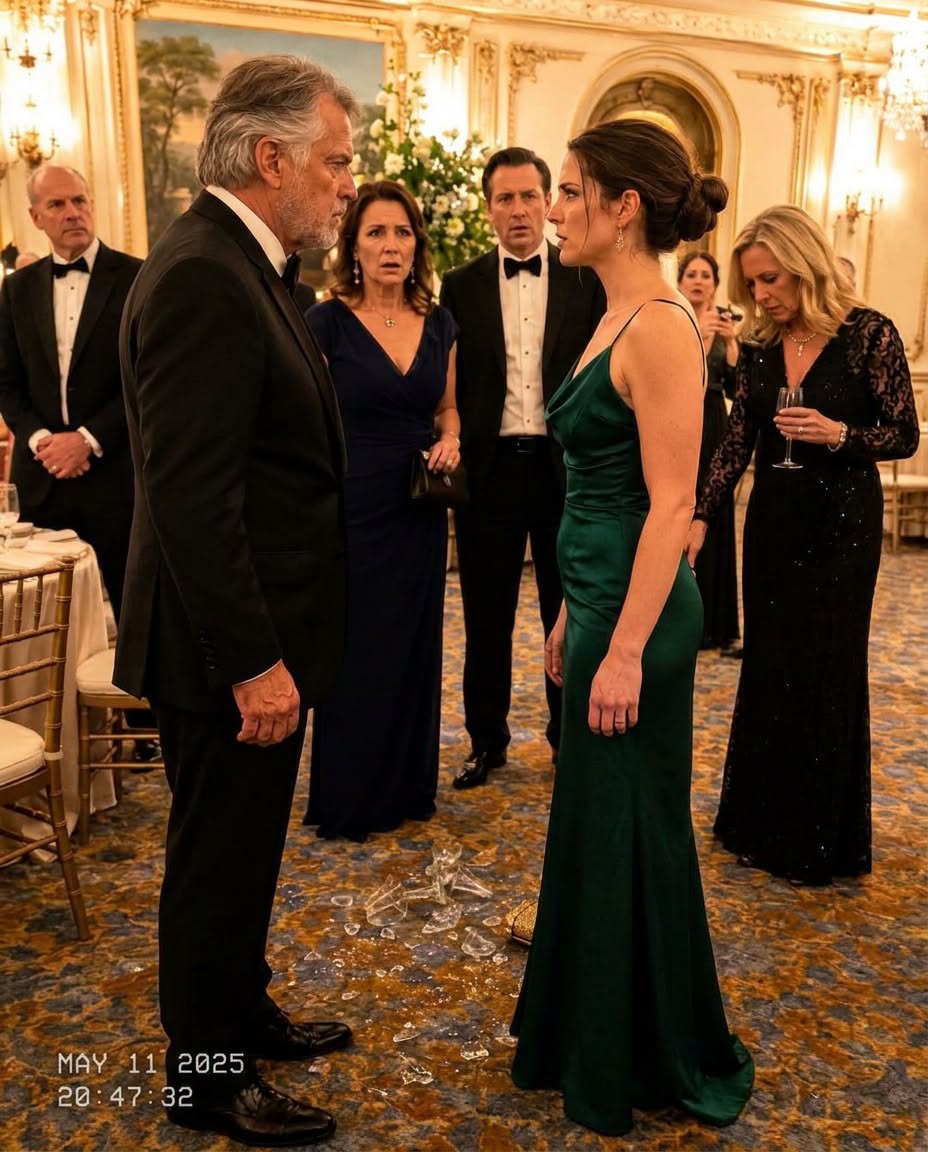
The crystal glass shattered across the ballroom floor just as Daniel stepped toward me, his face flushed with anger. Five hundred guests fell silent beneath the chandeliers, while the string quartet stopped in the middle of a song. Moments earlier, his mother had publicly accused me of living off her son’s success, and Daniel had ordered me to apologize without asking what had happened. When I quietly refused, he lost control and created a scene that left executives, investors, photographers, and board members staring in disbelief. My cheek burned where his hand had struck during the confrontation, but the humiliation hurt more than the pain. I reached into my purse, opened a conversation I had not used in years, and typed three words: “Come get me.” Daniel had no idea that the person receiving that message was Richard Carter, the founder and executive chairman of the company celebrating his promotion.
Daniel and I had met while volunteering after severe flooding in Iowa, long before luxury cars, private clubs, and executive titles entered his life. I was Hannah Carter, the only daughter of a private billionaire whose engineering company had built hospitals, airports, bridges, and renewable-energy projects across the country. My father had raised me to believe that wealth should solve problems rather than define a person, so I kept my family background private until Daniel proposed. He worried that colleagues might assume his career came from my father, and I promised that our connection would remain confidential. Richard honored that promise, giving Daniel only an opportunity to interview when his original application was rejected and allowing him to earn every promotion afterward. Success came steadily, but so did subtle changes: expensive status symbols, public jokes at my expense, impatience with my ordinary habits, and a growing willingness to let his mother treat me as an embarrassment.
The ballroom celebration was meant to honor Daniel’s appointment as senior vice president, and I had spent weeks helping organize the evening. During his speech, he thanked the board, his mentors, his department, and his mother, but never mentioned the wife who had supported him through years of late nights and missed weekends. Later, Evelyn cornered me near the refreshments and called me a nobody who had trapped an ambitious man. Daniel arrived, heard only his mother’s version, and demanded that I apologize to preserve appearances. My refusal exposed how much our marriage had changed: he no longer saw disagreement as something to discuss, but as defiance that threatened the image he had built. After his public outburst, he tried to describe the incident as a private marital misunderstanding, unaware that witnesses, photographers, and security personnel had already seen enough. Then the ballroom doors opened exactly fifteen minutes after my message was delivered.
Richard Carter walked past Daniel’s offered hand and came directly to me, asking only whether my husband had caused the mark on my face. When I answered honestly, my father did not threaten him or demand immediate punishment; he asked company leadership to follow its ethics and workplace-misconduct procedures. The chief executive introduced Richard as Carter Global’s founder and chairman, revealing my identity to a room that had spent years believing I depended financially on Daniel. Daniel’s promotion was suspended pending an independent investigation, while my father formally recused himself to prevent any conflict of interest. Outside counsel interviewed guests, reviewed security footage, and documented Daniel’s conduct at an official corporate event. The board later terminated his employment for violating leadership standards and damaging the organization’s reputation, while I pursued a protection order, medical documentation, and divorce through my own attorney. The legal and financial consequences did not come from my father’s wealth; they came from records, witnesses, company policy, and Daniel’s own choices.
After the divorce, I began using my full name publicly and established a foundation supporting people rebuilding after domestic intimidation, emotional mistreatment, and financial dependence. We funded temporary housing, counseling, childcare, career training, and legal assistance for families beginning again. My father once told me never to confuse forgiveness with restored trust, because bitterness can be released while access still remains earned. I eventually stopped thinking of the ballroom as the place where my marriage ended and began seeing it as the place where I finally stopped protecting an image that was harming me. I had not asked my father to destroy Daniel’s career or reputation; I had only asked him to come when I no longer felt safe standing alone. Daniel’s future was determined by the conduct he chose in front of people who could no longer pretend not to see it. Walking away did not make me weak—it allowed me to rebuild a life in which love could never again require silence.

