
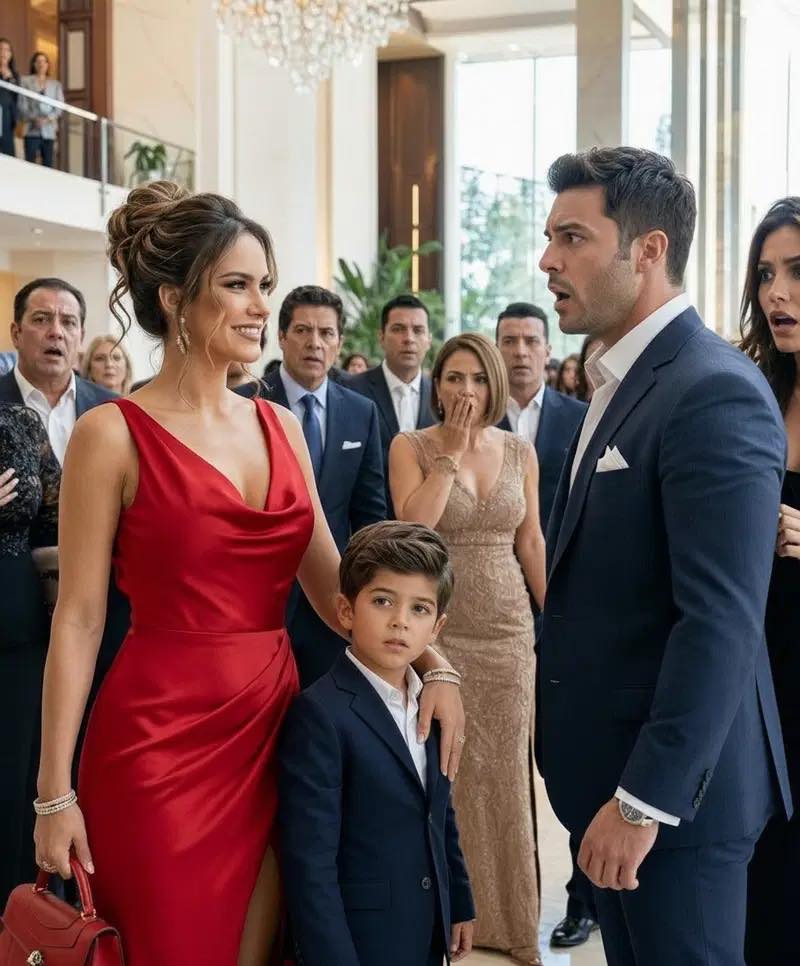
PART 1
“Your mistress is pregnant, and you brought me here just so your family could watch you humiliate me?” Those were the first words I said when I saw Valeria sitting in my chair at the head of the dining table inside the Santillán family home in Lomas de Chapultepec. I had spent the entire afternoon preparing almond mole, white rice, cactus salad, and cajeta flan, trying one more time to earn the approval of a family that had always looked at me as though I was unworthy of their name. But my husband, Alejandro Santillán, did not even have the shame to look away.
Valeria sat there in an emerald dress, wearing a false smile, one hand resting on her stomach while the other held my husband’s hand. Doña Graciela, my mother-in-law, smiled as if justice had finally been served.
“She can give my son a child, Mariana. You have failed him for years.”
The marble floor seemed to vanish beneath me.
“Alejandro, tell me this is some kind of joke.”
He rose from his seat, polished, cold, and cowardly.
“Valeria is pregnant. We’ll marry as soon as you sign the divorce papers.”
“But we are still married.”
My father-in-law stared into his drink. The cousins acted as though they had heard nothing. No one spoke for me. No one called it cruel. Doña Graciela pushed a folder toward me.
“Sign it and leave with dignity. You have embarrassed this family long enough.”
I opened it. Everything had already been prepared: divorce papers, asset waivers, and a demand for silence. My name appeared on every page, not like a wife, but like a problem they wanted erased.
“I’m not signing.”
Before I could step back, Doña Graciela struck me and I stumbled into a chair. Then she grabbed at my hair, shouting that I was useless, worthless, and a burden. Alejandro did nothing. He simply stood there and watched his mother tear apart what little dignity I had left.
“Defend me!” I begged him.
His jaw tightened.
“Don’t make this harder, Mariana.”
That night, they forced me out of the house in the rain. My suitcases landed near the gate like garbage. Alejandro came close only to leave me with one final lie.
“I never loved you. You married me because you kept pushing until I got tired of saying no.”
I sat on a bench, soaked, shaking, with a wounded mouth and a hollow chest. I do not know how much time passed before everything went dark. When I woke up, I was in a public hospital. A young nurse stood beside my bed, reviewing my file.
“Mrs. Mariana,” she said gently, “you are five weeks pregnant.”
I stared at her, unable to understand.
“That’s impossible. They told me I couldn’t have children.”
She gave me a small smile.
“Well, your baby seems to disagree.”
I cried without making a sound. The heir they had demanded for years was growing inside the woman they had just thrown away like a disgrace. That same week, I disappeared. I changed my phone number, my city, and my last name. I went to Guadalajara with almost nothing—except the life still beating inside me.
Six years later, my son Mateo looked exactly like Alejandro. The same eyes. The same serious mouth. The same focused expression whenever he concentrated. But he was mine. My miracle. My reason for standing up again. I worked in small kitchens first, then banquets, then private events for businesspeople and politicians. No one knew that the chef serving luxury dinners had once slept for months in a borrowed room with a newborn in her arms.
Until one night, at a gastronomic gala in Mexico City, I bumped into someone while leaving the hall.
“Sorry,” I said without looking up.
A hand caught my arm.
“Mariana.”
My blood turned cold. Alejandro Santillán stood in front of me, pale and older, staring at me as if he had seen a ghost.
“You’re dead,” he whispered.
And in that instant, I understood that someone had not only removed me from their lives. Someone had buried my name. I had no idea what was about to unfold.
PART 2
“Let go of me,” I said.
Alejandro released my arm as if my skin had burned him.
“Mariana… I went to your funeral.”
I laughed, but there was no joy in it. Only bitterness.
“How interesting. I wasn’t invited.”
His face twisted.
“My mother said you died in a car accident near Querétaro. She said there was no body to hold a proper wake. She said you were… impossible to identify.”
That was when real fear entered me. For six years, I thought I had only been hiding from a cruel family. But if they had held a funeral, then the lie was far bigger than I had imagined.
“What happened after that night?” he asked.
“I woke up in a hospital with bruises and a fever. They told me I was pregnant.”
Alejandro stopped breathing.
“Pregnant?”
“Yes.”
“Whose?”
I looked at him with every ounce of anger I had carried for years.
“Your son.”
The hallway seemed to fall silent. Alejandro stepped back.
“No… my mother never told me.”
“Your mother called me barren while your mistress sat in my chair with her hand on her stomach.”
He closed his eyes.
“Valeria lied.”
I stood completely still.
“What?”
“The child she had wasn’t mine. I found out two years later. My mother hid the truth to avoid scandal.”
Nausea rose in me. Not because of Valeria. Not because of Alejandro. But because of the depth of their cruelty. They destroyed me over a child who was never his. And when the real heir was born, they erased him. That night, I did not tell Alejandro where I lived. Before stepping into the elevator, I said only one thing.
“His name is Mateo. And you don’t get to appear in his life like you misplaced something and suddenly found it again.”
The next day, I called my lawyer, Teresa Robles. I told her everything: the dinner, the humiliation, the pregnancy, the false funeral, and the encounter with Alejandro. Teresa listened quietly.
“Mariana, this is no longer just a family issue. If they falsified documents, paid people off, or used your supposed death to hide abuse or keep you from claiming your rights, this is extremely serious.”
“I just want to protect my son.”
“Then we find out exactly what they buried.”
Within a week, the first piece of evidence appeared: an obituary published six years earlier in a local newspaper. “Mariana Vargas de Santillán, beloved wife.” But there was no valid death certificate. No identified body. No proper file. Only flowers, a private mass, and a story repeated by Doña Graciela. A funeral without a death. A lie dressed in candles.
Then Teresa found something worse: a recorded call from the hospital where I had been treated. A nurse had tried to contact Alejandro to tell him I was pregnant. Doña Graciela had answered the call. She told the nurse they had reached the wrong family. When Alejandro confronted his mother, she did not deny it. According to what his lawyer later told me, Doña Graciela simply said,
“That woman was going to use the pregnancy to trap you. I protected the family.”
But the family she claimed to protect began falling apart. Alejandro requested a paternity test through legal channels. I agreed only under court protection. No visits. No calls. No gifts. No approaching Mateo’s school. Then Doña Graciela made her worst mistake. She hired a private investigator to follow us.
The man appeared twice outside Mateo’s elementary school. He asked a neighbor whether the boy lived with me and claimed it was a “family matter.” I took photos of him. Teresa filed a complaint and requested a restraining order. But someone at the court leaked the file. The next morning, all of Mexico was talking about it.
“Millionaire family allegedly faked former daughter-in-law’s death to hide legitimate son.”
My phone would not stop ringing. Reporters, strangers, curious people, and judgmental voices all wanted a piece of the story. Some called me greedy. Others called me brave. I was neither. I was just a frightened mother trying to protect her child.
That night, Mateo found me crying in the kitchen.
“Mom, is my dad a bad person?”
My heart broke.
“Your dad did something very wrong years ago. But some things were hidden from him too.”
“Did he know about me?”
“Not at first.”
“Does he want to know me?”
I swallowed hard.
“Yes.”
Mateo looked down at his blue dinosaur, the one he carried everywhere.
“Do I have to love him?”
I knelt in front of him.
“No. No one will ever force you to feel anything.”
At that moment, my phone rang. It was Teresa. I answered with trembling hands.
“Mariana,” she said, “the result is here.”
I closed my eyes.
“And?”
Her silence lasted only two seconds, but it felt endless.
“Mateo is Alejandro Santillán’s biological son.”
Outside the window, a black car stopped in front of the building. And I knew the real war was only beginning.
PART 3
The first time Alejandro met Mateo, it was not inside a mansion or an expensive restaurant. It happened in a child therapist’s office, with cameras, signed agreements, and my lawyer waiting outside. Mateo entered holding his blue dinosaur. Alejandro stood up, then immediately sat back down so he would not frighten him.
“Hello, Mateo. I’m Alejandro.”
My son studied him with a seriousness that did not belong on a six-year-old’s face.
“My mom says you’re my biological dad.”
Alejandro swallowed.
“Yes. I am.”
“Do you know about dinosaurs?”
He blinked.
“Not enough. But I want to learn.”
Mateo placed the toy on the table.
“His name is Thunder. He only trusts brave people.”
Alejandro looked at the dinosaur, then at me.
“Then I’ll have to learn how to be brave.”
That sentence hurt more than I expected, because bravery was exactly what he had lacked when I needed him most. The visits moved slowly. Thirty minutes. Then one hour. Later, supervised outings to the park. Alejandro did not bring expensive cars or impossible gifts. The therapist told him not to confuse presence with presents, and for once in his life, he listened to someone other than his mother.
Mateo asked questions with the honesty only children have.
“Why didn’t you help my mom?”
One day, Alejandro answered with tears in his eyes.
“Because I was a coward. Because I was afraid of my family. And that was wrong.”
“Are you still afraid?”
“Sometimes.”
“Thunder says being brave means being scared but doing the right thing anyway.”
Alejandro cried quietly. Meanwhile, Doña Graciela lost the things she valued most: reputation, control, and obedience. The judge denied her any contact with Mateo because of abuse, intimidation, and manipulation. The Santillán Foundation lost donors. The house in Lomas was put up for sale. Her friends stopped inviting her to breakfast. And worst of all for her, Alejandro testified against her.
“My mother didn’t protect the family,” he told the judge. “She protected her pride. And I was complicit because I failed to defend my wife.”
That statement changed everything. Doña Graciela accepted a civil settlement: money placed in a trust for Mateo, funding for an organization that helped women leave violent marriages, and a public statement admitting that I had never died, that I had been expelled from her home under traumatic circumstances, and that my son had been hidden by a family lie. It was not a beautiful apology. But it was the truth, written under her signature.
Two years later, I opened my own restaurant in Roma Norte. It was small, warm, and filled with copper pots, fresh bread, and photographs from my real life: Mateo with crooked teeth, my first rented kitchen, and my mother hugging me on opening day. Alejandro stayed in Mateo’s life, but with clear boundaries. He was no longer my husband. He would never again hold my heart the way he once had. But he learned how to be a father without demanding applause for arriving late.
One night, after Mateo’s eighth birthday, Alejandro helped me carry presents to the car. Soft rain fell over the sidewalk. The rain no longer smelled like abandonment. It smelled like cake, roasted garlic, and a life rebuilt.
“You look happy,” he said.
“I am.”
“I’m glad.”
And I believed him. Before, I thought peace would come when every Santillán paid for what they had done. But I learned that healing was not about watching them fall to their knees. Healing was letting go of the need for them to understand my pain before I allowed myself to move forward.
Mateo ran out of the restaurant with frosting on his shirt.
“Mom! Dad! Look, I got a little telescope as a gift!”
We both turned at the same time. For one brief second, we were not victim and coward, abandoned wife and remorseful husband. We were simply two parents looking at a child who had survived a lie before he was even born and still learned how to laugh.
Years later, when Doña Graciela died alone in a private clinic, her obituary spoke of elegance, tradition, and charity. It mentioned nothing about the fake funeral. Nothing about the daughter-in-law she tried to erase. Nothing about the grandson she never got to hold. But the truth no longer depended on her. It lived in the files. In the news. In Mateo’s trust. In my restaurant. In every woman who came to my foundation and said,
“I need to start over too.”
One night, I finally put away the folder of evidence: the fake obituary, the legal papers, the DNA results, and Mateo’s first ultrasound. I did not burn it. Truth deserves to be preserved. But I took it out of my bedroom. The past no longer had the right to sleep beside me.
Six years earlier, they called me useless because they believed I could not give life. They buried me without a body so no one would ask where I had gone. But the woman they tried to erase came back with a son, a voice, and a table of her own. And in the end, the Santillán fortune could not buy the one thing that mattered most: truth, when born from innocence, always finds a way into the light.

