
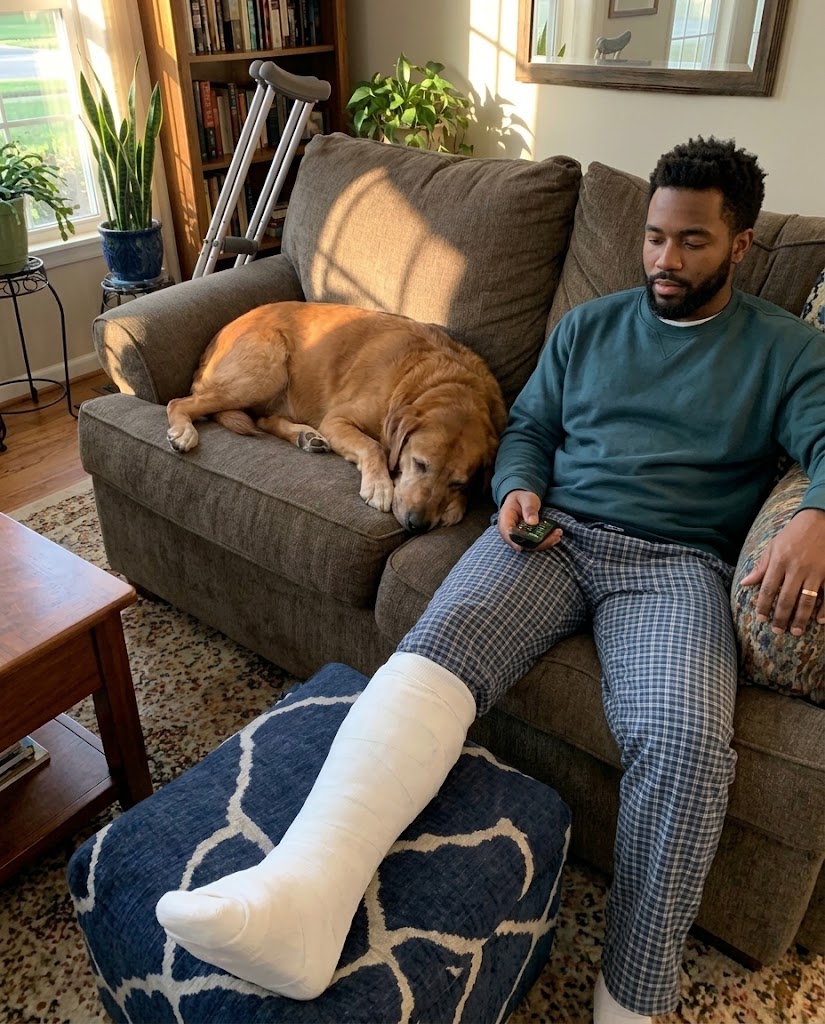
“Don’t touch the cast.” Conor said it so sharply that my hand stopped inches from his right leg. He was sitting on the bathroom floor beside the tub after slipping, one crutch under the sink and the other across the doorway, and the top edge of his cast had cracked enough to expose the shifted padding beneath it. For two weeks he had insisted the injury was nothing more than a fractured ankle from a wet floor at work, yet every time I tried to help—wrapping the cast for a shower, adjusting a pillow, asking about his follow-up—he pulled away. After thirty-two years of marriage, this was not the husband I knew; Conor usually treated a common cold like a small national emergency. Then the loose padding slipped lower, and I saw a long pink surgical scar running above the cast line. It was healing. It also had nothing whatsoever to do with a broken ankle.
The truth came slowly and then all at once. Conor admitted that months earlier a suspicious spot had been biopsied and diagnosed as skin cancer. It had been surgically removed before the ankle injury, and the cast had conveniently hidden the healing site. He kept saying he had intended to tell me “when he knew more,” but what devastated me was learning how many people already knew. Nathan, his coworker, had driven him to an appointment. Our daughter Tilly had taken him to a follow-up. His sister Amanda knew after the biopsy and had warned him that excluding me was a mistake. I had been the only one left outside. When I called Tilly, angry and hurt, she said something I did not want to hear: “Mom, you don’t let people be scared. You fix everything before they can even say what they’re afraid of.” She was not defending the deception, and neither was Nathan or Amanda. But each of them described the same version of me—competent, loving, immediate, and sometimes so quick to organize fear that the frightened person had no room left to feel it. That did not excuse Conor’s secrecy. It did make the problem more complicated than a simple lie.
A few days later, Conor asked me to attend his next medical appointment. My first instinct was to reach for a notebook, make a list, and start preparing questions. Instead, I asked, “Do you want your wife there, or someone to take notes?” He said, “My wife.” So I sat beside him and made myself wait while he asked his own questions. The physician explained that the cancerous area had been treated successfully but that Conor would need regular dermatologic surveillance and follow-up examinations. I asked one question when he was finished and left the rest alone. In the car, he thanked me for not taking over. That night he finally explained what had frightened him enough to hide the diagnosis. Years earlier, when my mother was dying, he had found me sitting on our kitchen floor after months of caregiving, work, medications, appointments, and almost no sleep. I had forgotten to return a library book, of all things, and that tiny mistake broke me open. When the doctor later said the word cancer to Conor, that was the image he remembered. He thought keeping the fear away from me was protection. “You took one of the worst moments of my life,” I told him, “and decided it was the only version of me you could trust.”
We had more repairing to do than either of us expected. Conor apologized to Tilly for putting her in the middle and acknowledged that asking our daughter to keep a medical secret from me had burdened her with a role she should never have had. I told both of them that nobody else gets to decide what I can handle on my behalf. I also admitted something harder: if my instinct to solve every problem made it difficult for Conor to admit fear, I needed to change that part of myself. But change did not mean accepting deception as care. “If I make it hard for you to be scared around me, tell me,” I said. “I’ll work on that. But don’t lie to me and call it love.” We made a simpler rule after that. Medical information did not belong to one spouse alone when it materially affected both of us, but the person receiving the diagnosis still got to decide what kind of support they needed in the moment—questions, planning, silence, company, or all four at different times. It was a small distinction, but after thirty-two years of marriage, small distinctions can reshape an entire relationship.
Several weeks later, the cast came off. One evening Conor sat beside me and admitted he was nervous about the next skin check. The old questions rose in me automatically—when, what time, what did the doctor say last time, should we call sooner—but I let them pass. “Do you want help,” I asked, “or do you want company?” He looked relieved. “Company.” He reached toward my hand, stopped halfway, and I closed the distance myself. After a minute he glanced down at his leg and said, almost sheepishly, “You can touch it now.” I rested my palm over the place where the scar disappeared beneath his jeans. I was still angry that he had shut me out, and I was profoundly grateful that he was okay. Both things were true. This time I was not reaching because Conor needed something fixed. He had asked me simply to stay. After thirty-two years, I finally understood that those are not the same kind of love.

