
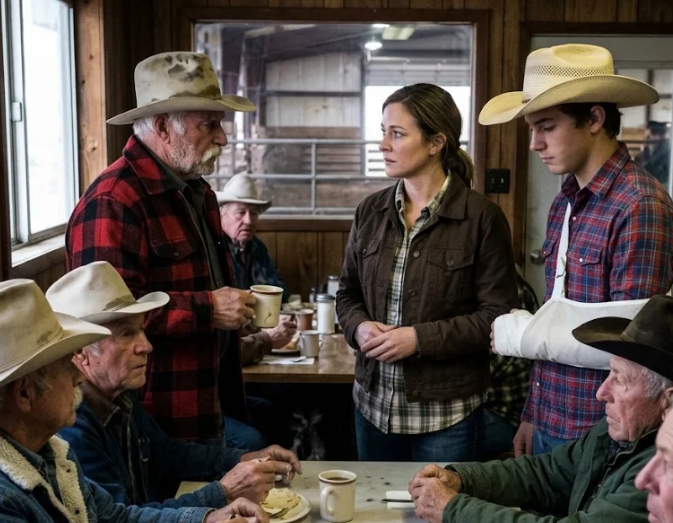
By 6:30 on sale morning, the sale barn café was packed, like it always is.
Don Hollister sat at the near end of the long table, the same seat he’d taken for thirty years. Felt hat. Tan canvas work jacket. White mustache over his coffee cup. Around him, a dozen cattlemen ate eggs and argued about calf prices.
My husband, Travis, stood beside me in his straw hat, his right arm in a white cast and sling.
Eleven Years
Travis had worked for Don for eleven years. Calving at 2 a.m. Fixing fence in sleet. Never once said no.
On Halloween, a cow hit a chute gate and pinned his arm against the steel pipe. Both bones snapped. Surgeons in Amarillo put in a plate and six screws.
His November paycheck came for $800. He’d earned $4,000 for October. Don kept the other $3,200.
“That’ll cover the days you can’t work,” he told Travis on the phone.
Travis asked for it twice. Once on the phone. Once by the cattle pens. Both times Don said they’d “settle up when you’re back.”
I filed a wage complaint with the state. They said it could take weeks, maybe months. Our mortgage was due Friday.
That Saturday, our seven-year-old, Emma, carried her piggy bank to the kitchen table and set it down in front of us. Fourteen dollars and some pennies. “It’s for our house,” she said.
That night, I asked Travis if he’d let me talk to Don at the café, in front of the men he ate breakfast with every week. He thought about it all evening. Finally he said, “I’ll be right beside you.”
The Long Table
Every man at that table looked up when we walked over. Forks stopped.
“Good morning, Mr. Hollister.”
“Casey. Travis.” He glanced at the sling. “How’s the arm?”
“Mending,” Travis said.
I kept my voice low. It didn’t matter. The whole café had gone quiet.
“Mr. Hollister, Travis worked every day of October. He worked until three o’clock the afternoon he broke his arm. You held back $3,200 he already earned. We’d like it today, please.”
Don’s face went red under his hat. “Casey, this isn’t the place.”
“I know, sir, and I’m sorry. But Travis asked you privately. Twice.”
The man next to Don put down his fork. Then the next. Down the line, nobody was eating.
“Did you send her here?” Don asked Travis.
“No, sir. She’s speaking for both of us.” Travis looked him straight in the eye. “Eleven years, Don. Every time you called, I came.”
At the far end of the table, Hank Riggs, who has called the auctions there for forty years, turned his chair around to face us. He didn’t say a word. He just watched Don.
“You know what kind of year it’s been,” Don said quietly.
“Yes, sir. Hard for everybody. But Travis didn’t break his arm because it was a hard year.”
Don set his cup down. He looked at each of the men beside him. Then he slid his hand into the pocket of his tan canvas jacket.
The Letter in His Pocket
He didn’t pull out a checkbook. He pulled out a folded envelope with a bank logo on it and laid it on the table in front of me.
“Read it,” he said. “Out loud, if you want. Everybody’s going to know by spring anyway.”
It was a letter from his bank. His operating line of credit had been frozen in October after the drought and the hay prices. Every check he wrote was bouncing. He’d been paying feed bills out of his own savings and selling his late wife’s jewelry to keep the cattle fed.
“I didn’t keep Travis’s money because of his arm,” Don said, staring at the table. “I kept it because I didn’t have it. And I was too proud to tell a man I’ve known for eleven years that I’m going broke. So I told him something worse instead.”
Nobody at that table said anything. Some of those men had known Don for half a century. None of them had known.
“That’s still not right, Don,” I said gently. “We have a mortgage too.”
“No,” he said. “It isn’t right. You’re the only one who’s been honest at this table all morning.”
Hank’s Hat
That’s when Hank Riggs stood up. He took off his old gray Stetson, turned it upside down and set it on the table in front of the man nearest him.
“Travis Bell has pulled half your calves at one point or another,” Hank said to the table. “Mine too. He’s owed $3,200. Don can’t pay it today. We can.”
Hank dropped in two hundred-dollar bills. The man next to him added a hundred. Wallets came out all down the long table. Twenties, fifties, a folded check. A waitress who’d been listening from the kitchen dropped in her tip jar money.
When the hat reached the end of the table, Hank counted it out right there next to the ketchup. $3,460.
He handed it to Travis. Then he turned to Don.
“You’re running forty head through the ring this morning. I’ll sell them first, while the buyers are fresh. You pay these men back out of the check. And you go see the bank with your son instead of carrying that letter around in your pocket alone.”
Don nodded. He couldn’t speak. He reached over and shook Travis’s good hand for a long time.
Friday
We paid the mortgage Thursday afternoon, a day early. Don paid every man at that table back by the next sale day. I withdrew my complaint with the state, because Don sent a letter to the labor office himself, admitting what he’d done and showing the payment.
While Travis’s arm healed, Hank hired him to work the sale barn office and run the gate on sale days, one-handed. When the cast came off in January, Don drove out to our place and asked, very formally, if Travis would come back. He offered him a raise and a written contract, with injury pay. “I should’ve had it all along,” he said.
Travis said yes.
The extra $260 from Hank’s hat went back to the waitress, who refused it, so we gave it to Emma. She put it in her piggy bank next to her fourteen dollars and announced it was “for the next family that needs it.”
That piggy bank sits on our kitchen counter now. It’s never been emptied.