
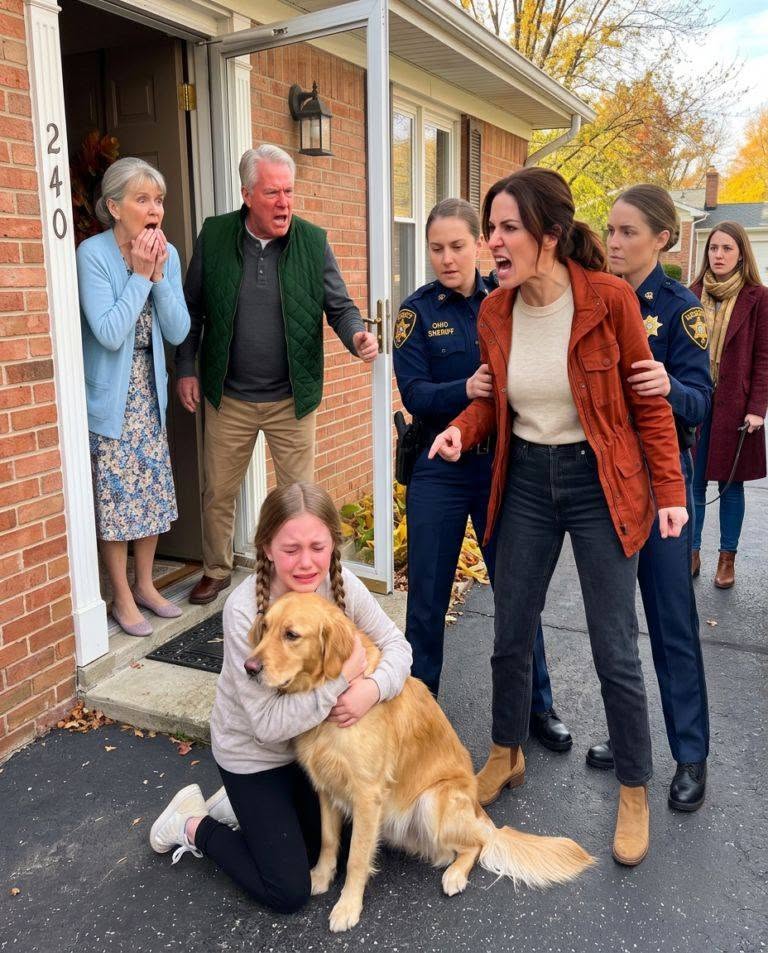
My 11-year-old daughter found a note from her grandparents taped to her bedroom door: “We gave your dog away. Your cousin didn’t want it around. Don’t make a scene.”
She was in tears.
I stayed completely calm.
I made a few calls that night.
The next morning, three hard knocks at their front door changed everything.
My daughter, Emily, found the note at 7:10 on a Thursday evening.
She stood in the hallway in her socks, still wearing the navy sweatshirt from soccer practice, holding the paper with both hands as if it might tear her apart.
“Mom,” she whispered. “Where’s Max?”
I read the note twice.
Max was a six-year-old golden retriever my husband, Daniel, had adopted for Emily after her father died. He slept beside her bed, waited outside the bathroom when she showered, and recognized the sound of her school bus before any of us did.
We were temporarily staying with Daniel’s parents, Robert and Linda Mercer, in suburban Ohio while our kitchen was being rebuilt after a burst pipe.
Daniel was in Pittsburgh for a three-day work trip.
His sister, Claire, had arrived that afternoon with her son, Tyler, who had recently decided he was “nervous around big dogs.”
Apparently, that was enough.
“Where did they take him?” Emily asked.
Downstairs, Linda was stirring pasta sauce.
Robert was watching television.
Claire sat at the kitchen island scrolling through her phone.
I held up the note.
Linda barely glanced at it.
“We handled it.”
“Where is Max?”
“Your daughter was getting too attached,” Robert said. “And Tyler shouldn’t have to be uncomfortable in his grandparents’ house.”
Emily started crying behind me.
Claire sighed.
“Please don’t turn this into drama.”
I didn’t yell.
That seemed to make all three of them more uncomfortable.
I asked again.
“Where is the dog?”
Robert muted the television.
“A family came for him. Good people. That’s all you need to know.”
I nodded.
Then I took Emily upstairs, locked our bedroom door, and called Daniel.
After that, I called the county sheriff’s office.
Max was legally registered to me.
His microchip was in my name.
I had his adoption contract, veterinary records, county license, and a security-camera notification showing Robert leading Max toward a stranger’s SUV at 3:42 that afternoon.
By 9:30, I had the license plate number.
By 10:15, a deputy had identified the people who took him.
By midnight, I knew something else.
Robert hadn’t “given” Max away.
He had sold him for eight hundred dollars through a local Facebook group.
The deputy told me not to contact the buyers myself. Law enforcement would recover Max and take statements the next morning.
So I put Emily to bed.
I packed our suitcases.
And before sunrise, I made one more call.
At 7:26 the next morning, three hard knocks shook the front door.
Robert was already in the kitchen.
Linda was pouring coffee.
Claire had slept on the living-room sofa because Tyler was using the guest room.
Emily sat beside me at the dining table, pale and silent.
I knew who was outside.
They didn’t.
Robert opened the door halfway.
His entire posture changed.
Two sheriff’s deputies stood on the porch.
Behind them was a woman in a gray coat holding a red leash.
At the end of that leash stood Max.
Emily’s chair crashed backward.
“Max!”
He heard her before he saw her.
His paws scrambled against the porch boards as the woman released the leash.
Max shot through the doorway, skidded across the hardwood floor, and almost knocked Emily over.
She wrapped both arms around his neck and buried her face in his fur.
That was when Linda screamed.
“What is this? What did you do?”
I looked at her.
“I found my dog.”
Robert turned toward me, his face dark red.
“You called the police?”
Deputy Harris stepped inside.
“Mr. Mercer, we need to speak with you about the sale of this animal.”
“I didn’t sell anything.”
The woman on the porch immediately spoke.
“You absolutely did.”
Her name was Megan Foster.
She and her husband had paid Robert eight hundred dollars in cash after he claimed Max belonged to him and said he was rehoming the dog because he was moving into assisted living.
Robert stared at her.
Then he made the mistake that finished that particular lie.
“I gave you back the money.”
Megan blinked.
“No, you didn’t.”
The room went silent.
Deputy Harris pulled out a notebook.
Linda dropped into a kitchen chair.
Claire suddenly became very interested in her phone.
I had already emailed the deputy screenshots from the exterior camera, Max’s registration, his microchip certificate, the adoption agreement, and a photograph of the handwritten note.
Daniel had also submitted a statement confirming that neither of us had authorized anyone to remove or sell Max.
Robert tried another explanation.
First, he claimed I had abandoned the dog at his house.
Then he said Max had threatened Tyler.
Finally, he said he had only been protecting his grandson.
Emily lifted her head from Max’s neck.
“That’s not true.”
Her voice was quiet, but everyone heard it.
Tyler appeared in the hallway behind Claire.
He was thirteen, barefoot, with messy hair.
He looked at his mother.
Then Robert.
Then the deputies.
“Max didn’t do anything,” he said.
Claire snapped, “Go upstairs.”
“No.”
Tyler swallowed.
“I said I didn’t like him licking my hands. Mom said Grandma would get rid of him.”
Linda’s face went white.
Deputy Harris looked toward her.
“Mrs. Mercer, did you participate in arranging the sale?”
“No.”
My phone buzzed.
Daniel.
I put him on speaker.
His voice filled the kitchen.
“Mom, I saw the messages.”
Linda froze.
Daniel had access to the family tablet sitting on his parents’ counter. Overnight, it had synced a group conversation between Linda, Robert, and Claire.
Linda had written:
“List the dog tonight. Sarah will complain, but she’ll get over it.”
Claire had replied:
“Just make sure Emily isn’t here when they take him.”
Robert’s response was worse.
“If someone pays cash, even better.”
For the first time since I’d walked downstairs holding that note, nobody told me not to make a scene.
Deputy Harris asked Robert and Linda to step onto the porch separately.
Claire started crying.
Not because Max had been taken.
Because she realized her messages were part of the evidence.
I helped Emily clip Max’s leash onto his collar.
Then we carried our suitcases to the car while the deputies took statements.
As I opened the passenger door for Emily, Linda hurried down the steps.
“You’re really going to destroy this family over a dog?”
I turned around.
“No. You decided what this family was worth when you sold something that belonged to an eleven-year-old and left her a note.”
Emily climbed into the car.
Max jumped in beside her.
And we drove away while the sheriff’s cruiser remained in the driveway.
We couldn’t go home.
Our house still had exposed drywall, industrial fans running in the kitchen, and boxes of flooring stacked downstairs.
Instead, Emily, Max, and I checked into a pet-friendly hotel twelve minutes from her school.
Daniel drove back from Pittsburgh before lunch.
The second he entered the room, Emily ran toward him.
He wrapped one arm around her and the other around Max.
For several seconds, nobody spoke.
Then he looked at me over Emily’s head.
“What did they say?”
“Everything except the truth.”
He nodded once.
“That sounds right.”
Daniel had spent much of the drive talking with Deputy Harris.
The family tablet contained more than the three messages he had read aloud that morning.
There were eleven.
And the conversation had started two days before Claire and Tyler even arrived.
Claire: “Tyler says that dog is annoying. Can you keep it outside?”
Linda: “Sarah acts like it’s another child.”
Robert: “It’s a dog.”
Claire: “I don’t want an argument all weekend.”
Then, Wednesday afternoon, Linda sent a photograph of Max sleeping beside the kitchen table.
Linda: “A man at church said goldens go for good money even when they’re older.”
Robert: “Not with papers.”
Linda: “He has papers. Sarah left the folder in the cabinet with the vet stuff.”
That message turned my stomach.
This hadn’t been an impulsive decision because Tyler complained.
They had gone through our documents.
They had planned everything.
Robert photographed Max’s vaccination record, cropped out my name, and sent it to Megan as proof that Max was healthy.
He told her the dog belonged to him.
Linda took the photographs for the listing.
Claire knew they were arranging the sale and agreed to take Emily to soccer early so she wouldn’t see the buyers arrive.
The note had been Linda’s idea.
“Keep it short,” she had written. “If Sarah comes home mad, tell her it was already done.”
Daniel sat on the edge of the hotel bed reading the messages.
His jaw tightened.
Emily sat on the carpet beside Max, checking his ears, paws, collar, and tail as though she needed proof that every part of him had come home.
“Dad,” she asked, “are Grandma and Grandpa going to jail?”
Daniel looked at me before answering.
“I don’t know.”
“Did I get them in trouble?”
“No,” he said immediately. “Adults are responsible for what adults choose to do.”
Emily nodded, but she didn’t look convinced.
That question stayed with me.
Robert and Linda’s decision hadn’t only frightened her.
It had made her feel responsible for the consequences that followed.
By Friday afternoon, the sheriff’s office had completed the first round of interviews.
Megan gave investigators the messages between herself and Robert, including the listing, the agreed price, and the address where she had picked Max up.
Her husband had withdrawn eight hundred dollars from an ATM twenty minutes before they arrived.
Their doorbell camera revealed something else.
Late Thursday night, after the deputy first contacted them, Robert went to Megan’s house and demanded that she tell police the transaction had actually been a “temporary adoption.”
She refused.
The camera recorded the conversation.
“You got your money’s worth,” Robert could be heard telling her.
That sentence destroyed his claim that no sale had happened.
Linda wasn’t doing much better.
She told investigators she believed Robert had permission.
Then Deputy Harris showed her the message where she had written:
“Sarah will never agree, so don’t ask.”
Claire hired an attorney before the weekend ended.
That told Daniel more than anything she said afterward.
His parents called him twenty-three times on Friday.
He answered once.
I sat beside him in the hotel while he put the call on speaker.
Linda was already crying.
“Danny, please. Your father is beside himself.”
Daniel stared out the window.
“You sold Emily’s dog.”
“It got out of hand.”
“You planned it for two days.”
“We were trying to make the house comfortable for Tyler.”
“Then you could have asked Sarah to keep Max in our room.”
Linda’s voice sharpened.
“You know how she gets.”
I almost laughed.
Not because it was funny.
Because there it was again.
The same assumption behind the note.
I was supposed to become the difficult one simply because I objected.
Daniel’s voice hardened.
“Do not talk about my wife like she caused this.”
“Your father could have a record because of her.”
“No. He could have a record because of what he did.”
A long silence followed.
Then Robert took the phone.
“This is family business. You don’t bring cops into family business.”
Daniel’s expression changed.
He had spent years avoiding direct fights with his father.
Robert treated disagreement as disrespect and silence as surrender. Daniel had learned early that the fastest way to end an argument was to stop participating.
Not this time.
“You took property that wasn’t yours, sold it to strangers, lied about ownership, and left my daughter to learn about it from a note on her door.”
Robert scoffed.
“It was an animal.”
“It was hers.”
“You’re choosing a dog over your parents.”
“No,” Daniel said. “I’m choosing my wife and daughter over people who think being related to me means they can do whatever they want.”
Then he ended the call.
For the next three weeks, the story traveled through the family the way stories like that usually do.
Not as facts.
As versions.
Robert told his brother that I had called police because he “rehomed an aggressive dog.”
Linda told an aunt that Max had nearly bitten Tyler.
Claire told two cousins that she didn’t know money had changed hands.
Then Megan posted a public comment beneath the original dog listing Robert had forgotten to remove.
She didn’t insult anyone.
She simply explained that the dog had been sold to her by someone who wasn’t the legal owner, that law enforcement had contacted her, and that she had voluntarily returned him to his family.
Screenshots traveled faster than excuses.
So did the photograph of Emily hugging Max on the hotel-room floor after he came home.
I didn’t argue with relatives online.
There was no reason to.
The official process moved more slowly, but it was much harder for Robert and Linda to control.
Investigators obtained the messages from Daniel and Megan.
They verified Max’s microchip and county license.
Our veterinarian provided years of records showing I had paid for his care.
The rescue organization sent the original adoption contract with my signature.
Eventually, a prosecutor filed charges related to the unauthorized sale.
Claire wasn’t charged, but her messages became evidence.
Linda’s involvement was treated differently from Robert’s because he had physically taken Max, negotiated the price, accepted the money, and delivered him.
Months later, Robert accepted a plea agreement rather than go to trial.
He received probation, community service, court costs, and an order to repay expenses connected with the incident.
The exact punishment mattered less to me than the official record.
There was no longer a version where Max had simply been “given to a nice family.”
There were documents.
Statements.
Timestamps.
And Robert’s own voice outside Megan’s house.
Our house was finally livable again in early October.
The first night home, Emily dragged Max’s bed into her bedroom.
He ignored it and slept across her doorway instead.
Emily had changed around adults.
She wasn’t exactly afraid.
She was more observant.
When someone made a promise, she asked exactly what they meant.
When a relative said, “Don’t worry about it,” she wanted details.
When Daniel told her she could decide whether she wanted contact with his parents, she said:
“Not yet.”
We respected that.
Linda mailed birthday cards.
Emily left them unopened for weeks.
Robert sent nothing.
Claire apologized once by text.
“I’m sorry this became such a big thing.”
I showed Daniel.
He read it twice.
“That isn’t an apology.”
I agreed.
Tyler’s apology was different.
He wrote Emily a letter in pencil.
He apologized for complaining about Max licking his hands and for staying quiet when his mother said Grandma could make the dog disappear.
He admitted he’d been afraid to contradict the adults after the deputies arrived.
At the bottom, he wrote:
“I didn’t want them to sell him. I hope Max is okay.”
Emily answered him.
She didn’t answer Claire.
At Thanksgiving, we stayed home.
Daniel roasted a turkey far too large for three people.
I burned the first tray of rolls.
Emily secretly fed Max a piece of plain turkey under the table even though she thought we couldn’t see.
At 6:14 that evening, the doorbell rang.
For half a second, every muscle in my body tightened.
Daniel checked the camera before opening the door.
It was Megan.
She stood on the porch with her husband and their eight-year-old daughter, Sophie.
Sophie was holding a small black-and-white puppy.
“We were nearby visiting my sister,” Megan said. “Sophie wanted Emily to meet someone.”
They had adopted the puppy from a rescue two weeks earlier.
His name was Pepper.
Emily came to the door with Max.
Sophie knelt.
Max carefully sniffed Pepper, then sneezed directly in his face.
Both girls burst out laughing.
It was the first time I had seen Emily laugh about anything connected to that week.
Then Megan handed me an envelope.
Inside was a copy of the handwritten note Linda had placed on Emily’s bedroom door.
I looked at her, confused.
“The deputy gave me a copy with my statement packet,” Megan explained. “I thought maybe you’d want it. Or maybe you want to throw it away.”
That night, after everyone left, I stood at the kitchen counter holding the note.
Daniel came beside me.
“You keeping it?”
I thought about the moment Emily had handed it to me.
Her expression.
Her shaking fingers.
The three sentences meant to end the argument before she was even allowed to have one.
We gave your dog away.
Your cousin didn’t want it around.
Don’t make a scene.
They had counted on embarrassment.
Family pressure.
The assumption that calling law enforcement would look excessive.
Most of all, they had expected that once Max disappeared, finding him would become more trouble than accepting his loss.
They were wrong because they mistook restraint for passivity.
I hadn’t screamed that night because screaming wouldn’t have brought Max home.
Records did.
The microchip did.
The security footage did.
The license did.
Megan telling the truth did.
Daniel refusing to excuse his parents did.
And unexpectedly, Tyler refusing to repeat his mother’s lie did.
I folded the note once and placed it inside the folder with Max’s adoption papers.
Not as a souvenir.
As a reminder to keep documentation for the things people assume no one will ever challenge.
Six months later, Linda asked Daniel whether Emily was “ready to move on.”
He told her moving on and pretending nothing happened were not the same thing.
Eventually, Emily agreed to meet Linda in a public park.
She brought Max.
Linda cried when she saw them.
Emily didn’t.
She sat on a bench with one hand resting on Max’s collar and listened while her grandmother apologized.
This time, Linda didn’t say things had “gotten out of hand.”
She didn’t blame Tyler.
She didn’t blame me.
She said:
“I knew you would say no, so I did it anyway. I thought because I was your grandmother, you would have to forgive me.”
Emily stayed quiet for a long moment.
Then she answered:
“Maybe someday. But you don’t get to decide when.”
Linda nodded.
It was the first useful thing she had done since the night she wrote that note.
Robert never came to the park.
He still believed the family had betrayed him by refusing to keep what he did private.
Daniel eventually stopped arguing with him.
Some arguments remain unresolved not because the truth hasn’t been explained clearly enough.
Sometimes a person simply prefers the lie that protects him.
A year after Max was taken, Emily came home from school carrying a photograph she had printed in the library.
It showed her sitting on our front steps with Max’s head resting in her lap.
She taped it to her bedroom door.
Underneath, she wrote one sentence:
“Max lives here.”
No accusation.
No warning.
Just a fact.
I stood in the hallway looking at it.
Emily glanced over her shoulder.
“Mom?”
“Yeah?”
“This time you can make a scene.”
I laughed so suddenly that Max started barking.
Emily laughed too.
And for once, the noise filling our house didn’t mean something had been taken from us.
It meant everything important was still there.

