
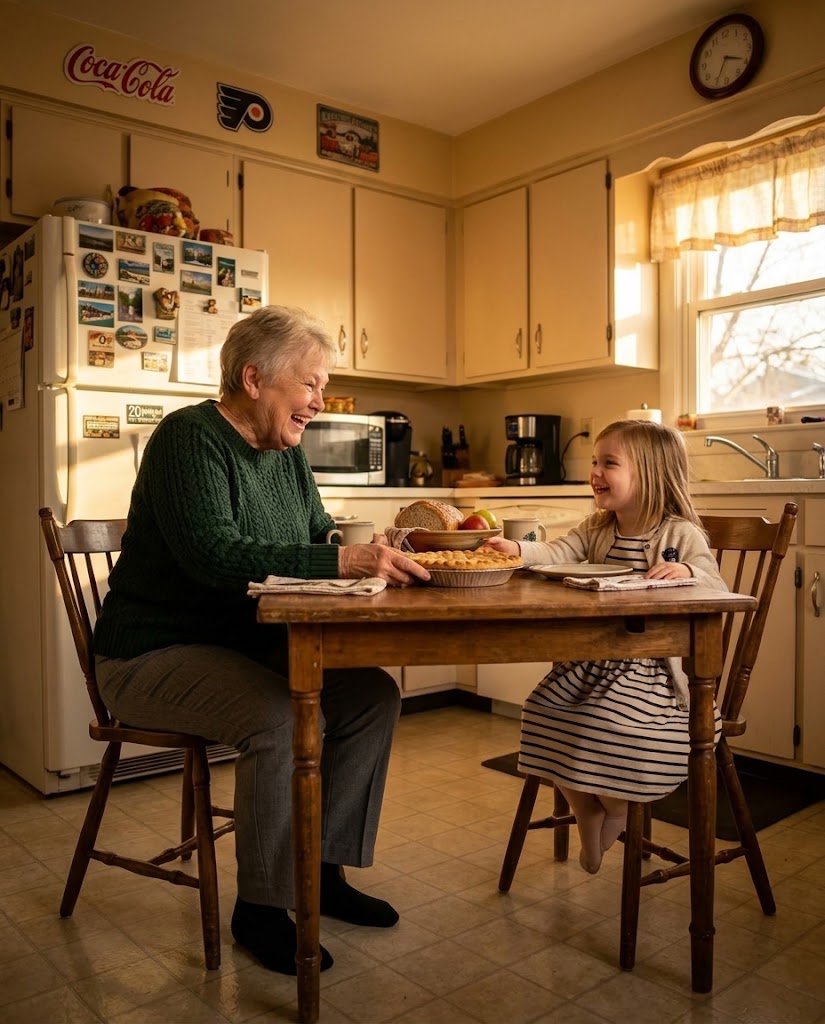
“Where’s my sandwich?” my ten-year-old daughter asked, staring at the bowl my mother had placed in front of her. The kitchen smelled of toasted bread and fresh coffee, and on the table sat two plates piled with turkey sandwiches, chips, and pickles—one for me and one for Grandma. Mia’s lunch contained only lettuce, six cucumber slices, and half a tomato. My mother smiled and explained that her granddaughter needed something healthier, as though serving a growing child a few leaves while everyone else ate lunch was perfectly reasonable. I picked up the bowl, opened the refrigerator, and began making Mia the same sandwich we were eating. Behind me, my mother complained that I was undermining her authority, but I barely heard her because Mia had asked, in a tiny voice, whether she’d done something wrong. When I turned around, she was pulling her shirt away from her stomach, and I recognized the movement immediately. I’d done the same thing at her age, standing in front of my own mother and wondering whether my body was something I should apologize for.
My name is Rachel, and I was thirty-eight that summer, raising Mia with a determination to give her some of the freedom around food and appearance that I hadn’t experienced as a child. Every year, we drove four hours to spend two weeks at my mother’s house, a place with a swimming pool, an enormous backyard, and a creek beyond the garden. My father had died four years earlier, but we continued visiting because those summers were among Mia’s happiest memories. She loved swimming until her fingers wrinkled, collecting stones from the creek, and helping Grandma make pancakes on a griddle she insisted was large enough to feed an army. During the drive, she’d talked almost nonstop about whether my mother still had chocolate chips and blueberries, and whether she could put both in her pancakes. I told her that sounded illegal, and she laughed because she knew Grandma had always allowed it. When we arrived, my mother, Margaret, came outside before I’d finished parking. Mia jumped from the car and ran toward her, calling her name. But instead of greeting her granddaughter warmly, Mom stopped and looked her over, her eyes moving from Mia’s face to her shoulders and stomach. Then she laughed and called her a “little piggy,” remarking on how much she’d filled out since their last visit. Mia’s smile disappeared. I told Mom to stop, but she dismissed my objection as oversensitivity and announced that two weeks with Grandma would help Mia lose some weight. Upstairs, as I unpacked, Mia sat quietly on the guest bed and asked whether she was fat. She was ten years old, an active child whose growth and health were matters for her pediatrician, not her grandmother’s casual inspection. I told her that bodies changed as children grew and that no one had the right to embarrass her about hers. Still, I recognized how much my mother’s words had hurt. Margaret had spent my childhood treating food and appearance as subjects open to constant correction. At thirteen, she questioned whether I needed second helpings. At fifteen, she told me a skirt had looked better before I’d gained a few pounds. Before my school prom, she advised me to stand sideways in photographs to make my waist appear smaller. She called those remarks honesty or concern, and for years I believed she was helping me. I could still recall the feeling of pinching fabric away from my stomach when someone commented on my size. I didn’t want Mia growing up with that habit. When my mother served the unequal lunches, I made my daughter a turkey-and-cheese sandwich with chips and told her plainly that she’d done nothing wrong. Margaret said I was making a mistake. I reminded her that Mia hadn’t asked for dietary advice and that we weren’t going to discuss her body at the table. For a brief moment, the subject seemed settled. Then Mom announced a new house rule: no sweets between meals, no second helpings at dinner, and nothing to eat after seven in the evening. Mia stopped chewing and asked whether the rule applied to everyone. Mom said it did, although cookies sat beside her own coffee cup. When I pointed them out, she claimed they were an exception because she’d already put them on her plate. After lunch, Mia retreated upstairs, and Mom followed me into the kitchen to accuse me of undermining her. She insisted she was preventing a future problem because Mia was gaining too much weight. When I asked who had determined that, she said she could see it with her own eyes. I told her she wasn’t Mia’s pediatrician, but she replied that she didn’t need a medical degree to recognize when a child should eat less. Then she used the same sentence she’d repeated throughout my childhood: one day Mia would thank her. I knew from experience how easily such remarks could settle into a child’s thoughts and remain there for decades. Rather than argue in circles, I sent two messages to people who knew our family history and might be willing to help me establish a boundary my mother couldn’t dismiss as a disagreement between the two of us. That evening, Mia told me she wanted to leave the next morning because she didn’t want Grandma watching her eat. Hearing that frightened me more than the insult itself. A child who had spent four hours dreaming about pancakes was now afraid to sit at her grandmother’s table. I promised Mia she wouldn’t have to remain somewhere she felt ashamed or unsafe, and that we’d address the problem before deciding whether to stay.
The next morning, the doorbell rang while Margaret was making coffee. I opened it to find my older sister, Megan, carrying grocery bags, with our aunt Carol—Mom’s younger sister—right behind her. I’d asked them to come for breakfast because I needed my mother to hear from more than one person that controlling a child’s food wasn’t an acceptable family tradition. Megan unloaded eggs, bacon, fruit, pancake mix, blueberries, and chocolate chips. Mia appeared at the bottom of the stairs and brightened when she saw the ingredients. Mom, however, pulled me aside and reminded me of her new rule. Before I could respond, Carol asked which rule she meant. I explained it, including the restrictions on sweets, second helpings, and evening food. Megan asked whether they applied to everyone, and Mom became irritated. Then, trying to defend herself, she said the rules were supposed to be about Mia. The kitchen went quiet. My sister slowly put down the spatula, and Carol looked toward our mother. Margaret insisted she wasn’t starving anyone; she simply thought Mia needed to lose a little weight. Megan reminded her that Mia was ten. Then Aunt Carol asked whether Mom remembered putting me on grapefruit diets when I was young. Margaret stiffened, saying the past wasn’t relevant. Carol disagreed. Megan quietly added that she hadn’t escaped our mother’s criticism either. Once, Margaret had told her she’d have a pretty face if she stopped eating so much. Mom looked genuinely surprised and said she didn’t remember making the remark. Megan answered that she remembered it perfectly. I could see my mother beginning to understand how differently those moments had lived in the memories of the people who received them. But I didn’t want breakfast to become a trial in which Mia had to listen to adults catalog every hurtful thing they’d heard about their bodies. I asked my sister to finish the pancakes while I explained the boundary clearly. We were not going to comment on Mia’s weight, monitor her portions, withhold food as punishment, or tell her she’d earned or forfeited dessert. Ordinary house rules about wet towels, muddy shoes, or bedtime were Margaret’s to make. Restrictions imposed specifically because she disapproved of my daughter’s body were not. I told her we would leave if those comments continued. She asked whether I’d really drive four hours home over what she considered a joke. I explained that the joke had already made Mia question her body and ask to leave a holiday she’d spent months anticipating. Margaret looked toward the staircase, where her granddaughter stood listening, and for once she didn’t argue. We ate breakfast together, though the atmosphere remained uncomfortable. Mia asked for another pancake, and Mom visibly caught herself before commenting. Later, I found her sitting alone on the porch. She motioned for me to join her and, after a long silence, told me that her own mother, Evelyn, had weighed her every Monday morning before breakfast. If she’d gained weight, Evelyn restricted what she was allowed to eat for the rest of the week. Margaret had been nine when the weighing began. I’d known my grandmother could be harsh, but I hadn’t understood how early those lessons had started. Mom said she’d always believed the routine helped her develop discipline, although she admitted she still couldn’t bear to keep a bathroom scale in her house. I asked whether she recognized that she’d been repeating the same fear with Mia. She stared across the garden and said that when Mia stepped out of the car, she’d heard her mother’s voice come out of her own mouth. She hadn’t understood the connection until our family breakfast. I told her that knowing where the behavior came from didn’t make it harmless, and she agreed. That evening, Margaret knocked on our guest-room door and asked Mia if she could come inside. She sat on the other bed, apologized for calling her a piggy, and admitted it had been cruel rather than funny. She also acknowledged that she shouldn’t have tried to control what Mia ate. My daughter looked up from her puzzle and asked whether Grandma still thought there was something wrong with her body. Margaret hesitated, then answered that there wasn’t. She explained, simply enough for a child to understand, that she’d grown up frightened of gaining weight because her own mother treated it as something shameful. Mia listened and said that sounded sad. Then she added, quite firmly, “So don’t do it to me.” Mom’s eyes filled, and she promised she’d try. I was relieved, but I didn’t treat the apology as permission to forget what had happened. Margaret had been repeating those habits for much of her life, and I knew changing them would require more than one emotional conversation. The real question was whether she could stop herself the next time Mia reached for another helping and nobody was there to remind her what she’d promised.
Three days later, we found out. During dinner, Mia reached for another roll, and Margaret began asking whether she was sure she needed it. She stopped halfway through the sentence, glanced at me, and corrected herself by asking whether Mia could reach the butter. Mia raised an eyebrow and told her it was a nice save. Everyone laughed, including Margaret, who looked both embarrassed and relieved. It wasn’t a flawless moment, but it was an important one: she had noticed the familiar judgment before completing it and chosen a different response. Over the following days, pancakes returned to the breakfast table, along with blueberries and chocolate chips. Mom stopped counting how many Mia ate and began asking whether she wanted help pouring the batter or turning the pancakes when the edges bubbled. My daughter gradually relaxed. She went swimming again, collected stones from the creek, and stopped watching Grandma’s face whenever food appeared. We spent time together doing ordinary things rather than making every meal an argument. Megan and Carol visited again before we left, and we talked privately about the ways food had been used in our family as a measure of discipline, beauty, and personal worth. My sister’s experience was different from mine, but both of us carried remarks Margaret claimed not to remember. Carol recalled similar comments from Evelyn when they were growing up. The discussion helped our mother see that the pattern extended beyond one thoughtless insult in the driveway. Still, I made it clear that I wasn’t appointing the family as a committee to supervise every bite anyone took. Mia deserved meals without scrutiny, not a new group of adults discussing her health in front of her. If genuine concerns arose about her growth or nutrition, I would address them privately with her pediatrician, taking into account her development rather than anyone’s opinion of how she looked in a T-shirt. I also spoke with Mia about what had happened. I told her she never needed to earn food by exercising, change her body to please a relative, or pretend she wasn’t hungry to make someone else comfortable. I asked whether she wanted to continue our visit, and she said she did, provided Grandma kept her promise. That condition seemed fair to me. Margaret accepted it without complaint. On our last morning, she made the pancakes herself. Mia helped scatter chocolate chips into the batter and added blueberries to her plate. When she’d finished eating, Grandma offered her more fruit without commenting on portions. As we packed the car, Mia ran back to hug her and asked whether we could stay three weeks the following summer. Margaret laughed and said we’d have to see whether I could tolerate her that long. I told her we’d review her performance, and she rolled her eyes, but there was affection in the exchange rather than the tension we’d felt on our first day. Before we left, she handed me a folded sheet of paper and asked me to read it later. Twenty minutes down the road, I stopped for gas and opened it. At the top she’d written, “Things My Mother Said That I Will Not Say to Mia.” Beneath were nine familiar phrases, including questions about whether someone had eaten enough, remarks suggesting a girl would be prettier if she lost weight, and the claim that nothing tasted as good as being thin. Some were things Margaret had said to me; others I’d never heard before. At the bottom she wrote that she’d spent years believing she was different from Evelyn because she’d rejected the most severe parts of her upbringing. She hadn’t realized how many of her mother’s words she’d continued to use. She ended with an apology. I folded the page and put it in my purse. I didn’t consider it a complete solution, but it was the first time I could remember my mother writing down her own behavior without defending it as concern. A month after our visit, Mia video-called her while eating a bowl of cookie-dough ice cream. Margaret asked what flavor it was and said it sounded delicious. Mia paused, narrowed her eyes, and asked whether that was all Grandma had to say. Margaret smiled and told her it was. Then Mia took an enormous spoonful while looking directly into the camera, and Mom laughed so hard she had to remove her glasses. I watched the exchange from the kitchen and felt something ease inside me. Mia wasn’t looking for approval about what she was eating. She was testing whether Grandma’s promise still held, and this time it did.
I haven’t forgotten the way Mia stood beside that first bowl of lettuce, waiting for someone to explain why her lunch was different from ours. What stays with me most isn’t the food itself, although it was an inadequate meal for a hungry child. It’s the question she asked while I was making her sandwich: had she done something wrong? At ten, she’d already begun connecting the way adults treated her with the shape of her body. I knew how quickly that connection could become a habit because I’d spent years making it myself. My mother hadn’t thought of her comments as cruelty. She believed she was offering guidance, perhaps the same sort of protection she’d wanted when she was young and being weighed before breakfast. That history explains some of her fear, but it doesn’t give her permission to pass it on. I’m glad she was willing to hear that distinction, and I’m glad Mia didn’t have to become responsible for changing her grandmother. The adults spoke, set boundaries, and made the practical decisions about our visit. Mia only needed to tell us how she felt. Since that summer, Margaret has occasionally caught herself before making a familiar remark, and I can tell the effort isn’t always easy. But she has kept the written list she made, and our conversations are no longer centered on defending what she said. They’re about what she wants to do differently. I still have the paper in a drawer at home. Every so often I take it out and recognize a sentence I once heard so often that it seemed ordinary. Then I think of Mia at Grandma’s griddle, waiting for the edges of her pancake to turn golden before flipping it. On our most recent visit, she added blueberries and chocolate chips, announced that her creation looked like a disaster, and ate it laughing. Margaret sat beside her with a cup of coffee and asked whether she’d saved enough batter to make one for Grandma. Mia grinned and reached for the ladle. Nobody counted the pancakes.

