
“We’re selling.” My mother slid a printed real-estate listing across the kitchen table as if she were presenting a property to one of her clients instead of telling me to leave the farmhouse where my grandmother had died. The asking price—$385,000—was handwritten in the margin, along with an open-house time for Saturday morning. Curt, my stepfather, poured coffee without looking at me, while my half-sister Presley filmed her cup for social media beneath a caption that read Morning routines. “You can stay with a friend while it closes,” Mom said. “Sixty days. Maybe less.” I stood beneath the faded yellow wallpaper Nana Evelyn had chosen decades earlier and realized that nobody at that table seemed to think my opinion mattered. So instead of arguing, I went upstairs and took down the quilted pouch my grandmother had pressed into my hands shortly before she died, telling me only, “Keep this. You’ll know when.”
Evelyn Summers had lived on Mill Creek Road for forty-one years, planted the magnolia out front, refinished the pine floors herself, and saved tomato seeds each fall in brown envelopes labeled in careful cursive. My mother moved into the farmhouse years before Nana’s death and often described herself as the daughter who had sacrificed everything to care for her, although Nana remained independent far longer than that story suggested. I had grown up inside a different family arithmetic: Presley received cars, braces, trips, and financial help, while I worked weekends through high school, paid my own way through community college, and learned early not to expect the same things. Nana noticed more than she ever said. Three weeks before she died, she gripped my wrist in the hospital and gave me the pouch. When I finally opened it in a gas-station parking lot that Tuesday morning, I found a brass key, attorney Arthur Finley’s business card, and a letter telling me that if I was reading it, my mother had probably done exactly what Nana feared. “Everything is already done,” she had written. “Don’t explain yourself. Just go.”
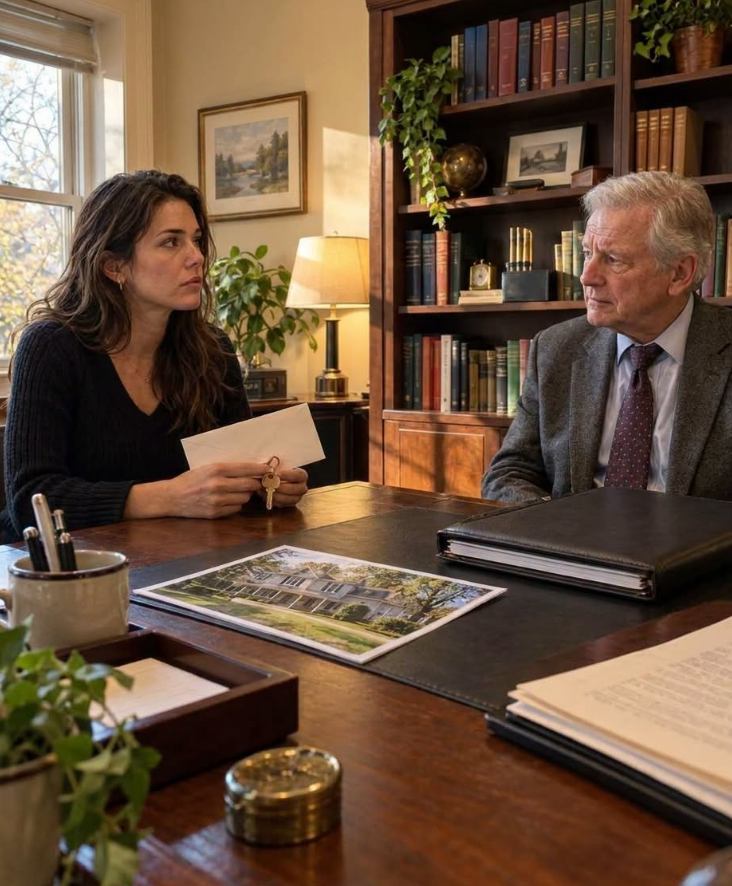
Arthur Finley had been waiting nine years for me to walk into his office. He explained that when I was twenty-five, Nana created the Evelyn Summers Revocable Living Trust and transferred the farmhouse into it. She remained in control while alive, but I was named sole beneficiary, and after her death the trust terms placed title in my name outside the ordinary probate process. My mother knew a trust existed but had never been told who would ultimately receive the house. After Nana died, she challenged the arrangement more than once, alleging that Evelyn had lacked capacity, but Nana had anticipated that too: her physician had documented her mental competency at the time the trust was executed, and her longtime accountant confirmed she was still managing her finances independently. Then Arthur showed me the online listing. My mother, a licensed real-estate agent, had listed a property she did not own. The house I had just been ordered to leave had legally belonged to me for two years.
Arthur did not promise a dramatic overnight eviction, and neither did I want one. He filed the appropriate action to recover possession from occupants who had no ownership interest or lease giving them the right to sell or remain indefinitely, while separately referring the unauthorized listing to my mother’s brokerage and the state real-estate regulator. The recorded deed and trust documents mattered more than anyone’s version of family history. Several weeks later, possession was formally returned to me, and I watched my mother and Curt load the last of their boxes into his truck. She paused once beside the tailgate and said, “This isn’t what Evelyn would have wanted.” I let the sentence pass without answering because Nana had already answered it herself nine years earlier in witnessed, notarized documents. Inside the farmhouse, nothing looked victorious. The pine floors were worn, the wallpaper was faded, the water heater was failing, and the tomato beds needed attention. But the house was mine, and for the first time in my life, being given something did not come with an explanation for why someone else deserved more.
That evening I opened every window and sat on Nana’s back porch with a cup of chamomile tea while the field darkened beyond the fence. At dusk, the porch light clicked on by itself. Arthur had given me the current keys, but I still carried Nana’s little brass one in my coat pocket even though it no longer fit any lock. In her final letter, she explained why she had left it: not because it still opened a door, but because she wanted me to understand that she had always planned for me to have one. Months later, I kept the yellow wallpaper, hung pale-blue curtains in the kitchen, repaired the roof, and planted seeds from envelopes Nana had saved years before. Presley eventually apologized for filming our family’s unraveling, and I answered only when I was ready. My mother continued telling people a different version of what happened, but I stopped correcting it. The documents already said enough. Some evenings I sit beneath that porch light with the old brass key in my pocket and think about how quietly Nana protected me. She never stood at the kitchen table demanding anyone choose me. She simply made certain that when the day came, there would still be a door I could walk through.