
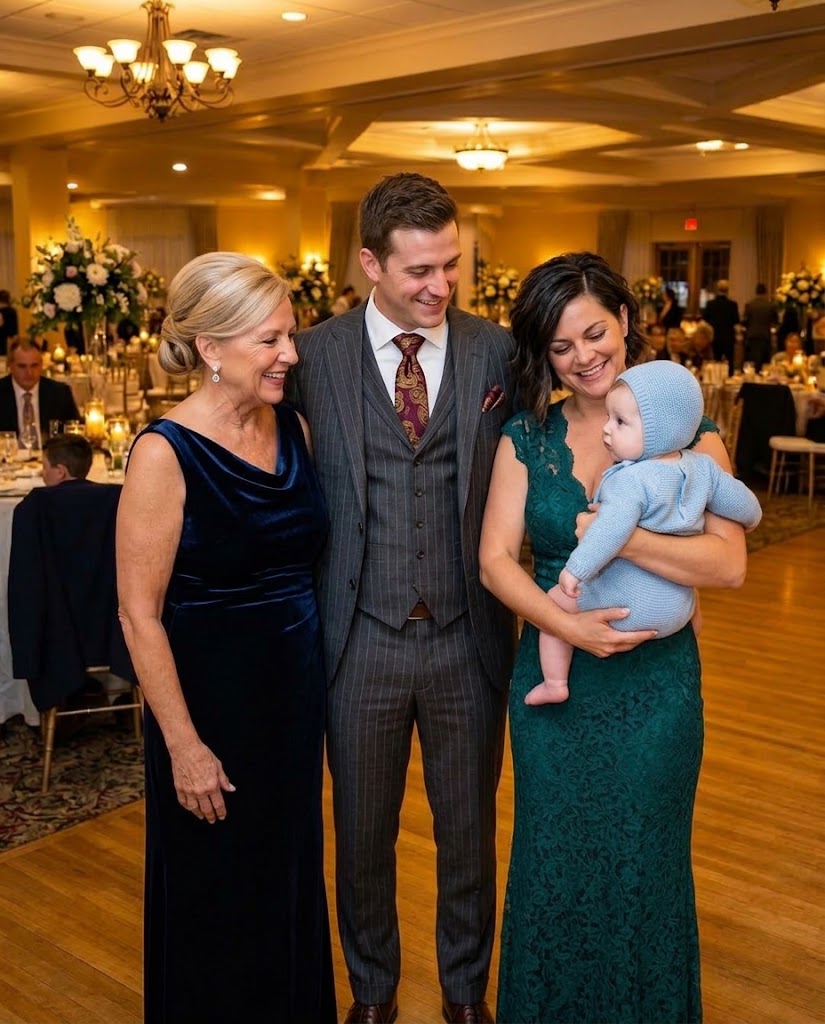
“Maybe it’s finally time you lost some weight, Jenna,” my mother-in-law announced, loud enough for the people gathered around us to hear. Crystal chandeliers glittered above the dining room of Le Château, where 150 guests had come to celebrate Clara and Philip Ward’s fortieth wedding anniversary, and the air smelled of white roses, expensive perfume, and freshly poured champagne. Clara stood before me in a dazzling silver gown, examining the midnight-blue wrap dress I’d bought after discovering that the designer dress she’d sent me was four sizes too small. Five months earlier, I’d given birth to my daughter through an emergency cesarean section, and I was still learning to feel comfortable in a body that had carried her through a difficult pregnancy. My husband, Ryan, stood beside me in his tuxedo, staring at the floor while his mother suggested that I wasn’t making enough effort to remain attractive to him. I felt the familiar heat of humiliation climb into my cheeks, excused myself, and hurried toward the marble restroom, where I sat trembling in a locked stall. Then a scream cut through the music, followed by Clara’s unmistakable voice demanding to know whether someone understood who she was. When I returned to the dining room, two police officers were standing beside my mother-in-law, and Detective Anita Shah was holding a folder that would finally explain why my credit had been ruined, why we couldn’t buy our first home, and why Clara had purchased an $1,840 dress that could never have fit me.
My name is Jenna Ward, and I was thirty-two when the anniversary party turned our family upside down. I grew up in Mineola, a small East Texas town where my father drove a feed truck and my mother worked at Dollar General. I attended Texas A&M with the help of scholarships and student loans, eventually becoming a speech therapist specializing in children with communication difficulties. I loved my work, particularly the moments when a child who had struggled for months finally managed to say something clearly enough to be understood. Clara always referred to it as my “little job,” a phrase she delivered with a pleasant smile that made it difficult to object without appearing oversensitive. Her son, Ryan, and I met eight years earlier at a wedding in Austin. I was wearing an unfortunate peach bridesmaid’s dress, he was in a rented tuxedo, and he accidentally spilled red wine down my front during the toast. We spent twenty minutes trying to remove the stain with club soda, laughing so hard that neither of us cared when it refused to disappear. We married two years later, and for six years I tried to persuade myself that Clara’s disapproval was something I could tolerate for the sake of family harmony. She was sixty-four, impeccably dressed, and accustomed to a life of extravagant parties, salon appointments, and carefully maintained appearances. Her husband, Philip, owned Ward Building Group, a Dallas commercial construction company that had provided them with a grand home in University Park, complete with imposing columns, a fountain, and a swimming pool. Clara believed everything reflected on the family, from clothing and table settings to the people her children married. The first time Ryan brought me to Sunday brunch, she surveyed my sundress and sandals and remarked that I looked “healthy,” stretching the word until I understood it wasn’t a compliment. She criticized my cooking, my housekeeping, my clothes, and eventually my profession. At our wedding reception, she told guests that Ryan could have married anyone, then paused meaningfully before announcing that he’d chosen me. People laughed because they thought she was joking. I knew she wasn’t. Her comments grew worse after I became pregnant. At five months, she asked whether I was sure there was only one baby. At Christmas, she warned that eating for two didn’t mean eating for five. By the eighth month, when walking across a room could exhaust me, she was recommending a personal trainer and cautioning that husbands sometimes lost interest when their wives didn’t regain their figures quickly. I gained forty-one pounds during the pregnancy. Hazel arrived three weeks early after nineteen hours of labor and an emergency C-section, weighing seven pounds and nine ounces, with dark hair and a determined little grip. She was the most beautiful thing I’d ever seen. Yet when Clara visited the hospital, she seemed more interested in photographing her granddaughter for social media than in asking how I was recovering. Before leaving, she reminded me that the hard work of getting my body back was only beginning. Five months later, I’d lost eleven pounds and was still breastfeeding, recovering from surgery, and waking repeatedly at night. I wore a size ten or twelve instead of my former ten, and Clara’s remarks had begun to follow me even when she wasn’t present. I’d stand before the bathroom mirror studying my stretch marks and the still-pink line of my incision, hearing her voice telling me Ryan deserved someone more attractive. My husband was loving and attentive at home. He changed diapers, cooked meals, did laundry, held Hazel while I rested, and told me I was beautiful. But he almost never challenged his mother directly. Whenever she made a hurtful remark, he asked me to ignore it because confronting her would only create an argument. I tried to accept that explanation until Clara announced plans for her fortieth wedding anniversary celebration. The party would be held at Le Château, an expensive French restaurant near Frisco, with a formal dress code requiring women to wear black or midnight blue. I struggled to find something I liked, and when Clara called to say she’d already ordered a gown for me, I briefly wondered whether she was finally making an effort to be kind. The box contained a magnificent midnight-blue silk dress with pearl buttons down the back and a designer label I’d only seen in magazines. It was a size two. I had never been a size two, even before becoming pregnant. When I called Clara to explain the obvious mistake, she laughed and said there had been no mistake. The party was two weeks away, she told me, which should provide enough motivation to lose weight. When I reminded her I’d recently had abdominal surgery, she dismissed it as an excuse and suggested I stop eating so much. After the call, I sat on the edge of our bed staring at the dress, trying not to cry while Hazel fussed in her crib. Ryan was appalled when he saw the size label, but once again he asked me not to confront his mother before the anniversary. We went shopping together instead, and I found a soft midnight-blue wrap dress that fit comfortably. It cost $220 on sale. When I stepped out of the fitting room, Ryan was standing with Hazel asleep against his chest, and the expression on his face made me feel beautiful for the first time in months. I bought the dress and put Clara’s gift back into its box. Before closing it, however, I glanced at the packing slip. The gown had come from Maison Lune Boutique in Highland Park, with a listed price of $1,840. The billing name was printed as J. Ward. Clara’s initials weren’t J. W., but mine were. I noticed the discrepancy, wondered whether it was a clerical error, and put the box on the closet shelf. It wasn’t until the anniversary party that I understood why that small detail mattered.
The mystery had actually begun months earlier, when Ryan and I tried to purchase our first home. We’d spent six years saving for a down payment while living in a small rented house in Lakewood. Once Hazel arrived, the two bedrooms felt crowded, with her crib in ours and the laundry appliances squeezed into a kitchen closet. In March, we visited a mortgage broker named Priya at a bank in Uptown Dallas. She reviewed our income, debt obligations, and credit histories, then studied her computer screen for an unusually long time. Finally, she asked whether I’d opened three credit cards and a personal line of credit during the previous eighteen months. I told her I hadn’t. I’d used the same Discover card since college and hadn’t applied for any new borrowing. Priya turned the monitor toward me. It showed a Capital One account with a $14,200 balance, a Chase account with $18,900, an American Express account with $11,400, and a $22,000 personal line of credit. All four accounts appeared under my full name, Jenna Marie Ward, using my Social Security number and date of birth. The outstanding balances totaled $66,500, and my credit score had fallen from 791 to 588. The bank couldn’t approve our mortgage application under those circumstances. Ryan and I sat in the parking garage afterward, stunned that someone had apparently stolen my identity and used it to incur tens of thousands of dollars in debt. Over the following weeks, I contacted the creditors, disputed the accounts, froze my credit files with the major reporting agencies, and filed an identity theft report with the Federal Trade Commission. The statements were being sent to a private mailbox at a UPS Store in Highland Park, identified as Box 1147. I eventually reported the matter to Dallas police and met Detective Anita Shah, who explained that investigators would need records from the creditors and mailbox provider to establish who had opened and used the accounts. She asked whether anyone outside my immediate household had ever received copies of my identification and financial documents. At first, I couldn’t think of anyone. Then I remembered a family dinner nearly two years earlier, when Clara and Philip had offered to contribute $20,000 toward our future house down payment. Clara said the lender would require paperwork for a family gift and asked for copies of our driver’s licenses, Social Security cards, and recent tax returns. Ryan and I had given her an envelope containing everything she requested. The promised contribution never materialized. When Ryan asked about it later, Clara said the market wasn’t favorable and Philip’s company was having a difficult year. I told Detective Shah about that envelope, though I still couldn’t imagine that my wealthy mother-in-law would need to steal from me. The investigation continued while I fought to have the fraudulent accounts removed from my credit reports. As the weeks passed, the creditors began making corrections, and my score gradually improved. Meanwhile, I kept attending family dinners where Clara criticized my body and compared me unfavorably with women she considered more suitable for her son. The evening of the anniversary party, I arrived wearing the wrap dress I’d chosen myself. Clara, who had required every other woman to wear black or midnight blue, appeared in a glittering silver gown that made her the center of attention. After she publicly mocked my appearance and Ryan failed to defend me, I retreated to the restroom, thinking about the example I wanted to set for Hazel. I imagined my daughter growing into a teenager who examined herself in the mirror and heard someone telling her she wasn’t good enough. I knew I would never tolerate anyone speaking to her the way Clara spoke to me. Then I heard the shouting. When I returned, Detective Shah was standing beside two officers near the anniversary cake, announcing that Clara was being arrested in connection with the identity theft investigation. The private mailbox had been traced to her, and financial records connected her to transactions made using the fraudulent accounts. According to the detective, the disputed credit lines had funded clothing, personal expenses, club costs, and charges associated with the anniversary celebration itself. A $12,000 event deposit had been charged to the fraudulent American Express account, and a further $18,000 payment had been declined after the account was flagged. The investigators also identified the $1,840 Maison Lune purchase on the Capital One account. I remembered the silk dress, the pearl buttons, and the packing slip bearing my name. Clara hadn’t merely bought me a deliberately undersized gown as an insult. She had purchased it using credit obtained through my stolen identity, damaging our ability to buy a home while accusing me of not measuring up to her standards. When I asked why she would do such a thing despite her apparent wealth, Philip finally spoke. Ward Building Group had been struggling financially for years, he said, and had entered Chapter 11 bankruptcy proceedings. Major contracts had fallen through, debts had accumulated, and he had sold assets, borrowed against their home, and depleted retirement savings in an attempt to stabilize the business. He’d told Clara that their lavish lifestyle had to change, but she’d continued spending and concealed the source of the money. She’d claimed her sister was paying for the anniversary party. Philip looked around at the chandeliers, the guests, and the enormous cake, realizing that the celebration itself had been financed through the identity theft. Ryan stood beside me, shaken. For the first time in six years, he confronted his mother openly, asking whether she’d used the documents we’d entrusted to her to destroy my credit and then humiliate me with a dress purchased in my own name. She couldn’t offer a convincing denial. Ryan turned toward me and apologized for remaining silent through years of insults. He said he had confused avoiding conflict with protecting his family and had left me facing his mother’s cruelty alone. As officers escorted Clara from the restaurant, her silver gown flashing beneath the lights, I watched the people who’d spent the evening admiring her turn away. Yet even as I felt relief that the truth had emerged, I found myself wondering what could make a woman so desperate to appear perfect that she’d risk losing everything to preserve the illusion.
The party ended almost immediately. Guests left quietly, the musicians packed away their instruments, and the anniversary cake stood largely untouched. Philip remained at the head table, overwhelmed by what he’d learned about his wife and the damage done to our family. I sat beside him for a few minutes before Ryan and I left. He apologized for failing to notice how Clara treated me and for accepting her explanation about the party expenses without investigating further. He also told me something about her childhood that helped explain, though not excuse, her fixation on appearances. Clara’s mother, Evelyn, had been a beauty queen and had begun controlling her daughter’s food when Clara was eight. According to Philip, Evelyn weighed her every morning and withheld breakfast if the scale showed an increase. She repeatedly told Clara that remaining thin was the only way to secure a husband and maintain a respectable life. For Clara’s sixteenth birthday, her mother bought her a dress two sizes too small and told her it would provide the motivation she needed to lose weight. Philip recognized the exact language Clara had used with me. For more than half a century, she’d equated thinness, wealth, and public admiration with personal worth. She avoided desserts, maintained rigid beauty routines, and treated any sign of aging or financial difficulty as a threat to her identity. None of that justified stealing my information or humiliating me after childbirth, but it gave me a clearer understanding of the fear beneath her cruelty. Clara was released on bail, and the criminal case proceeded over the following months. Prosecutors pursued charges involving identity theft and fraudulent credit use, and the investigation examined approximately $96,000 in disputed and attempted transactions, including charges related to the anniversary event. Some amounts had been posted as debts, while others, such as the declined restaurant payment, had never been successfully collected. I continued cooperating with the creditors’ fraud departments so the unauthorized accounts and balances could be removed from my records, understanding that restitution, credit corrections, and criminal penalties were separate matters. Clara’s attorney eventually negotiated a plea agreement. She pleaded guilty to an identity theft charge and received probation, community service, and restitution obligations. At my request, the proposed resolution also included regular treatment with a licensed psychologist experienced in disordered eating and body-image difficulties. The legal decision belonged to the court, but I hoped therapy might interrupt the pattern of humiliation Clara had endured as a child and then inflicted on me. Philip sold their University Park house to help satisfy the financial obligations, and he and Clara moved into a modest condominium in Richardson. Their former lifestyle disappeared along with the elaborate parties, designer shopping trips, and appearance of limitless wealth. Ryan and I remained cautious. He limited contact with his mother, and we agreed that she wouldn’t be allowed to make comments about my body or Hazel’s appearance if she wished to remain part of our lives. His apology at Le Château had been meaningful, but I needed to see him maintain those boundaries when there wasn’t a room full of witnesses. He did. When Clara attempted to explain away her past comments as harmless teasing during one telephone conversation, Ryan told her plainly that they had been hurtful and would not continue. Meanwhile, my credit disputes were gradually resolved. After the fraudulent accounts were removed, my score recovered enough for us to return to Priya and apply for a mortgage again. We were approved and purchased a three-bedroom house in Lake Highlands, with two bathrooms, a backyard shaded by a live oak, and a nursery for Hazel painted a cheerful yellow. I stood in that empty nursery the day we received the keys, watching my daughter crawl across the floor as though exploring every corner of her new world. Ryan sat beside me and admitted he’d begun to think we’d never reach this moment. We still had a mortgage to pay and a household to furnish, but the house belonged to us, acquired through our own savings and an application that finally reflected our actual financial circumstances. A few months after we moved, Clara asked to meet me privately. I agreed to see her at a small coffee shop in Richardson, partly because I wanted to understand whether the court proceedings and therapy had changed anything. She arrived wearing jeans and a plain gray sweater, her hair pulled back without the elaborate styling I remembered. In front of her stood a cup of black coffee and a partially eaten blueberry muffin. She admitted that ordering it had been difficult. Her therapist was helping her challenge food rules she’d followed since childhood, and eating a pastry in public was an exercise she’d never imagined needing at sixty-four. She said she’d spent years believing that a woman’s body was something other people had the right to judge and control. When I first joined the family, she explained, I had seemed comfortable laughing, eating, and being loved without meeting the standards Evelyn imposed on her. Clara found that threatening because it challenged everything she’d spent her life believing. Her financial fraud came from a similar fear of being exposed. Once Philip told her they could no longer afford their old lifestyle, she couldn’t tolerate the thought of acquaintances seeing that their wealth had diminished. Rather than accept the changes, she used my identity to keep buying the things she thought proved her value. She apologized without asking me to overlook the harm. Then she placed a flat white box on the table. Inside was the midnight-blue silk gown she’d originally sent me, transformed beyond recognition. After I’d returned it to her, she’d taken it to a seamstress named Rosa in Garland, who carefully opened the seams and remade the fabric into a tiny dress for Hazel. It had puffed sleeves, a round collar, and six pearl buttons down the back. Clara had enclosed a handwritten card for her granddaughter’s first birthday, explaining that the dress would someday become too small because Hazel was growing, not because there was anything wrong with her body. She promised never to criticize Hazel’s size or teach her that love depended on looking a particular way. I accepted the gift, but I told Clara that one apology couldn’t erase six years of unkindness or the financial harm she’d caused. She understood. We arranged a supervised visit with Hazel several weeks later, and Clara spent the afternoon playing with her granddaughter without once mentioning weight, clothes sizes, or appearances. At Hazel’s first birthday party, she wore the little midnight-blue dress. She spilled juice on it, smeared frosting across the silk, and laughed while grabbing pieces of cake in her hands. Clara laughed too. Then, to everyone’s surprise, she picked up a fork and took a small bite of the birthday cake herself. Philip rested an arm around her shoulders, and Ryan reached for my hand. Nobody made a speech or treated the moment as proof that everything was fixed, but I could see how difficult that simple act had been for her.
Hazel is older now, and the tiny midnight-blue dress hangs in her closet, carefully washed and preserved despite the frosting stains that never completely disappeared. Sometimes I take it out and remember standing in our bedroom after Clara’s first package arrived, trying desperately to pull a size-two gown over hips that had never been that small. I remember the shame I felt looking at my C-section scar, the stretch marks across my stomach, and the unfamiliar shape of my body five months after giving birth. Clara’s voice had become so persistent that I sometimes heard it in my own thoughts. Recovery from that kind of criticism hasn’t been instantaneous. There are still mornings when I catch myself studying the mirror more harshly than I would study anyone else, wondering whether my clothes fit properly or whether I look tired. But the voice is quieter now. I began walking regularly with Hazel in her stroller, sometimes circling White Rock Lake in the morning while the light spread across the water and birds gathered near the shore. I did it because I enjoyed the fresh air and the routine, not because I was trying to prove anything to Clara. My body has changed since childbirth, and it may change again. The stretch marks have faded, and the surgical scar is less noticeable than it once was, but neither is something I feel obligated to hide. When I look at Hazel, I want her to grow up seeing a mother who enjoys being alive rather than one who measures her worth against an impossible standard. That doesn’t mean pretending appearance never matters or that everyone should feel confident every day. I simply want her to know that clothes are supposed to fit people, not the other way around, and that growing bodies aren’t problems requiring correction. Ryan and I have also changed the way we handle difficult conversations with his family. For years, he believed that remaining quiet when his mother insulted me prevented conflict. In reality, his silence left me absorbing the damage and taught Clara that she could continue without consequences. His public apology at the restaurant was important, but what mattered afterward was his willingness to speak up in ordinary situations, when there was no detective, no audience, and no dramatic reason to take a stand. We now discuss boundaries before family gatherings and support one another when something needs to be said. Philip has become more involved as well. He continues to regret ignoring Clara’s comments for so long, and he acknowledges that protecting appearances was something both of them had done throughout their marriage. Their financial collapse forced difficult decisions that should have been made earlier, but the loss of the mansion and the parties has also brought greater honesty into their household. Clara’s therapy has continued beyond the period required by her probation. She’s spoken with us about the childhood rules that shaped her relationship with food, her mother’s constant weighing and criticism, and the fear she experienced whenever she felt she was losing control. I don’t know whether she’ll ever be completely free of those beliefs. She followed them for most of her life, and unlearning them has required more than a few appointments or an occasional slice of cake. But she has stopped making comments about my body, and she treats Hazel’s growth with delight rather than concern. At family celebrations, she sometimes eats dessert. Philip watches quietly, aware that an ordinary piece of pie represents a decision she once would have found frightening. I’m careful not to turn her progress into another standard she must satisfy for my approval. She doesn’t need to perform recovery any more than I need to perform thinness. We can acknowledge improvement without pretending the past has vanished. I still have moments when being around Clara is difficult. Her humiliation of me at the anniversary party remains vivid, as does the discovery that she’d used the identity documents I entrusted to her to create debts in my name. Her difficult childhood helps me understand her behavior, but it doesn’t make what she did acceptable. I haven’t forgotten the weeks spent contacting creditors, the mortgage application we lost, or the fear that someone could misuse my personal information so easily. I keep my documents secure now, monitor my credit reports, and am far more cautious about sharing identification, even with relatives. Family trust should never require surrendering control of sensitive information without understanding why it’s needed. The financial damage eventually became manageable, but the emotional damage took longer. I had to learn that being consistently insulted can alter the way a person sees herself, particularly during a vulnerable time like recovery from childbirth. I had spent years dismissing Clara’s remarks as the unfortunate habits of an older woman from a different background. It took the dress, the anniversary party, and the revelations that followed to make me understand how deeply those comments had affected me. I’m relieved Hazel will grow up knowing a grandmother who has begun questioning the beliefs she once treated as unquestionable truths. I don’t expect Clara to become a different person in every respect. She still enjoys beautiful clothes, pays attention to table settings, and sometimes worries more than necessary about what other people think. But she has started listening when someone challenges her assumptions, and she no longer measures the women around her against her own fears. On Hazel’s birthdays, she takes the little blue dress from the closet and holds it up beside her granddaughter, marveling at how much she’s grown since that first celebration. Hazel stretches out her arms, laughing, and Clara tells her how tall she’s getting. Nobody mentions sizes or diets. Nobody suggests she should become smaller. I stand nearby watching the dress that once made me feel ashamed of my body become an ordinary family keepsake, its delicate pearl buttons catching the light. The silk hasn’t changed, but the meaning of it has. I don’t know exactly what Hazel will think when she’s old enough to hear the full story. I hope she’ll understand that adults can make terrible choices, face consequences, and sometimes begin changing in ways they should have considered long before. Most of all, I hope she’ll never stand before a mirror wondering whether she deserves love because of the number printed inside a dress. For now, she simply laughs when her grandmother holds up the tiny gown, spreads her arms as wide as she can, and asks to see how much she’s grown. And Clara, who once believed that a woman had to make herself smaller to be worthy of love, smiles and tells her to keep growing.

