
My mother-in-law was receiving $1,200 every month to care for my husband’s ninety-one-year-old grandmother, but when I visited unexpectedly and discovered Grandma hiding in a back bedroom with her white hair badly tangled and unwashed for nearly three months, I thought I’d uncovered a terrible case of neglect—until a forty-year-old family secret revealed why she’d refused anyone’s help. It happened on a cold Monday afternoon in November. I had stopped by Darla’s house in Viroqua, Wisconsin, carrying a bag of cinnamon bread from the bakery beside my salon. Nobody answered the door, so I let myself in and walked toward Grandma Lorraine’s bedroom. When I knocked, she whispered, “Don’t come in, Nicole.” She hadn’t called me Nicole since my wedding seven years earlier. To her, I had always been Nicky. I opened the door a little and found her sitting in an old green recliner, holding one hand tightly against the top of her head. Her usually beautiful white curls were flat, greasy, and badly matted. A knot the size of a walnut had formed behind her left ear, and her scalp looked red and irritated. Grandma Lorraine had spent forty years running her own beauty salon, and she’d always taken enormous pride in her appearance. Now she wouldn’t even look at me. When I gently asked when she’d last washed her hair, she admitted she couldn’t remember. Her broken wrist made it impossible to lift both arms, and bending over the sink made her dizzy. She hadn’t attended church for seven weeks because she was ashamed to let anyone see her. I wanted to cry. Then I walked into Darla’s kitchen and asked why Grandma’s hair hadn’t been washed since August. Darla stopped stirring her pot of chili and said, “She won’t let me touch it. I’ve tried. And I’m not her maid.” I almost exploded. But then I noticed the medication organizer, the medical appointments covering the refrigerator, the neatly folded laundry, and the dark circles beneath Darla’s eyes. Something about this situation was far more complicated than I’d realized.
My name is Nicole, although Grandma Lorraine has called me Nicky for years. I’m a hairstylist in my early thirties, married to her grandson Joel, and I’ve owned a small salon on Main Street in Viroqua since 2016. What makes this story especially painful is that my salon was once Grandma Lorraine’s. She opened Lorraine’s Beauty Nook decades earlier, when women still visited beauty shops every Saturday for pin curls and weekly sets. She worked there for forty years before closing in 1998 to care for her husband Walter. When I bought the building, I didn’t know its history. Lorraine walked in before I’d even finished decorating, sat in my chair, and immediately began correcting my technique. She taught me how to set curls properly, protect a client’s forehead from shampoo, and make someone feel safe while their eyes were closed. She also introduced me to Joel, practically ordering him to ask me to dinner after I’d cut his hair. We’ve been family ever since. Last July, Grandma fell outside her home and broke her left wrist in two places. After hospitalization and rehabilitation, doctors said she couldn’t safely live alone. Joel and I offered our spare bedroom, but our apartment sits above the salon, and the steep staircase made it unsuitable. So she moved into Darla’s one-story house. Darla is sixty-two, works part-time at a convenience store, and has been married to Grandma’s son Ron for decades. The two women have never been close. For forty years, Lorraine criticized Darla’s cooking, housekeeping, and appearance, often in front of the entire family. When Grandma moved in, Darla became responsible for her daily care and managed her $1,640 monthly Social Security benefit as her representative payee. She allocated $1,200 toward room, board, and care, leaving the remaining $440 for other expenses. At first, I thought that was reasonable. Grandma had a warm room, food, medication, and transportation to appointments. But seeing the condition of her hair made me question whether she was receiving everything she needed. That evening, Joel was furious when I told him. He wanted to telephone his mother immediately. I asked him to wait because shouting wouldn’t solve anything, and Grandma would still need help washing her hair. Instead, I called Lorraine the following evening and told her I’d like to schedule an appointment. She protested that she wasn’t a charity case. “No, Grandma,” I answered. “You’re my two o’clock.” That had been her regular Saturday appointment for decades. After a long silence, she told me to bring the good setting lotion and a proper towel. Then she reminded me not to be late. For the first time in months, I heard the familiar authority return to her voice.
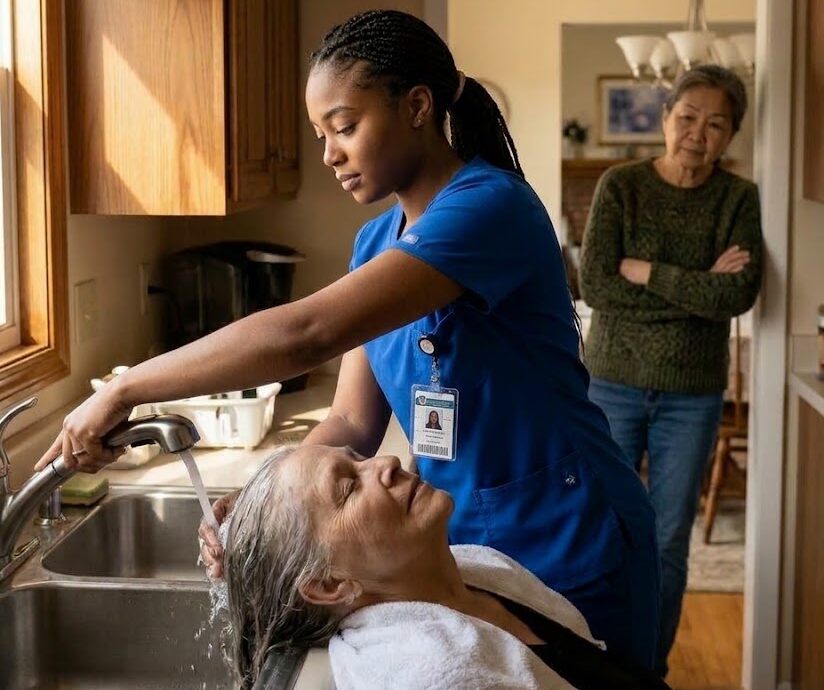
On Saturday, I packed my professional kit with gentle shampoo, conditioner, combs, setting lotion, seventy-four pin curl clips, a hairdryer, and three soft white towels. When I arrived at Darla’s house, she looked confused and asked why I’d brought so much equipment. “Grandma has an appointment,” I explained. “Two o’clock.” Lorraine appeared a few minutes later wearing her fifty-year-old lavender cardigan, pink lipstick, and a silk scarf covering her tangled hair. She moved slowly with her walker, but the moment she saw my supplies, she began giving instructions like the salon owner she’d once been. She refused the plastic shampoo cape and requested a white towel around her shoulders, the way her mother used to wash her hair when she was a girl. I arranged a chair beside Darla’s kitchen sink, supported Grandma’s neck with a rolled towel, and carefully helped her lean backward. Then I tested the water until it was perfectly warm. With one hand shielding her forehead, I let the first drops run through her hair. Grandma’s shoulders relaxed. “Oh, honey,” she whispered. I washed her hair twice, gently massaging her scalp and working through the buildup. Removing the knot behind her left ear took almost forty minutes. I held each section above the tangle so the comb wouldn’t pull painfully against her skin. Darla watched from the doorway without speaking. Then, halfway through, she suddenly said, “Nobody in this family came out here once to see if I was drowning.” I stopped combing. Darla explained that Ron was away driving his truck for weeks at a time, Joel worked long hours, and the other relatives rarely visited. She’d reduced her work hours so she could care for Grandma. Every morning, she organized medications. Twice a week, she drove her to physical therapy in La Crosse. She cooked, cleaned, washed clothes, and helped Lorraine use the bathroom in the middle of the night. And almost every day, Grandma criticized how she did things. Darla admitted she’d offered to wash Lorraine’s hair back in September, but Grandma had told her she’d rather go bald than allow her daughter-in-law to touch her head. Finally, exhausted and hurt, Darla stopped asking. I looked at her and realized that while I’d been worrying about whether Grandma was receiving proper care, none of us had asked whether Darla needed help providing it. I apologized. She began crying. We finished washing Grandma’s hair, and I carefully set every curl exactly as she requested. When I finally placed the mirror in her trembling hands, she stared at her reflection and whispered, “There I am.” Then she turned toward Darla, held out her good hand, and apologized for refusing her help. Darla asked why she’d been so determined not to let her wash her hair. Grandma lowered her eyes. “Because of 1986,” she said quietly. Darla went completely still. I looked between them and asked what had happened in 1986. Grandma began to cry, took a long breath, and finally told us—
“Forty years ago, Darla called me when she couldn’t wash her own hair, and I refused to help her.” Grandma explained that shortly after Darla gave birth to her first son, Matthew, in 1986, she’d struggled with severe sadness and exhaustion. Ron was away working, and Darla was alone with a newborn. One Saturday afternoon, she called Lorraine’s salon in tears, begging her mother-in-law to come over for just an hour so she could shower and wash her hair. Lorraine refused, explaining that she had appointments scheduled and couldn’t leave her customers. She told Darla she’d have to manage like every other mother. Then she hung up and returned to work. She never visited that day, or during the difficult weeks that followed. “I didn’t come when you needed me,” Grandma whispered. “And now I’m the one who can’t wash her hair.” She admitted she’d been ashamed to accept the very kind of help she’d once refused to give. Darla knelt beside the chair and wrapped her arms around her mother-in-law. They cried together, two women who’d spent decades carrying pain neither had known how to discuss. Later, Darla walked me to my car and handed me a green notebook. Inside was a detailed ledger of Grandma’s expenses. Medication copayments, nutritional drinks, adult briefs, medical equipment, transportation, groceries, utilities, church donations, and phone bills totaled roughly $1,000 each month. Darla had also lost about $640 monthly by reducing her hours at work. The $1,200 she’d been using helped cover both Grandma’s needs and the financial strain of caring for her. She wasn’t hiding lavish spending. She was trying to make an impossible schedule work without support. The following Tuesday, when Ron returned from his trucking route, our family gathered around Darla’s kitchen table. Joel and his brother Matthew came too. We discussed Grandma’s care, Darla’s reduced income, and the responsibilities everyone had quietly allowed one woman to carry. Ron admitted that every night he’d called home and asked how his mother was doing, but never asked how his wife was managing. We agreed on a shared care schedule. Joel would take an evening each week, Matthew would call regularly, I would handle certain medical trips and Grandma’s Saturday hair appointments, and Ron would take over caregiving duties whenever he was home. Joel and Matthew also agreed to contribute $200 monthly each to reduce Darla’s financial burden. Darla would continue managing Grandma’s benefit, with the family reviewing the expenses together and ensuring the arrangement complied with representative-payee requirements. The following Sunday, Grandma returned to church for the first time in weeks. She wore her lavender cardigan, pink lipstick, and perfectly arranged white curls. When an elderly friend complimented her hair, she proudly explained that her granddaughter-in-law had styled it. Then she added, “And my daughter-in-law helped.” Darla reached over and took her hand. It was such a small gesture, but after forty years of resentment, it meant more than anyone could have imagined.
In December, Darla came to my salon and asked me to teach her how to wash and set Grandma’s hair properly. I brought out a mannequin head with a short white wig, handed her a box of clips, and began demonstrating the techniques Lorraine had once taught me. At first, Darla was terrible at it. Her curls were too tight, then too loose. She dropped clips on the floor and kept pinning sections in the wrong direction. We laughed through the mistakes. She returned the following Thursday and the week after that. By February, she could create a beautiful set almost as well as I could. Grandma’s wrist slowly improved, although she never regained her full range of movement. She still needed assistance with certain tasks, but the family had finally learned to share responsibility. Now it’s April, and every Saturday at two o’clock, Lorraine has her appointment in Darla’s kitchen. Only this time, I’m usually sitting at the table drinking coffee while Darla does the work. She tests the water on her wrist, shields Grandma’s forehead with her hand, and gently massages her scalp. Grandma relaxes in the chair with her eyes closed, the same way she once taught hundreds of women to trust a hairstylist. After the wash, Darla begins setting the curls. Grandma holds the box of clips in her lap and hands them over one by one. Naturally, she still corrects the occasional crooked curl. “Take that one out,” she’ll say. “You’ll give me a headache.” Darla laughs, fixes it, and continues. Recently, when the last curl was brushed into place, Darla handed Grandma the silver mirror from my salon. Lorraine studied her reflection for a long time, then reached up and touched Darla’s cheek. “You’ll do,” she whispered. Those were the exact words she’d said to me years earlier after my first attempt at styling her hair. Darla began laughing and crying at the same time. Grandma turned toward me and asked me to write the next appointment in my book: Saturday, two o’clock, Lorraine Pederson, wash and set, with Darla. I wrote every word. Then I thought about what Grandma had told me when I was a young stylist: the most important part of our work was making someone feel safe with their eyes closed. She was right, but that Saturday taught me something even deeper. Sometimes the person who needs the most kindness isn’t the one sitting in the chair. Sometimes it’s the exhausted woman standing behind it, quietly waiting for someone to notice that she needs care too.