
The envelope felt far heavier than paper should.
When Samuel Price handed it to me, the bright dedication hall seemed to shrink around my hand. Across from me, Daniel stared at the words written in my father’s unmistakable handwriting: For Emily—when the Parkers finally show you who they are. His face drained of color.
“Emily,” he whispered, “what does that mean?”
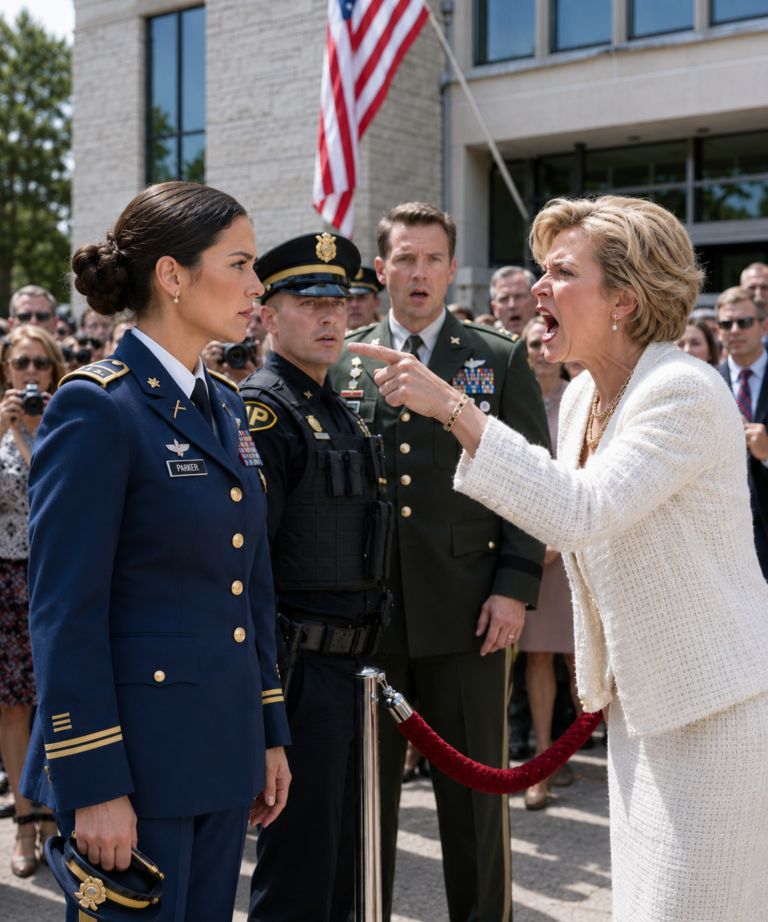
I barely heard him. Outside, Victoria Parker’s furious voice cut through the glass doors as reporters crowded the courtyard. Colonel Whitmore looked from the envelope to me.
“You don’t have to open it here.”
But I did. Waiting would only give fear time to grow. I broke the seal and unfolded the yellowed page. My father’s handwriting was strong and slanted, exactly as I remembered. My Em, if you are reading this, then the Parker family has done what I feared they would do. I wanted to tell you everything while I was alive, but some truths are dangerous too soon.
The Parkers were never true owners of the Savannah estate, the memorial funds, or the land near Fort Stewart. They were trustees. Caretakers. Their name remained because your grandmother believed legacy should serve families, not worship bloodlines. If the trust has been triggered, they broke faith. The sealed archive must be opened. Inside is the truth about Margaret Hale, Henry Parker, and the child history buried. I stopped breathing.
“What child?” I whispered.
Samuel’s expression tightened.
“That’s what we need to find out.”
Daniel shook his head.
“Henry Parker was my grandfather.”
Colonel Whitmore looked at me.
“And Margaret Hale was Emily’s grandmother.”
A cold suspicion passed through the room, but no one named it. The letter continued. Do not let Victoria control the story. She knows pieces of the truth and has spent her life protecting the Parker name. Samuel has instructions. Colonel Whitmore knows more than he has admitted. Trust them, but trust your own eyes most.
There is a key hidden where I taught you not to fear the dark. I knew instantly what he meant. My father’s house had a storm cellar. As a child, I had feared its darkness until he carried me down during storms and told me, “Darkness is only scary until you know what’s in it.” The key was there. Before we could leave, the main doors opened and Victoria entered like a storm in pearls.
“This ends now,” she said.
She pointed at the letter.
“That does not belong to you.”
“My father wrote my name on it.”
“Your father was a bitter man who couldn’t accept his place.”
Samuel stepped forward.
“If the archive contains fraud, misused funds, or trust violations, then it will be opened.”
Victoria’s eyes hardened.
“You have no idea what you’re touching.”
“Then explain it,” I said.
She looked at me with pure contempt.
“Your grandmother was a servant’s daughter who became useful to powerful men. The Parkers gave her protection. Without us, your family would have been nothing.”
“My grandmother owned the land,” I said.
“She was allowed to hold it.”
Samuel’s voice sharpened.
“That is not what the deeds say.”
“No,” Colonel Whitmore said. “But the archive might.”
Fear flashed across Victoria’s face. Then she smiled.
“You won’t find it.”
A phone rang. Victoria glanced at the screen, went still, and left without another word. Colonel Whitmore watched her cross the courtyard toward a black SUV.
“She’s going to the estate,” he said.
By the time we reached Savannah, the sky looked like bruised steel. Daniel drove while I held my father’s letter in my lap. Rain tapped the windshield. The silence between us was crowded with every dinner where Victoria corrected me, every photograph where she placed me at the edge, every time Daniel chose quiet instead of me.
“I’m sorry,” he said.
“I know.”
“No. Not all of it. When we married, my mother told me you’d leave once military life stopped feeling romantic. She said you loved the uniform more than the man.”
“And you believed her?”
His hands tightened on the wheel.
“Some part of me did.”
The truth hurt more than a lie.
“She made everything feel like a test,” he said. “If I defended you, I was betraying her. I thought silence kept peace.”
“No, Daniel. It kept her comfortable.”
The Savannah estate rose through the rain: white columns, iron gates, ancient oaks. Victoria had always called it Parker House. Now I saw it differently. Hale land wrapped in Parker pride. Inside, the mansion smelled of lemon polish, old wood, and rain. A crash sounded upstairs. We found Victoria in a locked study I had never been allowed to enter. Papers littered the floor. Drawers hung open. Documents burned in the fireplace. Tyler stood nearby clutching a metal box.
“Put the box down,” Samuel said.
Victoria laughed.
“You think this is about documents?”
On the desk lay an old photograph of a young woman beside the house. Dark hair. Steady eyes. My father’s eyes.
“My grandmother,” I whispered.
“She had no right to this house,” Victoria said.
“Then why erase her?”
Daniel looked at the fire.
“What did you do?”
“Everything I did, I did for this family.”
“No,” he said. “You did it for control.”
She slapped him. The sound cracked through the room. Daniel did not move. For one second, he looked like a little boy who had been struck before. I stepped between them.
“Don’t touch him again.”
Tyler tried to run with the box, but Daniel caught him in the hall. The box hit the floor and burst open. Letters, ledgers, a tarnished medal, and a velvet pouch spilled out. On the top letter was the name Margaret Hale Parker. Parker. By marriage. Not by birth. Victoria made a strangled sound.
“No.”
Samuel lifted the letter carefully.
“This predates the trust summary.”
Victoria finally sank into a chair.
“My grandfather Henry married Margaret Hale in secret before he married Eleanor Parker.”
Daniel went pale.
“That’s impossible.”
“It was buried,” Victoria snapped. “Corrected.”
Samuel examined another paper.
“There was a child.”
“Yes,” Victoria said.
“My father?” I asked.
“No.”
She looked at Daniel.
“Your father.”
The room tilted. Henry Parker and Margaret Hale had a son: Robert, Daniel’s father. Daniel stared at her.
“You knew I was a Hale?”
“You were a Parker. I made sure of it.”
The truth landed. Victoria hated me because my name threatened the lie she had built her life around. Then the velvet pouch opened and an old brass key fell out. Its tag read: Archive Room B — Fort Stewart Historical Repository. Colonel Whitmore picked it up.
“I know where this goes.”
At Fort Stewart, the archive waited underground behind a steel door marked Archive Room B. The brass key turned with a groan. Inside were shelves, boxes, photographs, and a cedar chest marked M.H.P. Margaret Hale Parker. Samuel cut the wax seal. The smell of old paper and lavender rose from inside. In Margaret’s journal, the first page read: They may take my name from the door, but they will not take my truth from the earth.
The documents proved her marriage had never been annulled. Henry had married her for land near the base, hidden her when a wealthier match became useful, then taken their son into the Parker household while forcing Margaret into silence. But Margaret kept records. Letters. Ledgers. Proof. Then we found letters between Robert Parker and my father. Robert had known the truth. He had asked Thomas Hale to watch Daniel because, as one letter said, Daniel still has softness in him. Don’t let her beat it out.
Daniel broke then, silently, folding inward with grief. Another folder contained a private investigator’s report. Robert had suspected someone tampered with his brake lines before his fatal car accident. Victoria shouted for us to stop. Then we found a cassette labeled: For Daniel, when truth becomes safer than silence. Colonel Whitmore found a player. Robert’s voice filled the room, warm, tired, alive.
“Daniel, my boy… your mother has built a beautiful cage and called it legacy. Do not mistake obedience for honor. Do not mistake fear for love.”
Daniel covered his eyes. Then Robert said the sentence that shattered everything.
“And Daniel… the woman you know as your mother is not the woman who gave birth to you.”
Victoria screamed. The tape continued. Daniel’s birth mother was Anna Whitmore—Colonel Whitmore’s sister. Anna had worked with Margaret to expose the trust fraud. She had given birth to twins. Daniel was taken by Victoria, who could not have children and wanted a Parker heir. His twin sister, Claire, was hidden by Margaret and Thomas Hale and raised in obscurity. Weeks later, Claire arrived at my father’s house in the rain with a photograph and a letter. Daniel stared at her eyes, so much like his own, and walked outside, shaken by the knowledge that he had grown up in luxury while his sister grew up hidden.
The investigation widened. Victoria’s committee collapsed. Funds were seized. Hale House was legally restored to a Hale-Whitmore trust under Margaret’s original instruction: the house must serve those who served. At the final hearing, Daniel testified against Victoria.
“My name is Daniel Robert Whitmore-Hale Parker,” he said. “And Victoria Parker taught me that silence protects abusers. I am done being silent.”
Victoria lost the house, the committee, and the name she had used like a weapon. Daniel was appointed executive director under strict oversight, not as a reward, but as a chance to turn a broken branch back toward service. Months passed. He changed slowly, visibly. He went to counseling, apologized without defending himself, and learned that love could not be repaired by speeches.
I learned that forgiveness and return were not the same thing. One year later, Hale House opened at sunrise. No pearls. No grand performance. The first guests were a young widow, a retired sergeant, and a private who had nowhere else to go. The portraits of Parker men were gone. In their place were photographs of real families—messy, grieving, laughing, welcome. Above the entrance hung Margaret’s words: A legacy is not what you keep. It is what you shelter. That evening, the house filled with noise, children, spilled lemonade, burned rolls, and too few chairs. Daniel stood beside me in the kitchen doorway.
“Are you happy?” he asked.
I looked at Claire laughing, Colonel Whitmore holding a baby, and the open door where another family was arriving with a casserole and an apology.
“Yes,” I said. “I think I am.”
For generations, that house had decided who belonged. Now its doors stood open. For the first time, it was not hiding a secret. It was keeping a promise.

