
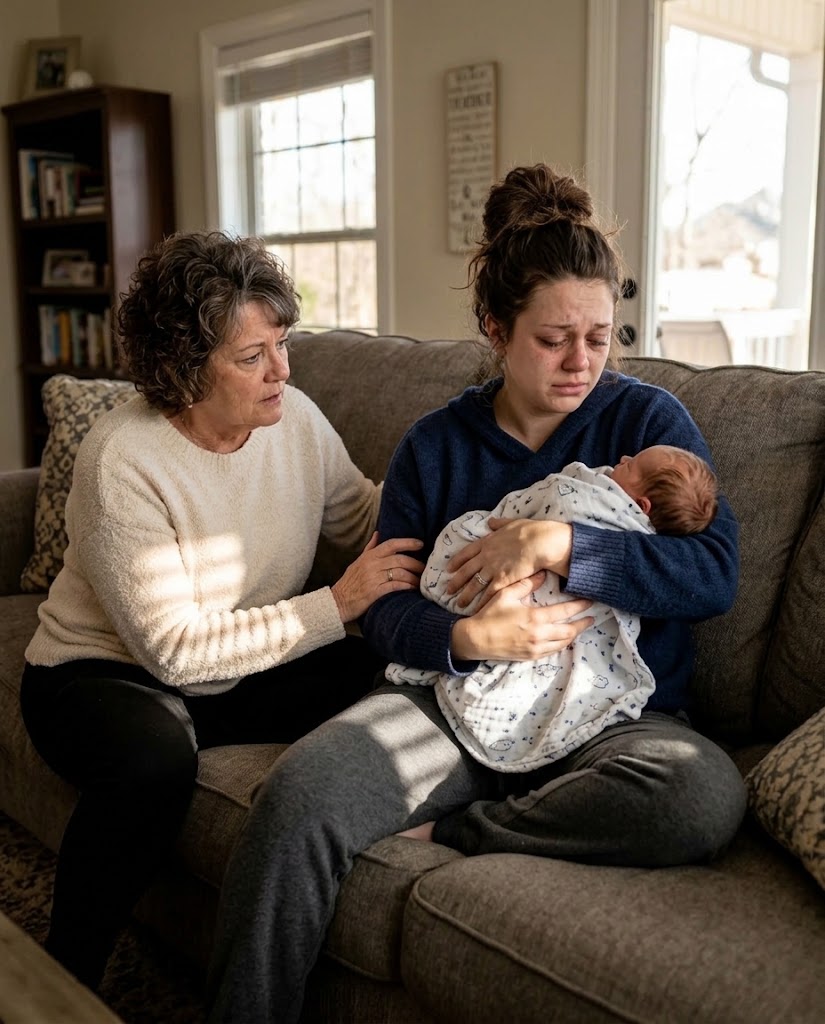
Hand him over.” Five days after an emergency C-section, I was standing in my own living room while my mother-in-law tried to pry my newborn son from my arms. Beatrice had let herself into the house with a spare key she admitted she had secretly copied months earlier, then greeted us from the couch as though our request for two visitor-free weeks had never existed. She called Finn “her baby” throughout my pregnancy and once joked that I was merely the incubator, but even I was not prepared to hear her tell me that he needed to bond with his “real mother figure.” When I stepped back, she grabbed my forearms and pulled hard enough to make my incision burn while Finn screamed between us. I was exhausted, shaking, and terrified my strength would give out. Then my husband Alden stepped between us and said, in a voice I had never heard him use with his mother, “Let go. Now.”
Beatrice released me, but the confrontation did not end there. When Alden told her to leave or he would call the police, she began sobbing that I was “erasing” her from the family. Then the tears stopped as abruptly as they had started. “Fine,” she said. “Give me my money back.” Years earlier, Beatrice had provided the down payment on our house, and Alden had allowed her name to be added to the deed because she described it as simple protection for her contribution. We had treated the money as family help; legally, however, she was a co-owner. She also still held title to the Camry she had bought Alden years before, and the next morning she sent someone to repossess it. Suddenly the copied key was not merely intrusive—it belonged to someone who believed the property itself gave her authority over us. With Finn asleep beside us and my incision still pulling every time I stood, Alden and I spent our son’s first night home behind a locked bedroom door, listening for footsteps downstairs.
The pressure worked on Alden at first. With no car, relatives calling to defend Beatrice, and the possibility that a co-owner could force a partition action or push for sale if no buyout could be negotiated, he suggested allowing her one supervised visit with Finn simply to calm things down. I asked him one question: if threatening our home bought her twenty minutes with our baby now, what would she threaten next time she wanted something? He had no answer. That was when we stopped asking how to preserve the house and started asking whether keeping it was worth the price Beatrice had attached to it. We could not afford an immediate buyout of her ownership interest, and I was unwilling to exchange access to our son for financial peace. So I told Alden we should sell. My parents offered us temporary help near their city, and the car Beatrice had taken inadvertently solved the remaining problem: Alden had switched to remote work because he could no longer commute, and his employer agreed to make the arrangement permanent if we relocated. The leverage Beatrice meant to tighten around us had opened the door out.
We met with a real-estate agent and an attorney, reviewed the deed and sale process, and told Beatrice before her Friday deadline that the property would be listed. She arrived smiling, clearly expecting compliance, then went white when Alden explained that she would receive whatever share of the net sale proceeds she was legally entitled to rather than access to Finn. She protested that she had never meant for us to sell. “Then it wasn’t a gift,” Alden told her. “It was a leash.” When she insisted that she had helped us build a family and accused me of stealing hers, I reminded her that she had tried to pull my newborn from my arms, threatened our housing when we objected, and reclaimed Alden’s car to increase the pressure. She reached for one final argument—his job was local—but he calmly told her his employer had approved the move. “We’re not giving up our home to keep you away from Finn,” he said. “We’re giving up your house so our next home belongs to us.” He did not promise permanent estrangement. He told her that any future relationship with Finn would depend on whether she could respect us as his parents without threats, financial pressure, or unauthorized access.
The house sold, Beatrice received the proceeds due to her ownership interest, and we moved several hundred miles away into a smaller home purchased without her money. On our first night there, I stood in the living room with Finn against my shoulder while Alden carried in the final box. There were fewer rooms, no carefully chosen nursery built around the life I had once pictured, and far less space than the house we left behind. Yet I had never felt safer. Alden shut the front door and turned the deadbolt, and the lock settled into place with a small, solid click. My mother was bringing a casserole later; my father had promised doughnuts. They had a key only because we had chosen to give them one. That difference was the whole point. Beatrice had taught us, painfully, that help stops being generosity when it can be withdrawn to force obedience. Our new house was smaller, but nobody owned a piece of our decisions anymore—and everyone who crossed the threshold did so because we had opened the door.

