
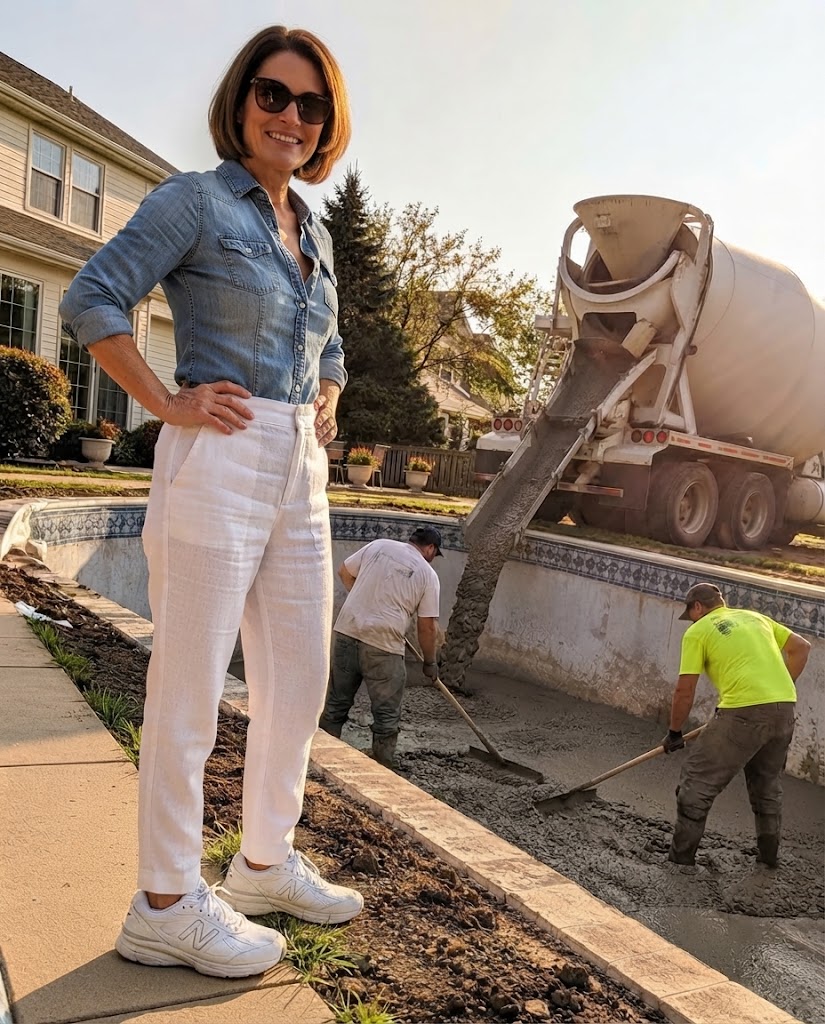
At 5:02 in the morning, I woke to the house vibrating and the sound of heavy machinery grinding through the gray dawn. When I pulled back the curtain, a concrete truck was sitting in my backyard, its tires crushing my hydrangeas and its chute stretched over the pool my late husband had built with his own hands. Thick gray concrete was pouring into the blue water. My neighbor Katherine stood beside the truck in a pink bathrobe with her arms folded while her husband Dale worked the controls. “Now there’ll finally be some peace and quiet,” she said when I ran outside barefoot. I watched the water turn gray, the blue tiles disappear, and the shallow-end steps vanish beneath the slurry. Those steps held the handprints of all four of my children, mine, and Mark’s, along with the words he had scratched into the wet concrete three months before learning he had stage-four pancreatic cancer: BE LOUD. LOVE, DAD. When my seven-year-old son Noah ran outside and screamed, “Where’s Daddy’s hand?” Katherine’s face went white, but the pool was already gone.
Mark had spent two summers building that pool legally and meticulously, with permits, inspections, construction drawings, receipts, and photographs preserved in a fat blue binder he jokingly called the Pool Bible. He was a shop teacher, the kind of man who believed anything worth building was worth documenting. After his diagnosis, he spent his final months sitting beside the pool while our children splashed, shouted, and laughed, telling me that their noise was “the best sound in the world.” After he died, the pool became the place where they still seemed connected to him. Katherine and Dale moved next door a year later. She complained about everything: bicycles in the driveway, recycling bins, Christmas gnomes, roses planted on the “wrong” side of the yard. I started keeping a notebook because Mark had taught me to write things down. Then one hot afternoon Katherine came through our side gate without permission and ordered my children out of the water because they were “too loud.” The strange part was that they had barely made a sound. I had spent months telling them to keep quiet for her sake, and by then they had learned to swim almost silently. The day before the concrete truck arrived, Noah had sat on his handprint and whispered, “Is Daddy mad at us for being quiet?”
The police did not need much detective work. Mark’s old security cameras had recorded everything: Dale cutting the padlock off my gate with bolt cutters, the truck crossing my property before dawn, Katherine pointing toward the pool, and the concrete starting to pour at 4:58 a.m. The cameras also captured her earlier confrontation with the children—and proved they had been so quiet that birds were louder than they were. Dale immediately admitted what he had done. My lawyer, Rachel Moss, documented trespass, major property destruction, emotional harm to the children, and the cost of restoring the pool to its previous specifications. Because Dale had used a commercial vehicle, materials, and equipment belonging to his licensed construction company, the state contractor licensing board also became involved. Katherine came to my door in tears after she was served and begged me not to threaten Dale’s license. That night Dale came alone and told me the part nobody knew. He and Katherine had lost their seven-year-old son Danny in a swimming pool in 1991. Katherine had stepped inside for a hot dog, returned minutes later, and found him silently at the bottom of the deep end. She had performed CPR until paramedics arrived, but he was already gone. For thirty-two years she avoided pools entirely. When she saw my children swimming quietly while I was inside making dinner, she was not truly angry about noise. The silence had taken her straight back to the day her son drowned.
Understanding that did not erase what she had done. Rachel reminded me that grief was context, not a legal defense, and I agreed. I kept the civil claim but changed what I asked for. Dale received a public licensing reprimand and probation rather than losing his livelihood outright. Katherine pleaded guilty to criminal trespass and completed community service teaching water-safety and CPR classes. Vance & Sons paid for the full removal of the concrete and rebuilt the pool according to Mark’s plans, permits, dimensions, tile pattern, and construction records. Dale handled the shallow-end steps himself. For eleven days he worked with a hammer, chisel, and brush because he believed the original concrete might not have bonded completely to the material poured over it. On the eleventh afternoon, he called me outside. Beneath the damage were six battered but recognizable handprints and the words BE LOUD. LOVE, DAD. Noah knelt beside his own print, discovered that his hand no longer fit inside it, then placed his palm into Mark’s much larger one. “It’s still here,” he whispered. Dale stood at the edge of the pool crying so hard he eventually had to sit in his truck.
The rebuilt pool opened on Labor Day weekend with a self-closing locked gate, a pool alarm, and one rule I should have understood much earlier: when children are in the water, an adult is watching them—not from the kitchen, not through a window, but from the deck. Katherine still teaches water-safety classes at the YMCA, and I took one from her. “Drowning is silent,” she tells parents. “If the pool suddenly gets quiet, that is not peace.” She never comes into my yard anymore, although she now keeps a lawn chair on her side of the fence facing the pool. Sometimes I see her body tense when one of the twins disappears beneath the surface, then relax when they come up shrieking. My children no longer whisper for anyone. They cannonball, splash, yell, laugh, and scream before they hit the water. The roses Katherine once told me were planted on the wrong side of the yard now grow on both sides of the fence. And every summer afternoon, I sit beside Mark’s restored handprint with my phone face down and listen to the noise. I used to think BE LOUD was only something a dying father wrote so his children would remember how to live. Now I understand it another way too. In water, sometimes the loudest sound is the safest one.

