
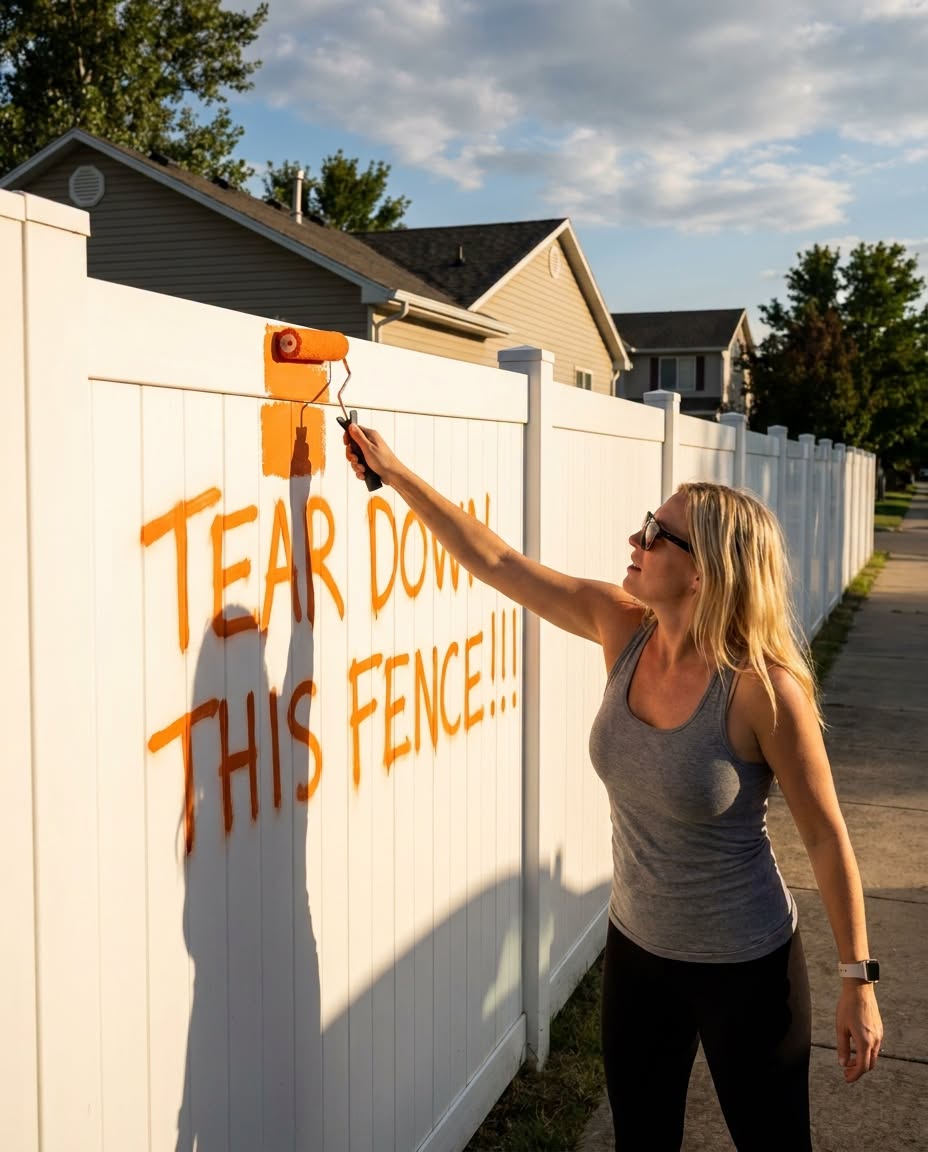
The city inspector had barely finished measuring my fence when he closed his clipboard and said there was no violation. I felt my shoulders loosen for the first time since the bright orange complaint notice had appeared on my mailbox three days earlier. Across the street, my new neighbor Claire stood beside her mailbox with a coffee mug and a smile that disappeared the instant she heard the result. She had spent weeks criticizing my trash cans, my grandmother’s wind chimes, my hedges and finally the fence that had been standing legally for years before I bought the house. I expected the inspection to end there. Instead, Greg, the inspector, looked toward Claire’s carefully landscaped yard and said there was something else he needed to check. A few minutes later, his measuring wheel crossed the street.
My name is Mia, and before Claire moved in, our neighborhood had been the kind where people waved, brought in packages for one another and generally minded their own business. Claire arrived with a different approach. Within days she was telling me where my trash cans should be stored, complaining that my wind chimes disturbed her peace and studying my property as though she had been appointed to enforce standards no one else knew existed. When she suggested my fence was too tall, I reminded her it had been there before I purchased the house and thought the matter would disappear. Instead, she filed a formal complaint with the city. I responded the only way I knew how: I gathered the closing survey, inspection report, permit records and property documents, then photographed every section of the fence before the scheduled inspection. The paperwork all pointed to the same conclusion, but an official notice still has a way of making even an innocent homeowner wonder whether some expensive surprise is waiting.
Greg measured every panel twice and confirmed that the fence complied with local requirements. What caught his attention instead were the survey markers beside Claire’s new decorative stone beds. Her contractor had built landscaping approximately thirty inches beyond her legal property line at the widest point, placing part of the stone border, several shrubs and a section of irrigation line inside a city easement and partly onto my lot. Claire immediately insisted the markers must be wrong, then suggested I might somehow have moved them. Greg calmly compared his measurements with the recorded parcel map and subdivision survey and told her that unsupported accusations would not change the boundary. By then several neighbors had gathered nearby, many of whom had watched Claire scrutinize my house for weeks. The complaint she had filed to expose my supposed violation had instead brought an official measuring wheel directly to the improvements she had never thought to verify.
Claire received a formal corrective-action notice requiring the encroaching improvements to be removed or relocated within thirty days. Because the issue involved both a municipal easement and a private property boundary, the city documented the measurements and advised her to contact the contractor and follow the appeal procedure included with the notice. The stone border came up first, followed by shrubs and sections of irrigation, and for nearly a month crews worked in full view of the street rebuilding a landscape project that had cost her thousands of dollars. My fence required no changes at all. Several weeks into the work, Claire approached me on the sidewalk and apologized without excuses. She admitted that she had spent so much time searching for problems at my house that she had never checked her own. I accepted the apology, and the complaints stopped.
Claire and I never became close friends, but we eventually became what the neighborhood had needed from us in the first place: decent neighbors. She stopped watching my property, we started waving when we crossed paths, and my grandmother’s wind chimes continued moving quietly whenever the breeze reached the porch. Looking back, what stays with me is not the satisfaction of seeing Claire’s landscaping removed. It is how little I actually had to do to defend myself. The survey markers had been in the ground the entire time, the permits had been in my files and the fence had always been compliant. I did not need to win an argument or manufacture a dramatic comeback. I only had to keep the paperwork, show up for the inspection and let an impartial measurement establish what was already true.

