
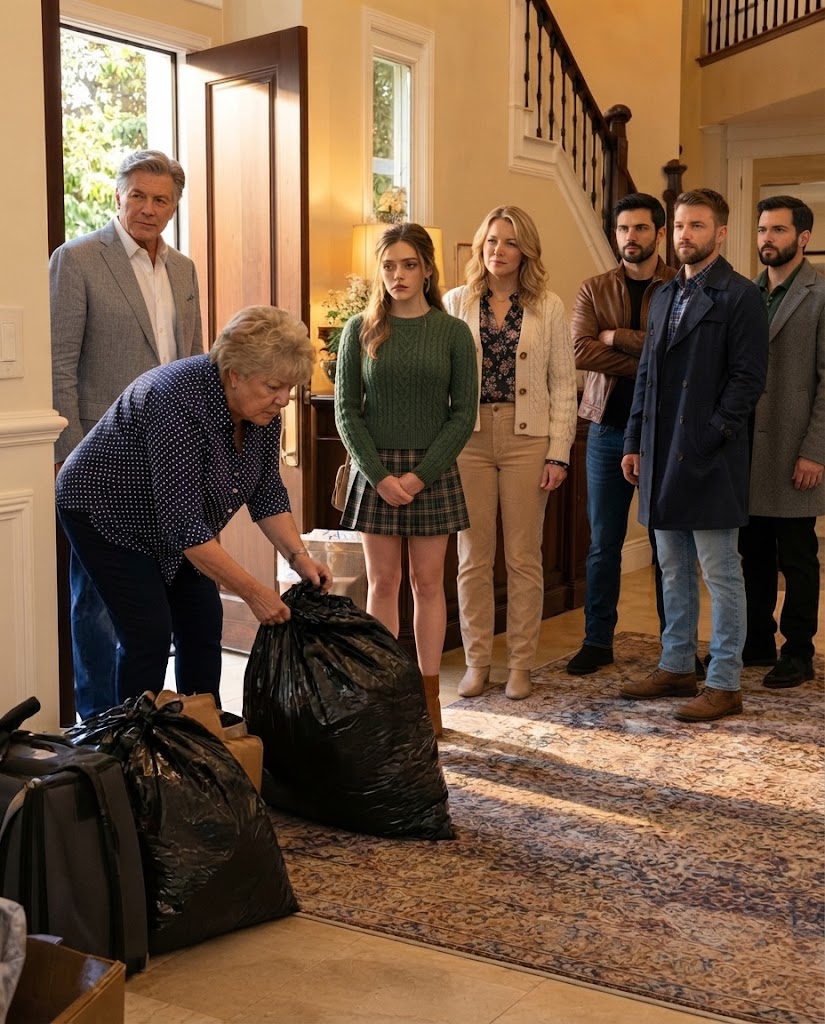
“I call the master bedroom,” my sister said as she climbed out of the moving truck the morning after we buried my grandfather. I was standing barefoot on the porch in one of Grandpa Walter’s flannel shirts, holding cold coffee beneath a funeral wreath whose black ribbon still said Beloved, when my mother came up the steps and shoved two garbage bags into my arms. I had not seen her, my father, or my sister Brianna in seventeen years—not since I was five, when they left me at this farmhouse with a pink suitcase and promised to return after the weekend. “Pack your things, Emily,” Mom said. “You were Grandpa’s burden. He’s gone now. This house is ours.” Behind her, movers were already unloading blankets and dollies while Brianna discussed repainting the bedroom where Grandpa had slept before heart failure forced him downstairs. I did not argue when Dad called a real-estate agent about listing the property, or when Mom began throwing Grandpa’s canned food into trash bags. Four days before he died, he had taken my hand in the hospital and warned me this exact moment would come. “Let them in,” he told me. “Let them talk. Then open my study.”
Grandpa had spent seventeen years teaching me the difference between people who said things and people who meant them. He raised me on a railroad machinist’s pension, garden vegetables, library books, midnight asthma treatments, and promises he kept even when nobody was watching. When I was sixteen, I finally asked why my parents had never come back, and he unlocked a brown leather ledger from his rolltop desk. Inside were years of dated entries: birthday letters sent to my mother, school photographs, hospital updates, Christmas cards, calls when I was in intensive care—all marked Returned. Unopened. No call back. Once their address disappeared, he kept writing anyway and stored the unsent envelopes in a drawer because he knew that someday someone might rewrite the story and tell me they had tried. One person had remained quietly connected to our lives throughout those years: my piano teacher, Miss Rose, a soft-spoken older woman who had taught me every Saturday from age eight through eighteen while Grandpa sat nearby reading the newspaper. I never understood why she sometimes watched me with tears in her eyes or why Grandpa called her an “old friend from another life.” On his deathbed, he made both of us promise something separately. He told me that when his attorney Samuel Price arrived after the funeral, I was to put him and whoever accompanied him inside the study and close the door.
Twenty minutes after my family began claiming rooms and discarding Grandpa’s belongings, the study door opened. Samuel stepped into the hallway first. Miss Rose followed him. My mother dropped the garbage bags she was carrying; a jar of Grandpa’s strawberry jam rolled across the rug and stopped against my old blue-and-yellow quilt. “Mama?” she whispered. That single word rearranged my entire childhood. Miss Rose was not merely my piano teacher. She was Grandpa’s estranged wife, my mother Karen’s mother, and my grandmother. She confessed that when Karen was six, she had been drinking heavily, told her daughter she was going to the store, and never returned. She got sober a decade later and came back, but sixteen-year-old Karen refused to see her. Grandpa respected that decision yet eventually allowed Rose into his own life again. Years later, when Karen abandoned five-year-old me on his porch with almost the same promise and the same age, Walter called Rose and told her she would help him break the pattern. That was why she taught me piano without revealing who she was. My mother had grown up wounded by one abandonment and then, without ever naming it, repeated it on her own child. Before anyone could absorb that, Samuel opened his briefcase and delivered the second truth: the farmhouse was not part of Grandpa’s probate estate at all. Three years earlier, Walter had conveyed the house, land, garden, and contents into a trust for which I was the sole beneficiary.
The documents changed the morning from a family assumption into a property matter. The recorded deed and trust instrument gave my parents no ownership interest, and Samuel explained that as beneficiary I could require them—and the movers they had hired—to leave. The older mover immediately refused to remove anything else, telling my father he would not empty a dead man’s house for people who had no title to it. Grandpa had also left letters. Mom’s envelope contained the brass key to the desk drawer holding the ledger and a note telling her that the house belonged “to the girl who stayed,” but that the door itself had never been locked against her. Brianna’s envelope held a photograph of the two of us on the porch the day I was left there, with Grandpa’s message written on the back: You were seven. You didn’t do anything wrong. Your sister has been waiting for you for seventeen years. Brianna then admitted our parents had told her I was medically too sick to live with them, that I hated the family, and that I would reject any letter she sent. By the time Dad threatened to hire another lawyer, even Mom was finished defending the fantasy. I told her I would not let her take the house, the furniture, or another piece of my life simply because she had returned. But I also would not slam the door forever. “Come back,” I said. “Not with a truck. By yourself. And keep coming back for as long as it takes.”
A year later, the farmhouse is still mine, the walnut paneling is still on the walls, and I work nights as a pediatric nurse, sometimes reading Charlotte’s Web beside frightened children with asthma because that is what Grandpa once did for me. Brianna stayed three weeks after the funeral, sleeping under a green quilt, helping me pack Grandpa’s clothes one shirt at a time, and learning the pancakes he used to make. She calls every Sunday now. Miss Rose teaches her piano and has photographs of people on top of the instrument at last. My mother has returned seven times, always alone. She and my father separated; she began counseling and started attending a weekly meeting at the Methodist church. The first time she came back, she brought Grandpa’s ledger after reading every page. Months later, she and Miss Rose stood in my kitchen together and canned tomatoes, remembering the years before everything broke. Nothing is repaired enough to call it healed. Some Sunday evenings I still look toward the road as though a brown car might appear. But the ledger is back in Grandpa’s desk, and beneath his final entry there is now one line in my mother’s handwriting: January 18. Came back. Knocked. She let me in. Grandpa did not leave me a perfect family. He left me something harder and more useful: a house that was legally mine, a record of what really happened, and the right to decide who could come through the door—and under what terms.

