
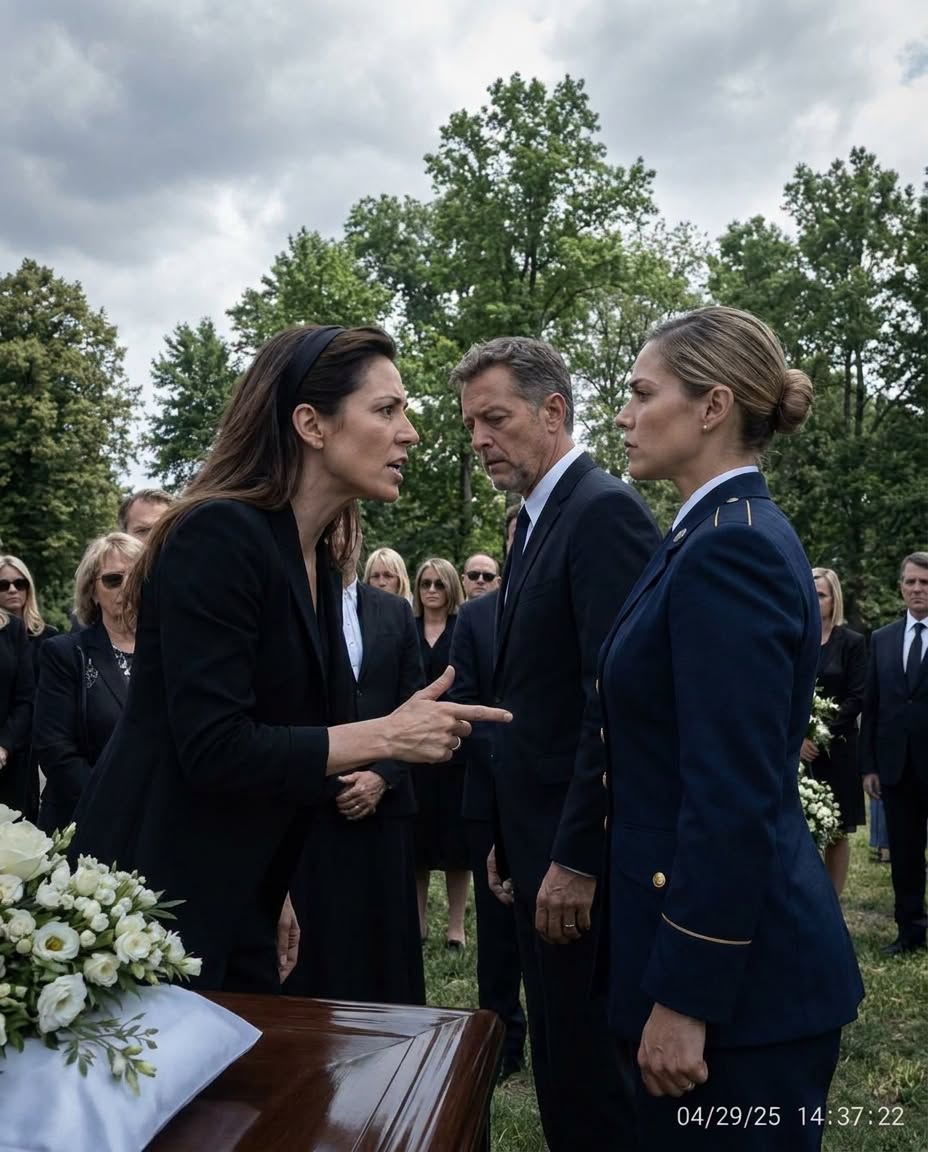
“Couldn’t you afford a proper black dress?” my sister asked beside our father’s grave, pointing at the ribbons on my Marine Corps uniform. The February sky hung low over the Ohio cemetery, and damp soil clung to my polished shoes as relatives turned to watch. Jasmine stood in an expensive silk dress and accused me of seeking attention, while several family members hid their laughter behind gloved hands. Only hours earlier, I had attended a military memorial for two Marines who had served under my command, yet no one at home had asked where I had come from or what the uniform represented. When the service ended, my mother texted instructions for the wake: stand quietly in a corner because Jasmine’s husband had important business partners attending. I read the message twice, then slipped my phone into my pocket without answering. My family believed the uniform made me less successful than they were, but they had never bothered to look closely at the silver eagle on my collar.
My name is Colonel Sophie Lewis, and for three years I had directed nearly all my additional overseas pay toward my father’s hospital care. Jasmine publicly claimed that she and her husband Ethan had financed private nurses and spared no expense, while my mother accepted the money without acknowledging where it came from. At the wake, held in Jasmine’s enormous suburban home, executives drank wine beneath vaulted ceilings while she repeated the story of her sacrifice. Ethan, a corporate defense attorney, had built his reputation around government clients and was pursuing a major Department of Defense project that could determine the future of his firm. Neither he nor Jasmine knew that I commanded Strategic Task Force 132, the program responsible for evaluating the same category of work. To them, I was simply the unmarried daughter who had chosen military service instead of a luxury house, a corporate title, and the approval of people who measured success by appearances.
The first person to recognize my rank was Master Sergeant Miller, an old friend of my father’s who studied my ribbons and then saw the eagle on my collar. Before he could greet me properly, Jasmine stepped between us and called my uniform a costume, while Ethan joked that I probably drove supply trucks or worked behind a desk. My mother joined them, suggesting that I abandon military life for a respectable corporate career and finally make real money. I remained silent until Ethan boasted that he worked with generals and decision-makers, then dismissed service members as people whose achievements did not matter outside the military. I came to attention and introduced myself by rank and command. The room changed immediately, because Ethan finally understood that the woman he had been ridiculing oversaw the task force connected to the most important government bid of his career.
I made it clear that my position would not be used for personal retaliation and that I would formally disclose the family connection and recuse myself from any final procurement decision involving Ethan’s firm. Independent ethics officers, contracting counsel, and the review committee would examine the bid, its financial disclosures, professional conduct, and any conflicts under the same federal standards applied to every applicant. That answer frightened Ethan more than anger would have, because procedure offered him no private favor and no opportunity to negotiate through family pressure. Jasmine demanded to know why my rank had been kept secret, while my mother suddenly claimed she would have treated me differently if she had understood my authority. I told them that affection offered only after discovering someone’s influence was not affection at all. Before I left, Master Sergeant Miller stepped forward and gave me a formal salute, honoring the uniform before anyone else in the room understood what it could do for—or cost—them.
Outside, the ordinary rental SUV waited among rows of polished luxury cars. I removed my cover, placed it carefully on the passenger seat, and looked back once at the house where my family had confused money with dignity and silence with failure. I had not exposed my rank to humiliate anyone or threatened a contract to settle a personal grievance. The truth had simply entered a room built on appearances, and the people inside revealed how quickly their respect changed when power changed hands. Miller had respected me before he knew whether my position could benefit him, which made his quiet gesture worth more than every apology that followed. My father’s funeral had shown me that shared blood could not guarantee loyalty, gratitude, or understanding. I drove away knowing that I no longer needed to stand in a corner waiting for people to recognize my value. Peace began the moment I stopped confusing their approval with home.

