
My son’s voice was perfectly calm when he told me I was no longer welcome in the Gulf Shores villa I had spent three summers rebuilding. “Megan’s parents will be living there now,” Derek said, as casually as if he were changing a dinner reservation. “It belongs to them, so you need to remove your things by Friday.” Two weeks later, Ray Proctor sat on the white-oak porch swing I had built in memory of my late husband, rested his boots on my railing, and announced over the phone that he and his wife had “hit the jackpot.” Donna measured my bedroom windows, criticized my handmade curtains, and selected gray paint to cover the coral walls I had chosen nearly twenty years earlier. They believed Derek had placed the property in his name and given them permission to move in permanently. What none of them knew was that a retired judge had helped me prepare for this moment six years before.
I am Vivien Ivers, a 67-year-old retired pediatric nurse, and I purchased that neglected Alabama cottage in 2006 for $85,000 using my savings and part of my husband Arthur’s life insurance. The roof leaked, the porch was rotting, and raccoons had claimed the attic, but I could see the four-bedroom home hidden beneath the damage. Over three summers, I invested $247,000 in repairs, working beside my contractor friend Tommy Guidry while keeping every receipt, inspection report, and permit in carefully labeled binders. Including property taxes and insurance, my documented investment eventually exceeded $452,000. Arthur had once warned me never to place a home in someone else’s name simply because they were family, but after he passed away, I spent years trying to compensate for the long nursing shifts that had kept me away from Derek. I paid $28,000 for Derek’s wedding to Megan and welcomed her parents, Ray and Donna, even after Derek began treating them more like family than he treated me. When their plumbing business failed and they lost their home, Megan began looking at my villa as the answer to a problem I had never agreed to solve.
Six years before Derek’s phone call, he arrived with grocery-store carnations and asked me to sign a quitclaim deed, claiming it would simplify estate planning and protect the villa from probate. I signed after he invoked his father’s memory, but guilt kept me awake that night, so I called my closest friend, Doris Palmer, a retired family court judge. Doris instructed me to check the county records immediately, and we discovered Derek had never filed the deed; he had simply placed it in a kitchen drawer and assumed my signature alone transferred ownership. Within two weeks, attorney Margaret Holloway placed the villa into a revocable living trust naming me as sole trustee and beneficiary, making Derek’s unrecorded document legally useless. I never told him because I desperately wanted to believe he would never try to use it. After his demand that I leave, I quietly photographed Ray and Donna occupying the property, collected copies of every construction record, and learned Derek had even listed the villa as his asset on a personal loan application. Then, on the Saturday morning the Proctors arrived with a fully loaded moving truck, I drove onto Gulf Shore Drive with Margaret’s legal folder beside me—and a sheriff’s cruiser directly behind my truck.
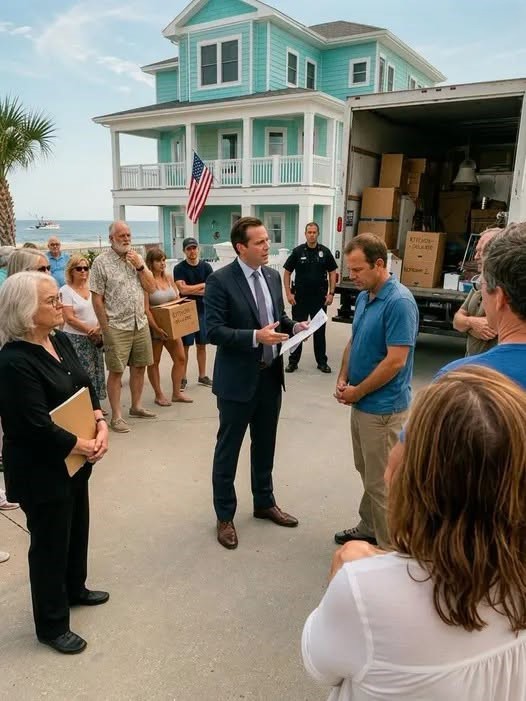
Deputy Warren Hicks served Ray and Donna with a court-authorized no-trespass order while thirty neighbors watched from the surrounding yards. Margaret explained that the trust held clear title to the property and that the photocopied deed Derek carried had never been recorded, giving him no legal authority to offer the house to anyone. Megan demanded that I honor their “agreement,” but I reminded her that understanding her plan was not the same as approving it. The attorney also revealed that Derek had misrepresented the villa on a credit application while struggling with $47,000 in debt, two car payments, and a mortgage that was already behind. His claim of ownership was referred for review because property records, insurance documents, tax statements, and every dollar of my investment contradicted his application. I updated my estate plan, protected the villa from future claims, and provided the necessary documents to the appropriate court and financial institutions. Ray threatened to remain until the deputy explained that refusing to leave could result in removal, and the Proctors finally reloaded every box they had brought. Derek stood at the bottom of my porch and asked why I had never warned him, but I told him the truth: I had wanted to be wrong about the kind of man my son had become.
After the moving truck disappeared, I changed the locks and walked slowly through every room. Donna had painted my coral bedroom gray and replaced my curtains, but my neighbor Beth had rescued the three original paint cans from the curb and returned them with a handwritten note. Tommy still had the old color codes, so together we restored the walls while preserving every mark that belonged to the home’s real history. I later arranged for the villa to benefit a Gulf Coast shelter through my estate, giving the property a future connected to women rebuilding their lives rather than relatives trying to claim what they had not earned. Derek has written asking me to make his legal problems disappear, but he has not yet offered the honest apology I need to hear. My door remains open to him as my son, though it is permanently closed to anyone who views my home as an available asset. Each morning, I drink coffee from Arthur’s chipped mug while sitting on the white-oak swing I built with my own hands—and after all these years, it still holds steady.

