
The third concrete truck was pulling out of my driveway when I returned from my eye appointment in Bedford, its enormous tires leaving deep ruts in the soft April ground. I eased my Buick into the grass to let it pass, wondering why anyone would be delivering concrete to my eighty-acre farm without my knowledge. Behind the barn, two unfamiliar trucks were parked beside my son Brian’s pickup, and the unmistakable smell of wet cement hung in the air. When I rounded the old corn crib, I stopped so suddenly that my good shoes sank into the mud. A freshly poured concrete slab, thirty feet wide and forty feet long, stretched across the back lot where orchard grass had been growing that very morning. My forty-one-year-old son was kneeling beside it with a steel trowel, smoothing the edges while two hired workers finished the surface. When I demanded an explanation, Brian cheerfully announced that he was building himself a repair shop, then added the words that hurt more than anything else: “It’ll all be mine soon enough anyway.” I was sixty-seven years old, very much alive, and standing on land that my late husband and I had spent a lifetime maintaining, yet my own son had already begun treating my future as something that belonged to him.
My name is Evelyn Baker, and my husband Carl and I were married for forty-one years before a heart attack took him in the barnyard six years earlier. After his death, I sold our cattle, rented sixty-one acres of tillable land to a neighboring farmer, and allowed the back lot to return to grass. Brian had spent twenty years repairing agricultural machinery, but when the implement dealership in Orleans changed ownership, he was among the experienced mechanics who lost their jobs. He had a wife, Stacy, a nine-year-old daughter named Josie, and bills that kept arriving whether he had work or not. That evening, Stacy called to apologize and explain that Brian had invested approximately six thousand dollars in the slab, using their tax refund and the remaining money from his severance package. He had also placed a deposit on a steel building, hoping to establish an independent machinery-repair business after months of working in their driveway and receiving complaints from their landlord. Stacy believed I had given permission because Brian had told her I approved the project, although the only conversation we had ever had about construction ended with my saying, “We’ll see.” I understood his desperation, but I could not excuse his decision to build without asking. What troubled me even more was his casual assumption that the property would soon be his. That night, sitting in Carl’s old chair, I remembered something I had almost forgotten: a nursery catalog from 1987, tucked away in my husband’s desk. On page fourteen, I had circled six varieties of apple trees, dreaming of turning the back lot into an orchard. Beside them, Carl had written, “Back lot. When we get to it.” We never did. There were always livestock to feed, machinery to repair, and expenses that demanded attention. For nearly four decades, I had postponed that dream, and after Carl died, I quietly convinced myself that the time for such plans had passed. Brian’s words forced me to confront an uncomfortable truth: I had been living as though my best years were already behind me, and my son had simply started believing it too.
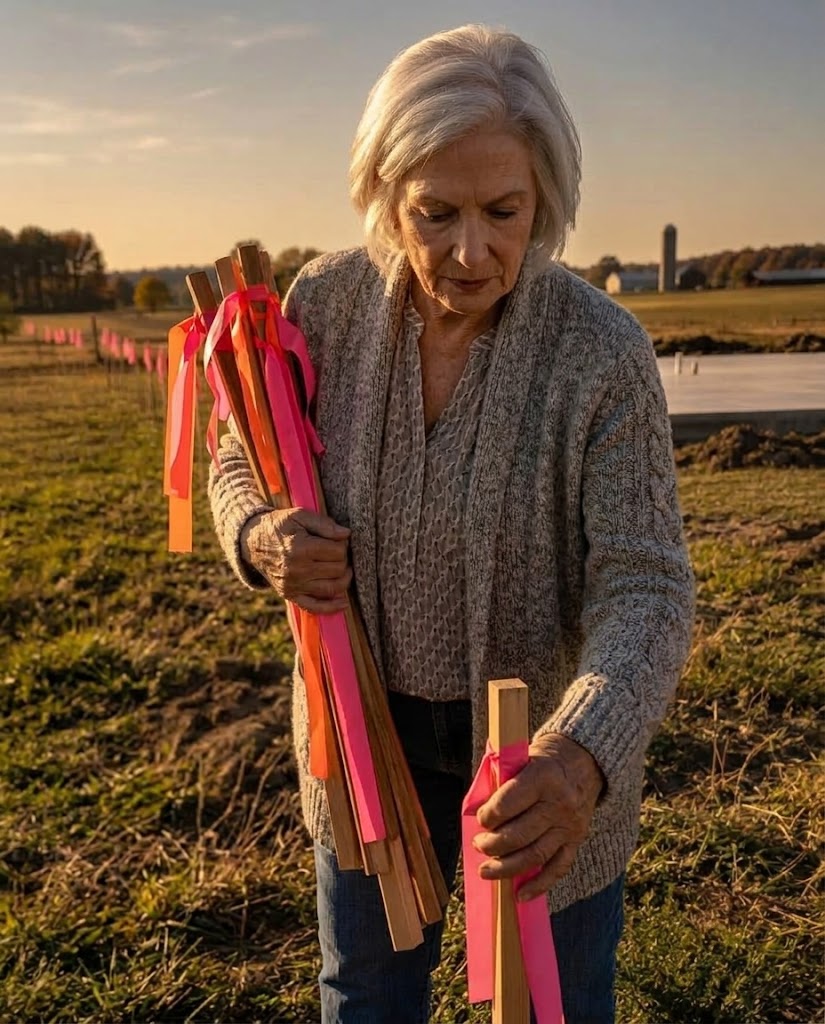
The following morning, I called Mr. Pruitt at the Orange County extension office and announced that I wanted to cultivate approximately two acres of my back lot, beginning immediately. He arrived with a soil probe, measuring tape, and wooden stakes, and together we examined the ground surrounding Brian’s concrete slab. He collected soil samples, explained that our clay loam would likely need agricultural lime to improve its acidity, and warned me not to plant in the area where the concrete trucks had washed out their chutes because cement residue could damage young roots. We planned sweet corn on the north side, a cutting garden filled with zinnias, cosmos, sunflowers, and gladiolus on the south, and an apple orchard on the slightly elevated eastern ground where cold air would drain away from the spring blossoms. I insisted that the boundary stakes be placed only six inches from Brian’s concrete, leaving him a sixty-foot access area on the western side for vehicles and equipment. When he drove through the gate and saw orange ribbons marking out my garden on three sides of his future shop, he was furious. He accused me of acting out of spite and complained that he would have no room to maintain the building. I reminded him that I had wanted an orchard on that land since before he could ride a bicycle and that his announcement about inheriting the farm had finally convinced me to stop postponing my plans. “I’m not stopping your shop, Brian,” I told him. “I’m planting mine.” He left without another word, but I went ahead with my plans. With help from our neighbor Dale, I prepared the ground and ordered twelve bare-root apple trees: five Enterprise, five GoldRush, and two Liberty, at thirty-two dollars apiece. Josie helped me plant every one, holding the slender trunks steady while I spread the roots and replaced the soil. When I told her the trees might take four or five years to bear fruit, she calculated that I would be seventy-one by then. “That’s not that old,” she said matter-of-factly, before marking one tree with two orange ribbons in memory of her grandfather. As spring became summer, Brian’s steel building rose beside my rows of vegetables and flowers, and his machinery-repair business began attracting customers. Soon visitors were coming for both his workshop and my garden, while local 4-H students harvested flowers for nursing-home residents and neighbors bought sweet corn from a roadside table, leaving donations for the food pantry. One afternoon, I overheard a customer compliment Brian on his property. My son quietly corrected him: “It’s my mother’s. I’m just on it.” That small acknowledgment meant more to me than I expected, but the conversation we truly needed to have was still waiting.
On the first Sunday in August, I invited Brian, Stacy, and Josie to supper and finally cooked the pot roast I had angrily returned to the freezer on the day the concrete was poured. We ate fresh corn, green beans with bacon, sliced tomatoes, and homemade pie at the same kitchen table where our family had gathered for decades. In the middle of dinner, Josie innocently asked her father who actually owned the farm, explaining that different people had given her different answers. Brian put down his corn and told her the truth: all eighty acres belonged to her grandmother, and he had built his shop without permission. Then he turned to me and apologized for suggesting that he was waiting for me to die so he could inherit the property. He admitted that unemployment and fear had made him desperate, and that he had avoided asking because he was afraid I might refuse. I told him I would probably have worried and argued, but ultimately I would have agreed. Then Brian revealed something I hadn’t known: shortly before Carl died, he had encouraged Brian to build a shop on the back lot if he ever decided to work for himself. I brought out the old nursery catalog and showed him Carl’s handwritten promise about my orchard. We sat quietly, realizing that the man we both missed had separately offered the same patch of land to each of us, believing there would somehow be room for both dreams. Brian was the first to suggest paying rent, and I agreed to an arrangement of one dollar per month plus one full Saturday of work on my farm, beginning at seven in the morning. We also agreed to establish his right to use the shop area through a written land-use agreement, making clear that ownership of the farm remained mine and that the building’s presence did not itself transfer title or guarantee an inheritance. Any permanent ownership transfer or estate-planning changes would require separate legal documentation. I wanted him to have a secure place to earn a living, but I also wanted both of us to understand that generosity and permission were not the same thing. Brian shook my hand across the table and placed the first dollar beside my plate, while Josie solemnly declared herself the witness. On the first Saturday in September, he arrived ten minutes early to help install protective fencing around the young apple trees. That morning, I voluntarily moved my boundary stakes four feet farther from his workshop so he could reach the gutters and maintain the exterior safely. He moved every stake himself, without being asked, and neither of us needed to discuss why that mattered.
By late November, the farm looked different from the lonely place it had become after Carl’s death. The corn had been harvested, the flower beds rested beneath the cooling soil, and twelve young apple trees stood inside protective wire fencing, their slender trunks wrapped against hungry rabbits and winter weather. Brian’s workshop was thriving, with machinery arriving most mornings and the familiar sound of an air wrench carrying across the yard. Each month, he placed a dollar bill on my kitchen table before beginning the day’s work, and I tucked it into Carl’s old coffee can on the windowsill. The money itself meant nothing compared with the understanding behind it: Brian had a place to build his future, and I still had the right to shape mine. One afternoon, with the autumn sun falling low over the fields, I walked to the Liberty apple tree Josie had marked with two orange ribbons for her grandfather. Along its slender branches were tiny brown buds, already formed and waiting for spring. I stood there longer than I intended, remembering the young woman I had been in 1987, circling apple trees in a catalog while my little boy played at my feet. I thought of Carl, who had always believed there would be time for everything, and of Brian, who had frightened me into remembering that time was still mine to use. Our family had not repaired every hurt with a handshake or a pot roast, but we had found a better way to share the place we loved without confusing affection with entitlement. I could hear my son whistling inside his workshop, terribly off-key, just as his father used to do when he worked on the tractors. In four or five years, if the weather cooperated and the trees remained healthy, Josie and I would be able to pick our first apples together. I would be seventy-one, perhaps seventy-two, and she would be a teenager. That did not sound old to me anymore. For the first time in years, I was looking forward to a future that belonged not merely to whoever inherited the farm, but to the woman who was still living on it. And when those apple trees finally bear fruit, I intend to be standing beneath them.

