
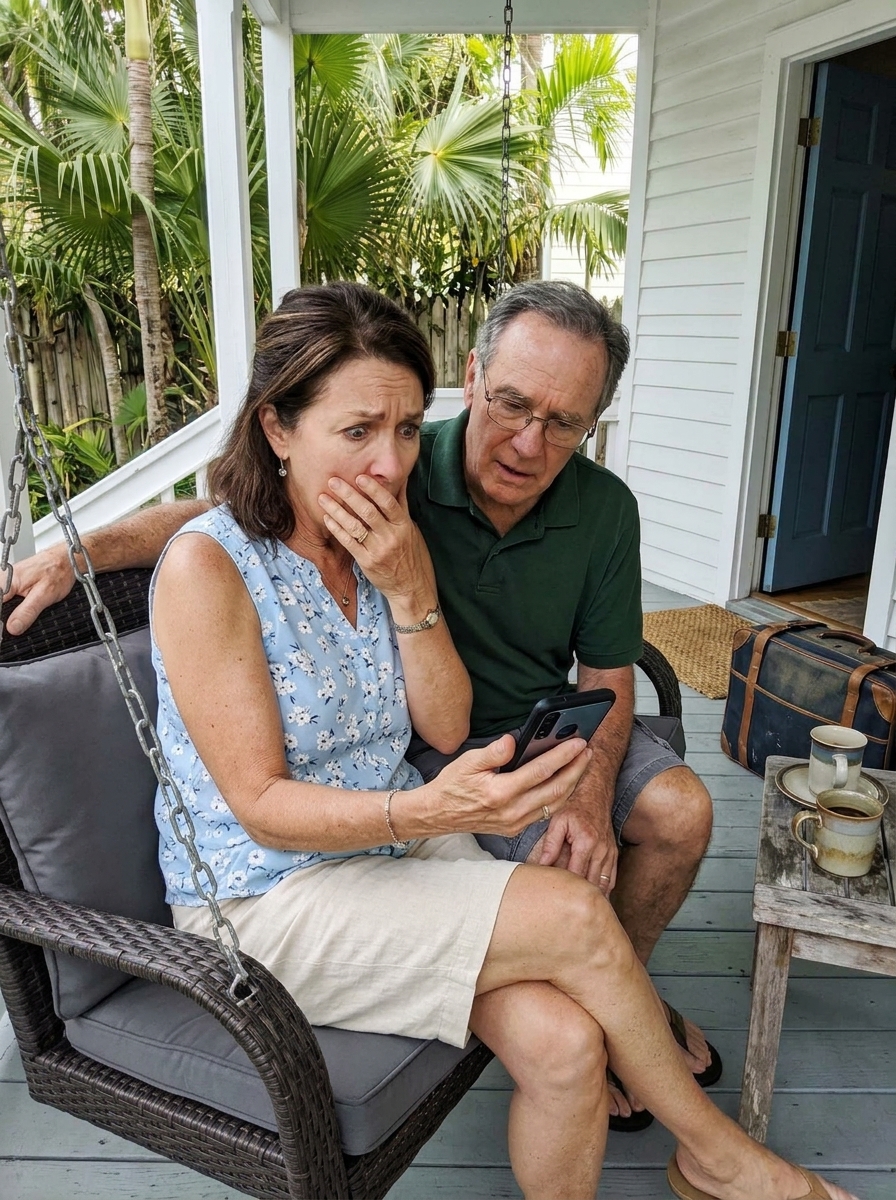
This is a fictional story.
“Cancel your flight, Mom. We need you here.”
My son Brian wasn’t asking. He was telling me.
It was 9:47 p.m. In eleven hours, my husband George and I were supposed to board a flight to Key West for a trip we’d been trying to take for five years.
Our 32nd wedding anniversary. A little cottage three blocks from the water, with a tiny kitchen and a porch swing.
Five Years of “Not Now”
My name is Helen. I’m sixty-eight years old. For the past seven years, I’ve been my grandchildren’s after-school pickup, sick-day nurse, summer camp, and weekend babysitter. I’ve been my son’s emergency fund more times than I can count.
Every time George and I planned a trip, something came first. A grandchild needed watching. Brian needed a loan. Someone had an appointment, an emergency, a crisis.
And George, bless him, never complained. He just folded his good shirts back into the drawer, put the tickets away and said, “Don’t worry, Helen.”
There was always sadness behind those words. I chose not to hear it.
That night, I had two dresses laid out on the bed — one navy, one cream — and I was holding them up in the mirror like a bride. George sat by the window checking our reservation for the third time.
“They have a porch swing,” he said quietly, as if saying it out loud might keep the trip from disappearing again.
Then Brian called.
“I Know.”
“Megan starts training Monday. We need you to keep the kids next week.”
“Brian, our flight leaves tomorrow morning.”
“I know.”
Those two words hurt more than shouting. Megan had known about her training for two weeks. She’d mentioned it at Sunday dinner. Nobody asked if we were free. Nobody arranged a sitter. They waited until my suitcase was packed, because they knew exactly which button to press.
A text followed: “Don’t be selfish. Family comes first. Cancel your trip.”
He called back at 10:22 with a list. The sitter was too expensive. The mortgage had gone up. Megan’s promotion depended on the training. Molly, seven, had a school project. Eli, four, still woke up at night, and only Grandma could settle him.
Some of it was true. That’s what made it hard.
“Brian, I know things are difficult. But I’m not canceling our trip.”
Silence. Then, coldly: “Fine. Just remember this when you need something from us.”
“I’ll remember that you said it,” I answered, and hung up.
5:22 A.M.
While the coffee brewed the next morning, his final message appeared.
“If you get on that plane, don’t ever call us again.”
“Helen,” George said gently, “we can still stay.”
I picked up my suitcase. “No. We’re going.”
At the airport, nineteen messages were waiting. The last one nearly broke me: “Molly asked why Grandma chose the beach over her.”
I cried in a bathroom stall while suitcases rolled past outside. Then I washed my face, walked to the gate, took George’s hand, and switched my phone to airplane mode.
Above the clouds, for the first time in years, nobody could reach me. And I could finally hear my own life breathing.
Nancy’s Message
We landed in Key West under a blazing afternoon sun. When I turned my phone back on, the messages flooded in — Brian’s angry, Megan’s guilt dressed up as concern.
But buried among them was a text from our next-door neighbor, Nancy, with a photo attached.
“Helen, is everything okay? Brian is at your house with a moving truck. There’s also a man in a suit with a clipboard walking through your rooms, taking pictures. He told me he’s an appraiser. Did you know about this?”
I opened the photo. Our driveway. A rental truck. My son carrying a box through our front door. And a stranger photographing our living room.
My son hadn’t wanted me to stay home.
He’d been waiting for me to leave.
What was Brian really doing in his parents’ house? Continue to the next page…
The Paper in the Drawer
I showed George the photo. He went very still.
“The power of attorney,” he said slowly.
Two years earlier, before George’s heart surgery, our lawyer had suggested a financial power of attorney “just in case.” We’d named Brian. George recovered completely, and we forgot all about it. We never revoked it.
Our house had been paid off for nine years. It was the only real thing we owned.
An appraiser doesn’t walk through a paid-off house for no reason.
I called our bank’s fraud line from the cottage porch, my hands shaking so hard I could barely dial. A calm woman named Denise pulled up our account.
“Mrs. Walsh, we have a pending application for a $185,000 home equity line of credit on your property, submitted by your son under a power of attorney. The appraisal is scheduled for today. Closing was set for next Thursday.”
Next Thursday. The day before we were due home.
“Please stop it,” I said. “We did not authorize that.”
“I’ll place a hold immediately. You’ll want your attorney to formally revoke the power of attorney today.”
Our lawyer, Tom Fischer, answered on the second ring even though it was Saturday. By 5 p.m., the revocation was signed electronically, sent to the bank, and filed with the county.
Why the Truck?
That evening, Megan called. Not Brian. Megan.
She was crying. “Helen, I swear I didn’t know about the loan. I only found out an hour ago, when the bank called Brian.”
The truth came out in pieces.
Brian had lost his job four months earlier and hadn’t told anyone, not even his wife. He’d been “going to work” every morning and sitting in coffee shops, applying for jobs. He’d run up their credit cards. Their mortgage was three months behind. The bank had sent a foreclosure notice.
His plan was to move his family into our house “temporarily” while we were away, take out a loan against it to pay his debts, and present it to us as “already done” when we came home. The babysitting request was real. But it was also a test. If I stayed, he’d have needed another week. If I left, he’d have the house to himself.
“He was so ashamed,” Megan said. “He thought if he told you, you’d think he was a failure.”
“So instead,” I said quietly, “he decided to take the only thing his father and I have left.”
The Call
Brian called at 9 p.m. His voice was hoarse.
“You froze it. Do you know what you’ve done? We’re going to lose everything.”
For thirty-seven years, every time my son was in trouble, I fixed it.
“Brian,” I said, “you told me that if I got on that plane, I should never call you again. So I didn’t. But you called me. So listen.”
Silence.
“I love you. I will always love you. If you had come to me and said, ‘Mom, I lost my job and I’m scared,’ your father and I would have helped you figure it out. But you didn’t ask. You tried to take our home behind our backs while we were celebrating thirty-two years of marriage.”
I heard him start to cry. My boy.
“Take the boxes out of our house tonight,” I said. “Return the key to Nancy. We’ll talk when we get home on Friday. Not before.”
“Mom—”
“Goodnight, Brian.”
The Porch Swing
Nancy texted the next morning: “Truck’s gone. Key’s in my mailbox. Everything looks fine. Enjoy your trip, honey. You’ve earned it.”
And we did.
We drank our coffee slowly on that porch swing every morning. We walked to the water at sunset. George danced with me in the tiny kitchen to a song on the radio. On our anniversary, I wore the cream dress.
One night, George took my hand and said, “I’ve been waiting a long time to have you all to myself again.”
I realized he’d been waiting for years. And I’d made him.
Home
When we got home, Brian was sitting on our front steps. Alone. He looked thinner.
He stood up and said the words I’d waited years to hear. Not “I need.” Not “you have to.”
“I’m sorry, Mom. Dad. I’m so sorry.”
We didn’t give him money. We gave him something better: the name of a financial counselor, an introduction to George’s old friend who runs a logistics company and was hiring, and a promise that I’d watch the kids every Tuesday and Thursday. Not every day. Tuesdays and Thursdays.
He got the job. They sold their house before foreclosure and moved into a smaller rental. Megan finished her training and got her promotion.
And Molly? I took her out for ice cream and told her the truth: that Grandma loves her more than the whole ocean, and that grandmas need vacations too.
She thought about it seriously. “Can I come next time?”
“Maybe,” I said. “But not on our anniversary.”
Next year, George and I are going back to Key West. Same cottage. Same porch swing.
I’ve already told everyone the dates. Nobody has asked me to cancel.
This story is a work of fiction. Names, characters and events are invented.