
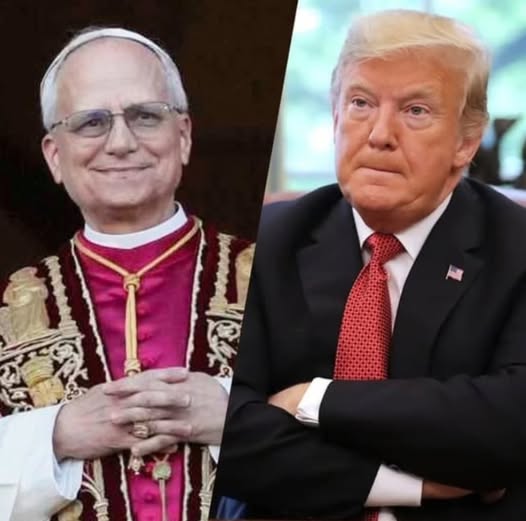
The election of Pope Leo XIV, formerly Cardinal Robert Prevost, has brought a new wave of moral debate into global politics, particularly surrounding the contentious issue of immigration. Known throughout his career as a steadfast advocate for the dignity and rights of migrants, the new pontiff is already distinguishing himself as a bold and uncompromising voice. His message directly challenges the growing wave of nationalist rhetoric, and it has placed him at odds with some of the most influential conservative leaders in the United States.
From the very beginning of his papacy, Pope Leo XIV has made it clear that his vision for the Catholic Church builds on the legacy of his predecessor, Pope Francis. Francis had long championed the idea that Christian love cannot be confined by borders or nationality, and Leo XIV has embraced this teaching with equal force. In his view, compassion is not something that should be rationed based on where a person comes from or what papers they hold. Instead, he insists that true Christian love is universal, unconditional, and grounded in the belief that all human beings are entitled to dignity and respect.
This philosophy has already led to a public clash with U.S. Vice President JD Vance, who has frequently promoted a political vision in which the needs of American citizens are placed above those of migrants. Vance has framed this argument through the concept of ordo amoris, or “order of love,” suggesting that citizens naturally deserve priority in the distribution of resources and protection. Pope Leo XIV, however, has rejected this interpretation. Engaging directly with the debate through statements and social media commentary, he has made clear that love, as understood in Christian teaching, is not hierarchical. By singling out some groups as less deserving, he argues, society undermines the very essence of the Gospel message.
The new pope’s firm stance on immigration is not a sudden development but part of a consistent moral trajectory that stretches back to his years as a cardinal. Even before his election to the papacy, he was outspoken in his opposition to former U.S. President Donald Trump’s restrictive immigration measures. He was particularly critical of policies that separated families at the border and limited asylum protections. To him, these actions represented not only political decisions but ethical failures, contradicting the Church’s teachings on human dignity and solidarity.
By continuing to voice these convictions as Pope Leo XIV, he is positioning the Vatican as a clear counterweight to nationalist movements that are gaining traction in many parts of the world. His leadership underscores that Catholic social teaching extends beyond national boundaries and calls believers to view humanity as a single family. In his speeches and writings, he has emphasized that compassion should not stop at the edge of one’s country but should extend to those who are vulnerable, displaced, or seeking refuge.
Unsurprisingly, his words have already stirred political backlash. Conservative leaders in the United States, particularly those aligned with the hardline immigration positions of JD Vance and Donald Trump, are likely to see his interventions as an unwelcome intrusion into domestic affairs. Yet the pope does not appear deterred. His mission, he has stated, is not to align with political ideologies but to remain faithful to the Gospel and to the Church’s moral responsibility to defend the marginalized.
The implications of Pope Leo XIV’s papacy go beyond the United States. Migration crises are intensifying worldwide, from conflicts in the Middle East to climate-driven displacement in Africa and South Asia. By making immigration one of the central moral issues of his papacy, he is positioning the Catholic Church as a key global voice on humanitarian policy. His words may not have the power of law, but they carry immense moral authority, and they could shape debates in international organizations, influence public opinion, and challenge political leaders across continents.
In many ways, Pope Leo XIV represents continuity with Pope Francis, yet his willingness to engage directly with specific political figures shows a willingness to confront issues head-on. His disapproval of Vance’s rhetoric and his long-standing criticism of Trump-era policies are evidence that he is not afraid of controversy. Instead, he seems to recognize that moral clarity often requires conflict, particularly when the dignity of the vulnerable is at stake.
As his papacy unfolds, the world will be watching how he balances diplomacy with his prophetic role. Some will praise him for his courage, while others will accuse him of meddling in politics. But to Pope Leo XIV, the mission appears clear: to remind the global community that love and compassion cannot be restricted by walls, laws, or borders. In his view, the call of the Gospel demands nothing less.
By stepping into this role so decisively, Pope Leo XIV has ensured that the Catholic Church will remain at the center of the moral conversation on immigration for years to come. His words are not only a challenge to the policies of leaders like JD Vance and Donald Trump but also a broader appeal to humanity’s conscience. At a time when debates over borders and migration dominate political agendas, his voice serves as a powerful reminder that true leadership begins with empathy, solidarity, and the courage to embrace all people as brothers and sisters.