
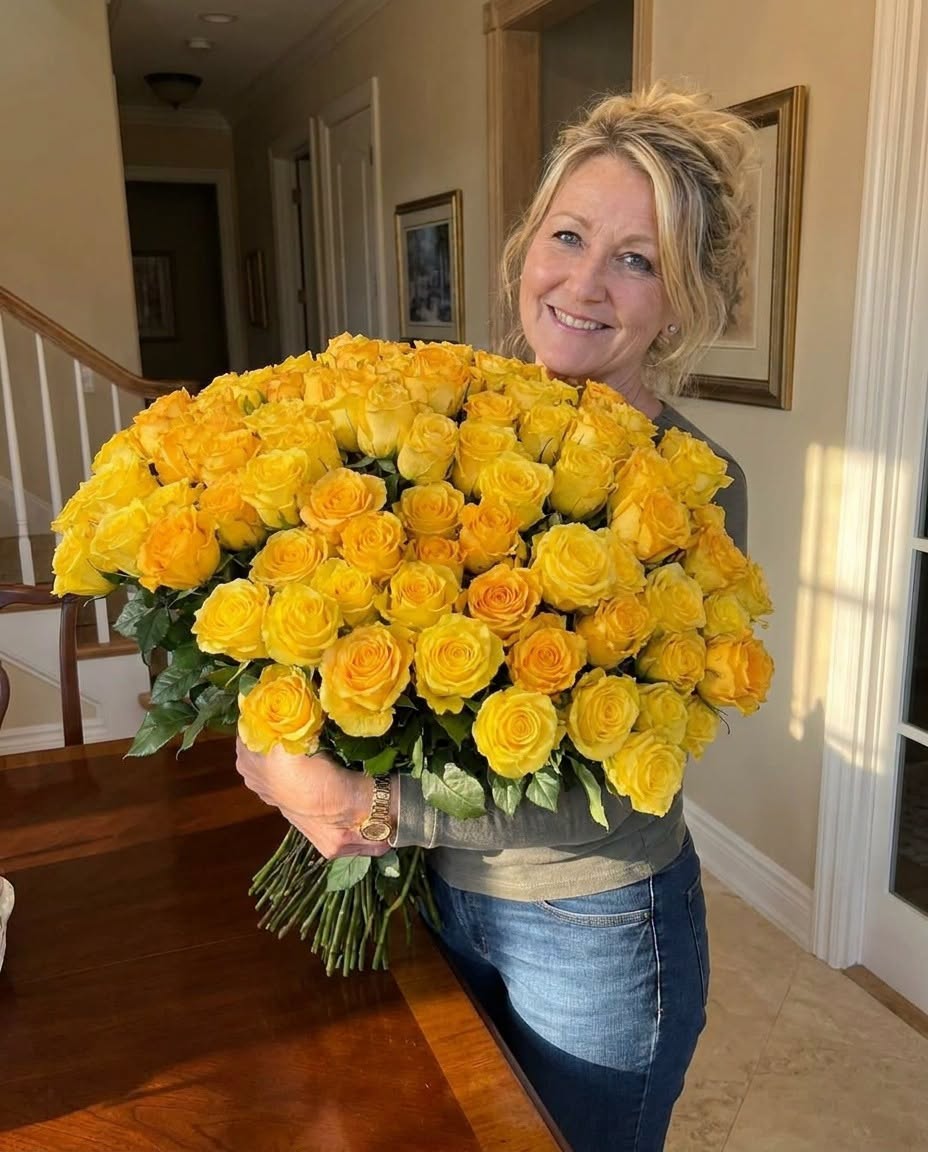
The roses arrived just after noon, one hundred of them, bright yellow and heavy enough that I had to brace the bundle against my chest while the delivery driver stepped back toward his van. There was no card, no signature, only my name and address printed on the florist’s tag, and at first I smiled because I assumed my husband Marcus had arranged the surprise from his business trip. Then I remembered that in nineteen years of marriage he had always bought me white roses, never yellow, and that there was no birthday, anniversary or milestone to explain exactly one hundred blooms. I called him twice and received only voicemail. While waiting, I noticed the arrangement was unnaturally precise—ten rows of ten—and began examining the flowers one by one. Hidden beneath the petals of three separate roses were identical small red marks, carefully placed where nobody would see them accidentally. Something old and half-forgotten rose in my memory, and instead of calling Marcus again, I locked the doors and called the police.
The first responding officers were polite but understandably cautious about treating a bouquet as evidence until Detective Hollis arrived and saw the three marked flowers. He had worked with my late father, Ray, a homicide detective who had spent years haunted by an unsolved case involving three women who disappeared twenty-three years earlier. Each victim had received exactly one hundred yellow roses shortly before vanishing, and each bouquet contained three hidden red marks—a detail law enforcement had deliberately withheld from the public as a signature only the perpetrator should know. Hollis immediately secured the house, and the situation worsened when Marcus’s supposed business trip began falling apart under basic verification. His company believed he was home, there was no flight under his name and the hotel reservation he had given me did not exist. Then police opened a gray lockbox from his office and found old newspaper clippings about the disappearances covered in Marcus’s handwriting. By midnight, the man who had made terrible pancakes on Sunday mornings and slept beside me for nineteen years had become a person of interest in a decades-old investigation.
The next morning changed the direction of everything. Fingerprints recovered from the florist’s retained order paperwork did not belong to Marcus; they matched Gareth Pruitt, a retired detective who had worked the original disappearance case alongside my father. Hollis then explained something Ray had apparently carried to his grave: before his death, my father had begun to suspect his own partner but never obtained enough evidence to act. Marcus had recently discovered Ray’s private case notes in an old box stored in our garage and secretly begun reconstructing the investigation. The newspaper clippings in his office were not trophies but research. According to Hollis, Pruitt appeared to have realized Marcus was getting dangerously close and used the yellow roses to resurrect the old signature, frighten him and draw attention toward our house while Marcus himself disappeared. The flowers that had made me question my marriage were not evidence that Marcus had been hiding the killer from me. They were evidence that the killer had discovered Marcus was hunting him.
Investigators eventually traced Pruitt through an old family property record to an isolated hunting cabin outside the city. Marcus was found there alive and Pruitt was arrested. Evidence recovered from the property linked Pruitt to the three historic disappearances strongly enough for the case to move forward after twenty-three years of uncertainty. Marcus returned home after medical treatment with bruises, a bandaged wrist and an apology he could barely get through without shaking. He admitted that he had lied about the business trip because he believed secrecy would keep me outside the danger surrounding my father’s old files. I told him the lie had nearly destroyed the very trust he thought he was protecting, and he agreed. The investigation finally provided the victims’ families with answers and transformed my father’s unfinished private notes into something with legal consequence, but it also left Marcus and me facing a quieter form of repair: rebuilding the confidence that protection should never require one spouse to decide alone what the other is allowed to know.
Weeks later, Marcus and I sat together on our back porch after sunset, his hand resting over mine while the yard disappeared into darkness beyond the porch light. The bouquet remained sealed in police evidence, and even seeing yellow roses in a shop window still tightened something in my chest. I thought about my father telling me long ago that some monsters leave symbols instead of fingerprints, words I had dismissed as the exhaustion of a detective carrying too many unsolved things home with him. He had been right, but the part that stayed with me most was not the darkness he had recognized. It was the record he had refused to throw away. Because he kept writing, Marcus found the thread. Because Marcus followed it, Pruitt finally became afraid enough to reveal himself. And because the truth survived longer than the man who first recorded it, three families finally received answers while my husband came home alive. That night, sitting beside him beneath the same kind of darkness that once frightened my father, I understood that some unfinished things do not disappear. They simply wait for someone else to pick them up.

