
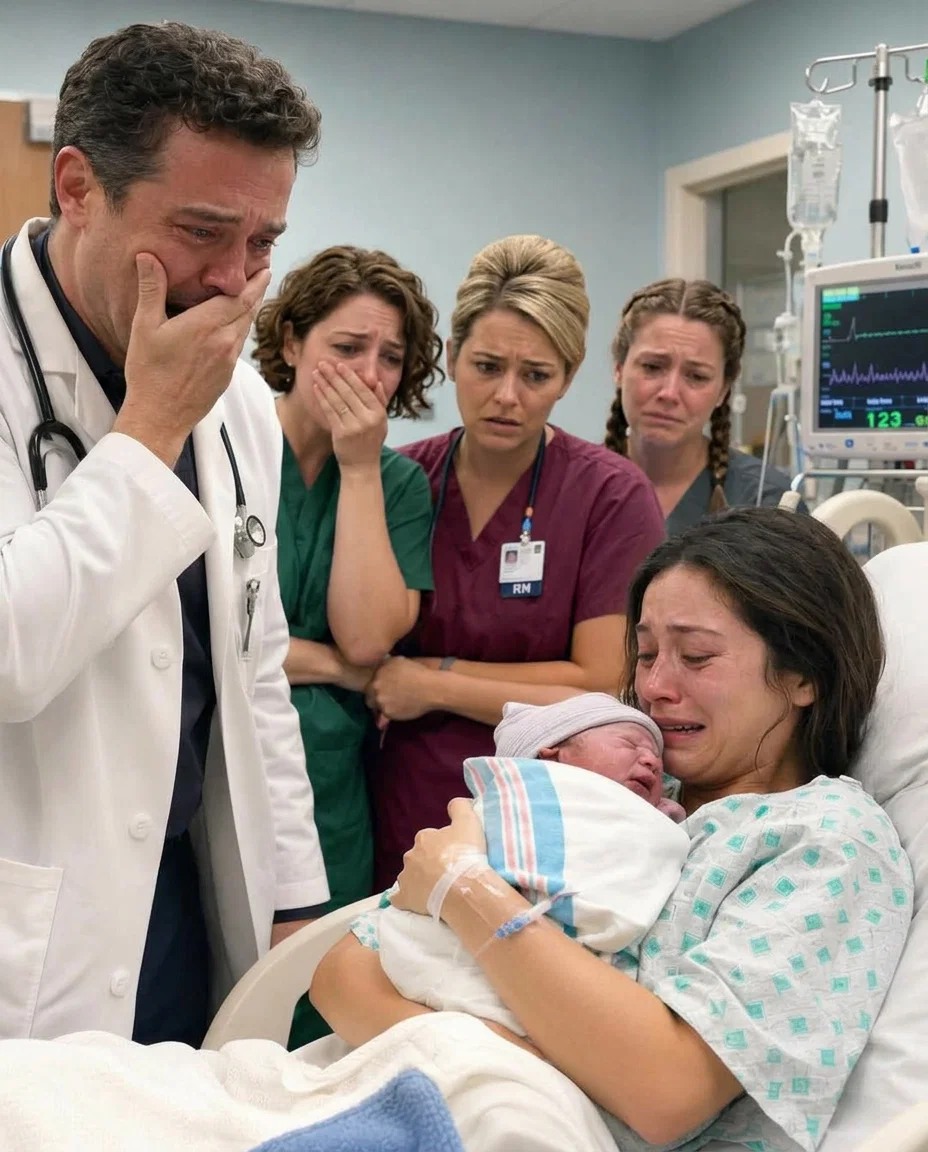
Dr. Robert Wright had spent thirty-two years mastering the art of staying calm.
He had stood beside frightened mothers, overwhelmed fathers, and newborns who arrived too soon, too quiet, or too fragile. People trusted him because he never shook, never panicked, and never let the fear in the room become his own. But in Delivery Room Four, with gray winter light pressing against the windows, Robert looked at the newborn in the nurse’s arms and felt the world tilt beneath him.
The baby was tiny, angry at the cold, his little fists curled near his cheeks. Damp dark hair clung to his head. Just below his left collarbone, where the blanket had slipped aside, was a birthmark shaped like a broken crescent—pale at the edges, darker in the center, like a small moon cut by shadow. For one impossible moment, Robert was no longer in the hospital. He was decades in the past, holding another newborn with the same mark in the same place. A child who had disappeared. A child he had believed was lost forever.
“Doctor?” the nurse asked.
Joanna noticed his reaction. Exhausted from labor, her body still trembling, she lifted her head with the fierce awareness only a new mother has.
“Is something wrong?” she whispered.
Robert opened his mouth, but no words came. He wiped at his eyes quickly, as if embarrassed, then pushed his shaking hand into his coat pocket.
“Nothing is wrong with the baby,” he finally said, though his voice sounded fragile.
Joanna’s eyes narrowed.
“Then why are you crying?”
He looked down at her chart again. Joanna Ellis. Twenty-eight years old. No emergency contact. No spouse listed. Father of child: not provided.
“May I ask,” Robert said carefully, “what is the father’s name?”
Joanna’s fingers tightened around the sheets. She had spent seven months teaching herself not to react to that name.
“Why?”
“Because I need to know.”
The nurse shifted uneasily.
“Doctor, maybe this can wait.”
“No,” Joanna said. “If something is wrong with my baby, you tell me now.”
Robert’s face changed. The calm doctor’s mask slipped, revealing an old man carrying a grief too heavy to hide.
“Nothing is wrong with him,” he said. “But I think I may know his family.”
For months, family had meant only Joanna. Her hands on her stomach. Her voice in an empty apartment. Her aching body standing through long shifts at the diner because there was no one else.
“The father’s name,” Robert repeated softly.
“Logan,” she said.
Robert closed his eyes.
“Logan Wright?”
Joanna’s heart slammed. She had never given the hospital Logan’s last name.
“How do you know that?”
Robert opened his eyes.
“Because he is my son.”
The words landed like a confession. Joanna stared at him, too tired to decide whether she had misheard.
“Logan is my son,” Robert said again. “I didn’t know about the pregnancy. I swear I didn’t.”
Something buried beneath months of loneliness, unpaid bills, swollen ankles, fear, and anger stirred inside her.
“He left when I told him,” she said. “He said he needed air. He packed a bag and promised he would call.” Her voice cracked, but she forced herself to keep speaking. “He never did.”
Robert lowered his gaze.
“I’m sorry.”
“Where is he?” Joanna demanded. “If he’s your son, where is he?”
Robert looked at the baby, then back at her.
“I don’t know.”
“What do you mean, you don’t know?”
“I haven’t seen him in seven months.”
The nurse placed the baby into Joanna’s arms. Instinct overpowered everything. She pulled him close, breathing in his warm newborn scent. Her son quieted almost at once.
“The night he left you,” Robert said, “he came to me.”
Joanna looked up slowly.
“He was terrified. I had never seen him like that. He said he had made a mistake, that he needed to leave, that people were looking for him. I thought he owed money. I thought he had gotten himself into trouble. He had always been impulsive.”
“Did he tell you about me?”
“No. He didn’t mention you. He didn’t mention a baby.” Robert’s face tightened with regret. “If he had—”
Joanna waited.
“I told him to stop running. He became angry and said I had never understood anything about blood.” Robert looked again at the birthmark. “Then he left. Three days later, his car was found abandoned near Blackwater Bridge. No crash. No signs of him. Just the car, his phone, and his wallet.”
Joanna’s breath caught.
“No body?”
“No body. The police believed he staged it and ran. I wanted to believe he was alive.”
For seven months, Joanna had imagined Logan somewhere free, careless, laughing too easily, telling someone new that his past was complicated. That image had hurt, but it had kept her standing. Anger was easier than grief. Now there was a bridge, an abandoned car, and a father who had vanished from more than one life.
Robert pulled a chair closer and sat carefully.
“My wife and I had two sons,” he said. “Logan, and another boy. His name was Elias.”
The name meant nothing to her.
“Elias had a birthmark under his left collarbone, exactly like your son’s. When Elias was five, he disappeared.”
The nurse crossed herself without thinking.
Robert kept going, as though stopping would break him.
“It happened at the county fair. One moment he was beside my wife. The next, he was gone. We searched for months. Police, volunteers, dogs in the woods. Nothing. No note. No body. No reliable witness.”
His hands pressed hard against his knees.
“My wife kept his room the same for ten years. His shoes by the bed. His drawings on the wall. She died believing he was still alive.” His voice almost failed. “That birthmark appears in my family sometimes. When it appears, it looks almost identical.”
Joanna looked down at the mark on her son’s skin.
“So this baby is your grandson,” she said.
The word trembled between them.
“What did Logan tell you about his family?” Robert asked.
She gave a humorless laugh.
“Almost nothing. He said his mother died. He said you were strict. He said he hated hospitals.” She paused. “He said there were things nobody in his family talked about. He had nightmares. Once, he said a name in his sleep.”
Robert barely breathed.
“What name?”
“Elias.”
The nurse made a soft sound.
Robert stood so quickly the chair scraped the floor. Joanna flinched.
“I’m sorry,” he said, though his eyes had turned distant and afraid. “Three months before Logan disappeared, he came to my house drunk. He went into Elias’s old room. I had kept it locked after my wife died. I couldn’t clear it out. Logan broke the lock.”
Joanna waited.
“He said he remembered something. He remembered the fair. He remembered Elias being led away. A woman in a green coat was holding his hand. But Elias wasn’t crying. Logan said Elias looked back and smiled.”
Joanna glanced at the sleeping baby.
“Logan was three years old when Elias vanished. For years, he remembered nothing. Then suddenly, after nearly twenty-five years, the memory returned.”
“Why then?”
“Because someone sent him a photograph.”
Joanna went still.
“He refused to show it to me. He said if I saw it, I would try to stop him. He said he knew where Elias was.”
Alive. The missing boy might have grown into a man.
“We fought,” Robert said. “I thought it was a hoax. Families like ours attract cruel lies. People claimed to be Elias before. They called asking for money. Every time, my wife broke a little more. I couldn’t endure it again. But Logan believed it.” His eyes shifted toward the baby. “Then he met you. Then he disappeared.”
A knock sounded at the door.
Everyone froze.
Another nurse stepped in, holding a clipboard.
“Dr. Wright, someone at the front desk asked for Joanna Ellis.”
Joanna tightened her arms around the baby.
“I don’t have family here.”
“He said he was family. He left before security reached him.” The nurse held out a white envelope. “He left this.”
Only one word was written on the front.
JOANNA.
Robert reached for it.
“No,” she said.
He stopped.
Joanna took it herself. The envelope felt too light. Inside was a photograph.
It was clear and recent. Logan stood in what looked like a cellar. He was thinner than she remembered, his face sharp, his beard untrimmed, his eyes hollow with fear. One hand was raised toward the camera, as if telling the person behind it to stop.
Beside him stood another man, slightly older. Same dark hair. Same mouth. Same eyes.
And beneath his open collar, just visible, was the broken crescent birthmark.
Robert made a sound that was not a word.
Joanna turned the photo over. Logan’s handwriting covered the back.
He’s not dead. Don’t trust my father. Protect the baby.
She looked up.
Robert Wright stood beside her bed with tears running silently down his face.
The lights flickered once. Twice. Then steadied.
The baby began to cry.
Joanna forced herself to breathe. Her mind moved through everything Robert had said, everything he had avoided, and the shape of a story that still did not fit together.
“Sit down,” she said.
Robert sat.
“You knew about this photograph before tonight,” she said. “When did you receive it?”
He reached into his coat and removed a folded paper, soft from being handled too often.
“Five months ago.”
He handed it to her.
It was another photograph, grainy and cheap, showing a man outside a gas station at night. Dark hair, narrow face, scar near the jaw. On the back, written in black marker, were the words:
ASK LOGAN WHAT MICHAEL DID TO ELIAS.
Joanna stared at him.
“Did you go to the police?”
“Yes. They took a copy. Nothing happened.”
“And Logan?”
“Logan was already gone.”
She handed the photograph back and thought of Logan waking from nightmares, saying his brother’s name, chasing a memory into danger.
“You said Logan wrote, ‘Don’t trust my father.’ Why would he write that?”
Robert was silent for a long time.
“I made a choice twenty-five years ago,” he said at last. “The night after Elias disappeared.”
Joanna waited.
“There was a witness. A woman who worked at a food stall near the fair entrance. She came to me privately, not the police. She said she had seen Elias being led away by a man in a gray jacket. Not a woman. A man. She said she recognized him.”
“And?”
“The man she described was my father.”
The room went completely still.
“I was thirty-eight,” Robert said. “A doctor. A husband. A father. My wife was in shock. My father was controlling and cruel, but I never wanted to believe he could—” He stopped. “I told the woman she must have been mistaken. I told her grief had confused her memory. I gave her money and told her not to come forward.”
Joanna felt cold.
“But you didn’t really believe she was wrong.”
Robert pressed his hands together.
“I told myself I did.”
“And Logan found out.”
“The gas station photo. The message on the back. If Logan traced Michael through my father’s old associates, then he may have confirmed it. My father is dead now, but Michael worked with him in those years. If Elias was not taken by a stranger, but handed to someone as part of some old debt or punishment—”
He could not finish.
Joanna looked at the man in front of her. She understood the shape of his guilt, but she did not forgive it. A child had been lost. A witness had been silenced. A family had broken for decades because a frightened man had chosen not to look too closely at the truth.
“The photograph Logan left me,” she said. “It shows two men who found each other.”
Robert nodded.
“Then Logan wasn’t running from fatherhood.” She looked again at the fear in Logan’s eyes. “He found his brother. And then something found them.”
“Yes.”
“And whoever sent this envelope knows where I am.”
“Yes.”
“And you have carried a photograph for five months and a secret for twenty-five years, and none of it helped anyone.”
Her words were not gentle. She was too tired for gentle.
Robert accepted them without defending himself.
Joanna looked down at her son and the crescent mark beneath his collarbone. Then she made a decision.
“Call the detective from the original case. Not the department. The detective. Tonight. Tell him about Michael. Tell him about the photographs. Tell him Logan found Elias and someone is watching.”
“Joanna—”
“Then you tell me everything else you left out. Your son trusted someone enough to send me a message at the hospital where his baby was being born. The least I can do is understand what he was trying to say.”
Robert looked at her for a long moment. Then he took out his phone and made the call.
Detective Carver, who had worked Elias Wright’s disappearance for eleven years before retiring, answered on the fourth ring. He listened without interrupting. When Robert finished, there was a brief silence.
“I’ll be there in forty minutes,” Carver said. “Don’t let anyone into that room you don’t know.”
Robert leaned back, his face changed by a strange kind of relief.
“I should have done this five months ago,” he said.
“Yes,” Joanna answered.
The nurse brought tea no one drank. Joanna fed her son for the first time, a simple act that felt both separate from the mystery and tied to everything. Robert sat across the room with folded hands, sometimes looking at the baby with an expression too complicated to name.
Carver arrived thirty-eight minutes later in civilian clothes. He was compact, in his late sixties, with the stillness of someone who had waited a long time for the same question to be answered. He studied both photographs, read the writing on the backs, and asked his questions carefully.
Near the end, he looked at Joanna.
“A man asked for you at reception?”
“Yes.”
“He said Logan sent him?”
“That’s what the nurse said.”
Carver nodded slowly.
“Logan was alive recently. And he trusted this person enough to send him to the one place he knew you would be.” He paused. “Leaving the envelope and disappearing before security arrived does not feel like a threat. It feels like someone trying to reach you without being followed.”
“If Logan found Elias,” Joanna said, “and someone is watching them both, then they know Logan has a child.”
“That envelope was confirmation,” Carver said. “And maybe protection.”
Robert looked at the photograph of the two men in the cellar.
“Where do we start?” he asked.
Carver opened a small notebook.
“You give me everything. Every conversation with Logan. Every detail about your father and Michael. We find them before whoever has them decides sending that photograph was a mistake.”
It took three weeks, two jurisdictions, and an old financial record from thirteen years earlier for Carver to connect the missing pieces.
Joanna was moved to a private room while her son was monitored. She learned his sounds and he learned hers. Between feedings and sleepless hours, she waited for her phone to ring.
When Carver finally called Robert, Joanna was already reaching for her shoes.
Logan and Elias were found at an abandoned farmhouse two counties north. Both were alive. Logan had an injured wrist that had not healed properly. Elias had spent most of his adult life under another name and had only recently begun to understand how that life had been given to him.
The man holding them was a younger associate of Michael’s, someone who believed he could profit from the situation. He had miscalculated many things, including how patient Detective Carver had been with this case.
Two days later, Logan was brought to the hospital.
Joanna watched him enter the room. He stopped when he saw his son in the bassinet and stood frozen.
He was thinner. Older. His wrist was braced. He looked like someone who had lived inside fear for too long and did not yet know what to do without it.
When he finally moved toward the bassinet, his face changed in a private, irreversible way.
“I was going to call,” he said, voice rough.
Joanna let the sentence hang.
“I was going to call when it was safe. I found Elias. I knew it was dangerous, and I couldn’t put you in the middle of it. I thought I could finish it and come back.”
“You could have told me.”
“Yes.”
“I spent seven months thinking you chose to leave.”
“I know. I was wrong. I didn’t know how to handle it, and I chose badly.” He looked down at his son. “I sent the photo the only way I could, through someone I trusted, to a place I knew you would be.”
“Don’t trust my father,” Joanna said.
Logan looked toward Robert in the corner.
“What I knew then and what I know now are different things,” Logan said. “He made a terrible choice. But he called the one detective who never stopped caring and told him everything. That matters too.” He paused. “Not equally. But it matters.”
Joanna thought about choices, guilt, and whether trying to repair something ever fully closes the damage left behind.
“Elias found me,” Logan said. “He had been searching for years. When the photograph arrived, he sent it. He wanted me to know before he came forward, in case I wasn’t ready.”
“Was he taken by your father?” Joanna asked Robert.
Logan looked at the bassinet.
“Yes. It’s complicated. Elias will tell it himself, when he’s ready.”
Robert nodded.
He stood by the bassinet for a moment. The baby looked back with the unfocused patience of the newly born.
“He needs a name,” Robert said.
“I know,” Logan replied.
Joanna had been thinking about it since the night of the photographs, the flickering lights, and the envelope that turned everything upside down. She had thought about what it meant to be born into a story already full of secrets, loss, and impossible returns.
“Elias,” she said.
Both men looked at her.
“Not to replace the one who was lost,” she said. “To give the name somewhere to go that isn’t only grief.”
Logan looked at his father.
Robert looked at the baby.
“Elias,” he said softly.
The baby blinked, as if considering it.
Outside the hospital window, the gray winter light began to soften. There was still a long road ahead: legal questions, buried truths, Robert’s confession, Elias’s story, Logan’s healing, and a family trying to rebuild itself from pieces no one had known how to hold.
But inside that room, there was a mother who had survived seven months alone, a father standing beside his newborn son, and a grandfather quietly crying in the corner.
Some stories are not solved all at once. They are reshaped slowly into something people can live inside.
The baby slept.
The lights stayed steady.
And outside, the winter morning finally arrived.

