
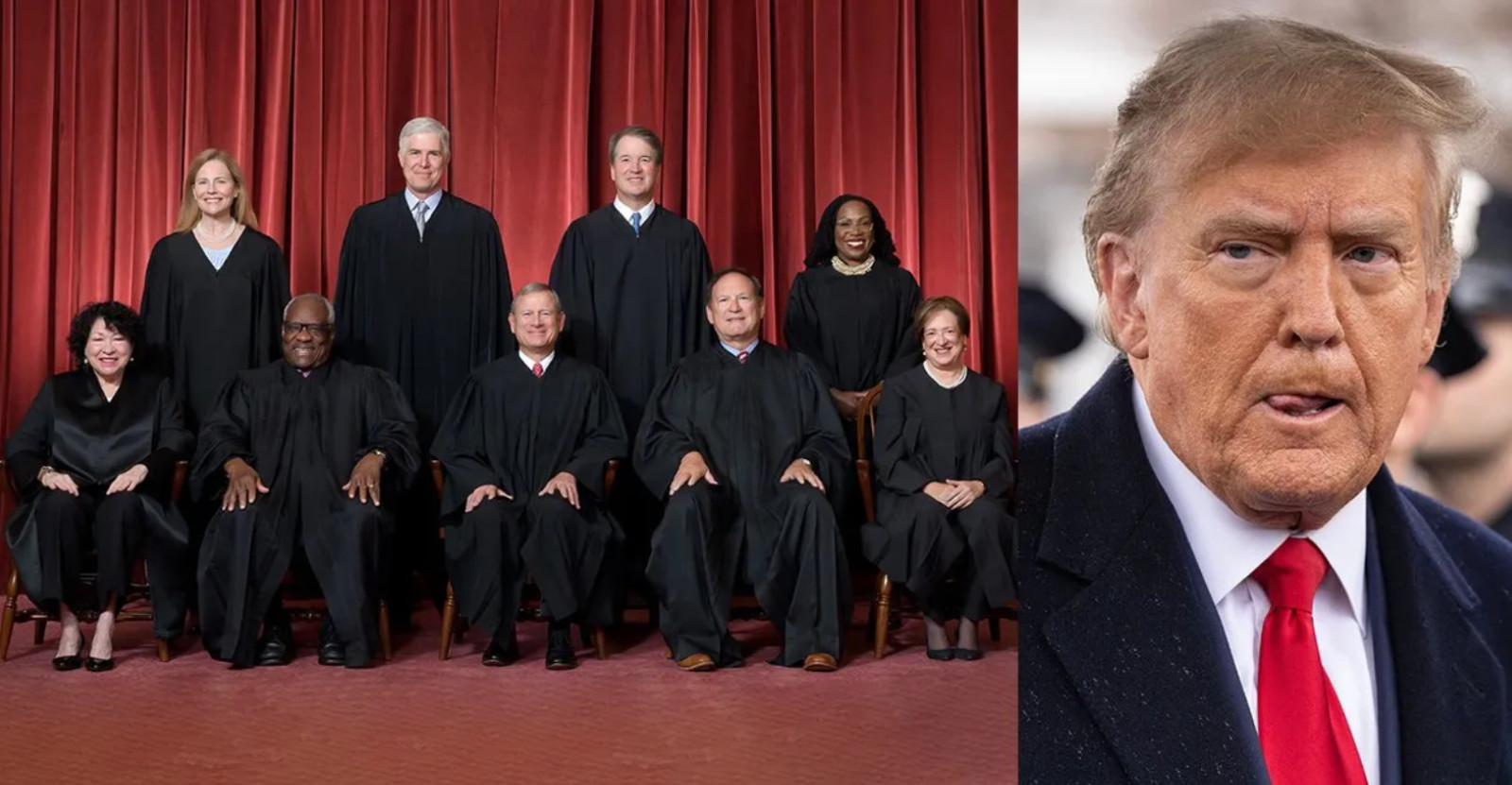
The U.S. Supreme Court on Monday gave President Donald Trump’s administration another big win.
The nation’s highest court tossed a Biden administration ruling that regulated efficiency standards for furnaces and water heaters.
In American Gas Association v. Department of Energy, justices on the high court vacated the District of Columbia district court’s ruling, which had upheld the Biden administration’s decision to enforce regulations on non-condensing appliances.
Lawyers for the American Gas Association and other trade groups said the Biden administration’s rules wrongly regulated the sale of commercial water heaters and furnaces.
“The Department may not adopt standards that effectively eliminate from the market products that have distinct ‘performance characteristics,’” Solicitor General John Sauer wrote in a brief to the high court.
The U.S. Supreme Court said that the D.C. district court should think again about its decision to uphold the Biden administration’s choice.
The Trump administration asked the high court to overturn the decision.
Sauer said the Trump administration is thinking about how to get rid of the rules from the Biden administration that are at issue in the case.
“The Department has determined that the rules at issue are factually and legally flawed, and the agency is considering a new rulemaking in which it would correct those errors,” Sauer wrote.
The case will return to the D.C. district court for further decision-making, where judges will likely issue a different ruling in light of the high court’s decision.
This is the second blow to Biden’s liberal agenda.
The House of Representatives voted 226–197 on Wednesday to repeal Biden-era restrictions on household showerheads.
The vote marks a bipartisan victory for Republicans who say they are defending consumer choice against excessive federal regulation.
The measure — formally titled the Saving Homeowners from Overregulation with Exceptional Rinsing Act, or SHOWER Act — drew support from 11 Democrats who joined the GOP majority in approving the bill.
“Washington bureaucrats have gone too far in dictating what happens in Americans’ own homes,” said Rep. Russell Fry (R-SC) who sponsored the legislation.
“This is about defending consumer choice, pushing back on regulatory overreach, and standing up for commonsense policy,” Fry added.
The issue is a Biden-era interpretation of water-use standards that limited the combined flow rate of multi-nozzle shower systems, which effectively reduced water pressure per head in households that use multiple fixtures.
The Department of Energy rule, finalized under former President Biden, required the total flow from all nozzles in a single shower unit to remain below the federal cap of 2.5 gallons per minute — a standard that had remained largely unchanged since 1992.
Republicans said the rule typified a broader effort by Democratic administrations to regulate everyday life through the Energy Department and Environmental Protection Agency.
“It seems like the Democrats want to tax you out of existence and overregulate you,” said Rep. John McGuire (R-VA). “So, this is a step in the right direction. Less regulation.”
The SHOWER Act would codify an executive order signed by President Donald Trump in April of last year, which restored an earlier definition allowing each shower nozzle to be treated as its own “shower head” under federal law.
That Trump directive effectively increased available water pressure for multi-head fixtures and gave consumers more discretion in choosing their setups.
“By codifying how different nozzles are categorized, the SHOWER Act offers a commonsense fix that will allow households to choose what meets their needs, not what Washington mandates,” said Rep. Brett Guthrie (R-KY) chairman of the House Energy and Commerce Committee.
Fry echoed that sentiment, calling the Biden-era rule “a symbol of bureaucratic micromanagement.”
He said, “The SHOWER Act reaffirms that each nozzle is a shower head — plain and simple — and that homeowners, not the federal government, should decide how much water pressure they want.”

