
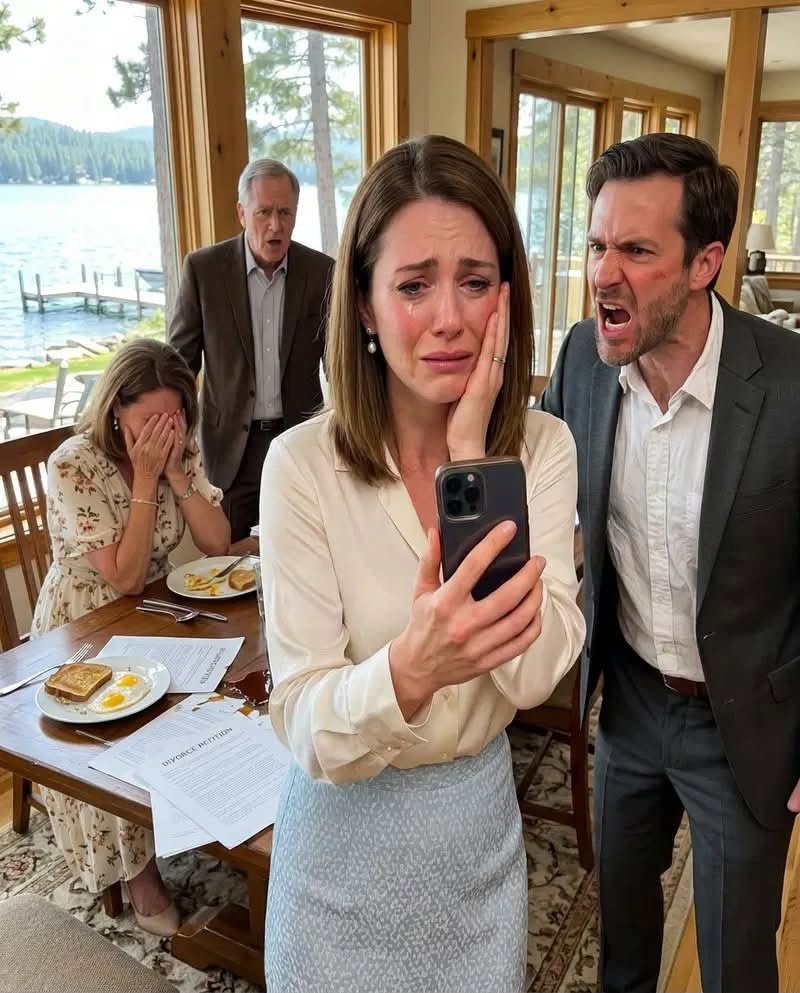
The first morning after our wedding, my husband shamed me in front of his whole family, assuming I would stay quiet and take it. But none of them knew I was prepared to reveal the truth, leave with my dignity intact, and make them all regret thinking I was weak.
The first morning after our wedding, I woke to the scent of coffee, bacon, and gleaming silverware. For three seconds, I forgot where I was. Then I noticed the pale blue walls of the Kensington family lake house in Vermont, my wedding dress hanging like a ghost from the wardrobe door, and my new husband, Brandon, standing before the mirror fastening his watch.
“Breakfast is at eight,” he said without looking at me.
I smiled, still warm with sleep. “Good morning to you too, husband.”
His reflection did not smile. “Don’t call me that in front of everyone. It sounds… needy.”
The word cut, but I swallowed the sting. Twenty-four hours earlier, he had cried through our vows. Twenty-four hours earlier, his mother had hugged me and called me “family.” I told myself he was anxious, exhausted, overwhelmed.
Downstairs, the whole Kensington family sat around a long oak table: his parents, his sister Claire, two uncles, an aunt, and three cousins still laughing over mimosas. I sat in the empty chair beside Brandon.
His mother, Patricia, glanced at my plain white blouse. “No makeup, Evelyn? Brave choice for a new bride.”
A few of them chuckled.
Before I could respond, Brandon leaned back and said, “She’s trying to look natural. It’s part of her little librarian charm.”
More laughter followed.
I tightened my grip around my coffee cup. “I’m a school counselor.”
“Oh, right,” Claire said with a smile. “Feelings and stickers.”
Brandon’s father, Richard, folded his newspaper. “So, Evelyn, now that the wedding show is over, Brandon told us you’re planning to quit your job and focus on supporting him.”
I turned toward Brandon. “That’s not true.”
He gave me a warning look. “We discussed priorities.”
“No,” I said calmly. “You discussed them with yourself.”
The room went cold.
Brandon laughed too loudly. “See? This is what I meant. She gets emotional when she feels small.”
Patricia sighed. “Honey, no one is attacking you. But in this family, wives understand presentation. Loyalty. Discretion.”
Then Brandon did it.
He pulled a folded paper from his jacket and pushed it across the table.
“Our post-wedding agreement,” he announced. “Just housekeeping. Evelyn will transfer her savings into our joint investment account, sign over the condo before the honeymoon, and agree that any future divorce settlement excludes Kensington assets.”
My ears began ringing.
I looked around the table. No one looked shocked. No one looked confused. They were waiting.
They had arranged this.
Brandon smirked. “Don’t embarrass yourself. Just sign it.”
I picked up the pen.
Then I looked at him and smiled.
“No.”
I stood, reached into my purse, and set my phone in the middle of the table. The voice recorder was still running.
Every insult. Every lie. Every demand.
All of it recorded.
PART 2
For one full second, nobody moved.
Then Patricia’s hand shot to her pearls. “You recorded a private family conversation?”
I looked at her steadily. “A private family ambush.”
Brandon’s chair scraped backward. “Delete it.”
“No.”
“Evelyn.” His voice dropped into the tone he used when waiters served the wrong wine, quiet but cruel. “You’re making yourself look unstable.”
I unlocked my phone, tapped twice, and sent the audio file to three places: my personal email, my attorney’s secure folder, and my best friend, Marissa.
Brandon saw the progress bar and lunged.
Richard grabbed his arm. “Not here.”
That told me everything. Not that Brandon was furious. I already knew that. It told me Richard understood consequences.
I picked up the unsigned agreement and read the title aloud. “Marital Property Clarification and Spousal Conduct Terms.”
Claire muttered, “Oh my God.”
I turned the pages slowly. “Section four: I agree not to make public statements that could damage Brandon Kensington’s reputation. Section six: I agree to resign from employment within ninety days. Section nine: I agree that emotional incompatibility will not constitute grounds for financial claim.”
Brandon’s uncle cleared his throat. “This is standard protection for families with assets.”
I laughed once, surprised by how cold it sounded. “I own my condo. I have no debt. I paid for half of the wedding. And Brandon’s company is currently under review by a federal grant committee that includes my school district’s nonprofit partner.”
The room shifted again.
Brandon’s face tightened. “What are you talking about?”
“I’m talking about the proposal you asked me to look over last month.” I tilted my head. “The one where Kensington Development claimed it had secured community support from three youth organizations.”
Richard stood. “Careful.”
“I was careful,” I said. “That’s why I made copies before I gave Brandon feedback. Two of those organizations never agreed. One director told me she refused to sign after Brandon’s team pressured her.”
Patricia’s mouth opened, then closed.
Brandon whispered, “You wouldn’t.”
“You humiliated me before breakfast,” I said. “Do not pretend you know what I would do after that.”
My phone buzzed.
Marissa: Got it. Are you safe?
I typed back: Yes. Leaving now.
Brandon stepped between me and the hallway. “We’re married. You don’t just walk out.”
I looked down at the gold band on my finger. It suddenly felt heavy, like something borrowed from a stranger.
Then I slipped it off and placed it beside his untouched coffee.
“I walked in as your wife,” I said. “I’m walking out as evidence.”
Behind me, Richard snapped Brandon’s name, but I was already leaving. I went upstairs, packed my overnight bag, and took only what belonged to me: wallet, passport, laptop, phone charger, the blue earrings my mother had given me.
When I came back down, the family was no longer laughing. They spoke in urgent, clipped voices. Brandon was pale. Patricia was furious. Richard looked afraid.
That was the first honest expression I had seen on any of them.
I opened the front door.
Brandon called after me, “Evelyn, wait. Let’s talk.”
I did not turn around.
PART 3
By noon, I was in a rented room at a roadside inn forty miles from the lake house, sitting cross-legged on a faded quilt while the truth of my marriage settled around me.
My marriage had lasted less than twenty-four hours.
I should have cried. Part of me wanted to. One version of me was still beneath the wedding arch, believing Brandon’s trembling voice when he promised to protect my peace. One version of me was still dancing with him under string lights, laughing when cake frosting brushed his cuff. That version did not yet know she had been invited into a trap decorated with flowers and filled with champagne.
But the woman in that motel room knew.
So I did not fall apart.
I opened my laptop.
First, I called my attorney, Daniel Reyes. He was a steady man in his late forties who had handled my condo purchase two years earlier. After I explained what had happened, he stayed silent for a long moment.
Then he said, “Evelyn, do not meet him alone. Do not sign anything. Do not delete anything. Send me every document you have.”
“I already sent the audio.”
“I’m listening now.”
I heard clicking on his side. Thirty seconds passed.
Then Daniel exhaled. “This is worse for them than they understand.”
“Because of the agreement?”
“Because of the pattern,” he said. “Coercion, financial pressure, witness participation, reputational threats. And if what you said about the grant proposal is accurate, Brandon has bigger problems than a failed marriage.”
“It is accurate.”
“Then we move carefully.”
For the next two hours, I built a timeline. Daniel told me to write everything while it was fresh: the breakfast comments, the way Brandon blocked the hallway, the sections of the document, the false claims in the proposal, and the names of the organizations listed without consent. I attached screenshots of texts Brandon had sent before the wedding: jokes about how “my money would finally learn ambition,” reminders that Kensington wives did not “cling to day jobs,” and one message I had dismissed at the time: “After the ceremony, my parents can help you understand the structure.”
The structure.
Now I understood.
At 3:14 p.m., Brandon called.
I let it ring.
Then Patricia called.
Then Claire.
Then an unknown number.
Then Richard Kensington.
I answered Richard’s call and put it on speaker, with Daniel silently listening on another line.
“Evelyn,” Richard said, his voice smooth and careful. “This morning became unnecessarily dramatic.”
“Your son demanded access to my savings in front of twelve people.”
“A poor choice of timing,” he replied.
“A poor choice of crime scene.”
His silence was brief, but satisfying.
He continued, “No one wants this to escalate. Brandon is upset. Patricia is upset. You are upset. We can solve this privately.”
“What does privately mean?”
“It means you return to the house, we talk as adults, and you agree not to circulate the recording.”
“I’ve already sent it to my attorney.”
His voice sharpened. “That was irresponsible.”
“No. Irresponsible was trying to strip a woman of her independence at breakfast.”
A door shut on his end. When he spoke again, the charm had disappeared.
“Listen to me. Families like ours survive because we know how to handle noise. You are not the first young woman to misunderstand her place.”
Daniel’s pen stopped moving.
I stared at my phone.
“Richard,” I said softly, “thank you.”
“For what?”
“For confirming it wasn’t just Brandon.”
I ended the call.
Daniel said, “Send me that recording too.”
I did.
By Monday morning, Daniel’s office sent the first formal letter to Brandon’s attorney. It demanded preservation of all communications, financial records, drafts of the post-wedding agreement, and grant-related documents. It also stated that any attempt to contact, intimidate, defame, or financially pressure me would be documented for legal action.
By Monday afternoon, the second letter went to the nonprofit grant committee.
That one was not emotional. It did not mention my wedding. It did not mention my humiliation. It simply listed verifiable concerns: unauthorized use of organization names, possible misrepresentation of community partnerships, and documents showing Brandon Kensington had submitted claims requiring review.
I attached only what was needed.
Facts do not need perfume.
On Tuesday, Brandon came to my condo.
I saw him through the camera before he knocked. He wore the navy suit from our rehearsal dinner and held a bouquet of white roses. For a moment, the image was almost funny. Same man. Same flowers. Different script.
I answered through the doorbell speaker.
“Leave.”
He looked up at the camera. “Evie, please.”
I hated hearing him use my nickname.
“There is nothing to discuss.”
“I messed up,” he said. “I let my family push me. You know how they are.”
“Yes. I do now.”
He lowered the flowers. “I love you.”
“No, Brandon. You liked my obedience when you thought it was permanent.”
His jaw tightened. There he was, the breakfast-table version of him showing through the apology costume.
“You’re destroying my life over one bad morning.”
“One bad morning revealed the life you planned for me.”
He stepped closer to the door. “Open it.”
“No.”
“Open the door, Evelyn.”
I saved the doorbell footage while he was still standing there.
Then I said, “A letter from my attorney is in your inbox. Read it in your car.”
He stared at the camera for several seconds. His face shifted again, from pleading to anger to calculation.
Finally, he threw the roses into the trash bin beside my steps and walked away.
The footage went to Daniel.
By Thursday, the consequences began.
First, the grant committee suspended Kensington Development’s proposal review pending investigation. Then one nonprofit director, Sandra Bell, called me directly.
“I wondered why your name sounded familiar,” Sandra said. “You were the one who asked good questions on the proposal.”
“I’m sorry you got pulled into this.”
“No,” she said. “I’m sorry I stayed quiet after they pressured us. That ends today.”
Sandra submitted her own statement. Two other organizations followed. By the end of the week, Brandon’s company had lost not only the pending grant, but also a city partnership tied to the same proposal materials.
Richard’s lawyers tried to call it a misunderstanding. They said a junior staffer had used outdated language. They said Brandon relied on verbal enthusiasm. They said the proposal was preliminary.
Then Daniel produced Brandon’s email to me from three weeks before the wedding.
Can you make the youth partnership section sound more confirmed? Dad says committees don’t fund possibilities.
Preliminary became intentional.
Intentional became expensive.
Meanwhile, my annulment petition moved ahead. Daniel explained that fraud and coercion could support my case, especially because of the timing and the post-wedding agreement. Brandon fought it for exactly nine days, until his attorney warned him that discovery would expose the family’s private communications.
Then he agreed.
There was no dramatic courtroom scene. No judge slammed a gavel while Patricia fainted in pearls. Real life was colder than that. Real life happened through emails, affidavits, certified letters, and calendar invites. Real life was watching arrogant people become cautious because paperwork made them mortal.
Three weeks after the wedding, I saw Claire at a grocery store.
She looked thinner, tired, stripped of the shine she had worn at breakfast. I was choosing peaches when she appeared at the end of the aisle.
For a moment, neither of us spoke.
Then she said, “Brandon lost his position.”
I placed a peach gently into a paper bag. “At the company?”
“At the company. On the charity board. Everywhere that mattered to him.”
I did not answer.
Claire swallowed. “My father is furious.”
“I imagine.”
“He says you planned this.”
I looked at her then. “I planned a marriage. Your family planned an extraction.”
Her eyes lowered.
After a silence, she said, “My mother wants the recording deleted.”
“That will not happen.”
“She’s embarrassed.”
“She should be.”
Claire flinched, not from offense, but recognition.
“I laughed,” she said quietly. “At breakfast. When Brandon mocked your job.”
“Yes.”
“I keep hearing it.”
I tied the peach bag closed. “That’s between you and your conscience, Claire.”
She nodded once, then walked away.
That was the last time I saw any Kensington in person for months.
The annulment was finalized in early autumn. I wore a gray dress to Daniel’s office and signed the final page with a steady hand. When it was finished, Daniel shook my hand.
“You’re free,” he said.
I looked at the signature, the clean black ink, the official stamp.
“No,” I said. “I was free when I said no.”
That evening, Marissa came over with Thai food, cheap champagne, and a cake that said CONGRATULATIONS ON YOUR UN-WEDDING in crooked blue icing. We laughed until my stomach ached. For the first time since the lake house, laughter did not feel like armor.
A month later, I returned to work. The students did not know the details, only that Ms. Hart had taken some time off and come back with shorter hair. I sat in my office beneath the same posters about boundaries, courage, and self-respect, and I understood them differently now. Not as gentle words for teenagers, but as survival instructions.
One afternoon, a senior named Lily sat across from me and said, “How do you know when someone’s sorry?”
I thought of Brandon holding roses with anger in his eyes.
“You watch what they do when sorry doesn’t get them what they want,” I said.
Lily thought about that.
“Then I don’t think he’s sorry,” she whispered.
I handed her a tissue. “Then you already know more than you think.”
Winter arrived. The lake house faded from my life except through the occasional legal update. Kensington Development settled with the city and withdrew from two public projects. Richard resigned from a hospital foundation board after reporters started asking about donor influence. Patricia stopped posting family brunch photos online. Brandon moved to Florida, according to someone who thought I would care.
I did not.
People asked whether I regretted the wedding.
The honest answer was complicated. I regretted the dress I never wanted but let Patricia choose. I regretted ignoring Brandon’s small cruelties because they were wrapped in ambition. I regretted mistaking control for confidence. I regretted thinking love meant making myself easier to manage.
But I did not regret that morning.
That morning gave me the truth before the trap fully closed.
Sometimes humiliation is meant to make you smaller. Sometimes it becomes the room where your backbone finally stands straight.
Brandon believed I would cry, sign, obey, and spend my life trying to earn respect from people who had already decided I deserved none. His family believed a new bride would be too ashamed to fight back. They counted on my silence, my politeness, and my fear of making a scene.
They miscalculated one thing.
I had spent years teaching young people that a boundary is not a request. It is a door.
And that morning, in front of all of them, I closed mine.

