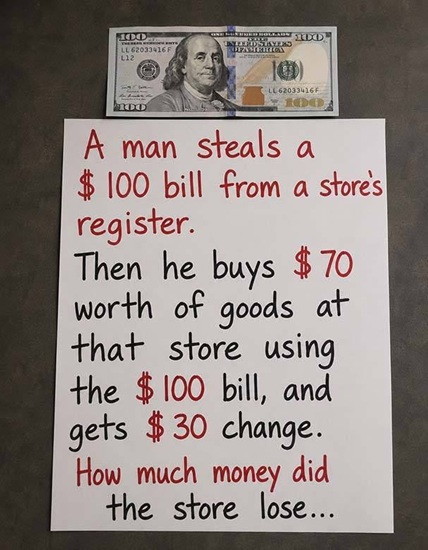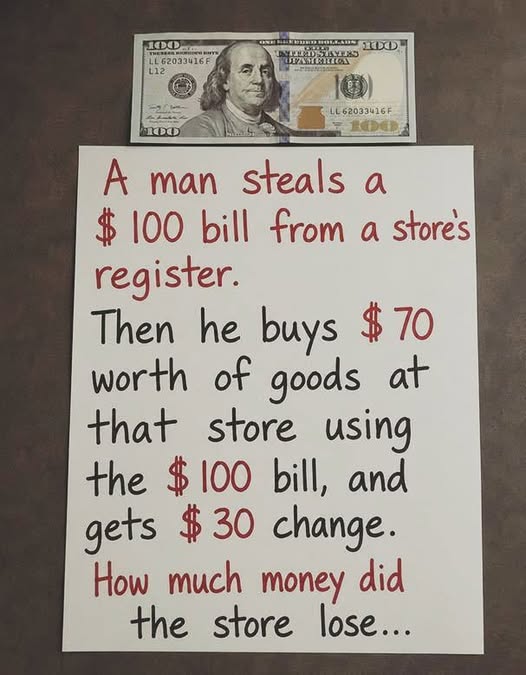
This deceptively simple math riddle has gained widespread attention online because it appears easy at first glance, yet consistently leads to disagreement, confusion, and intense debate among people trying to solve it. At its core, the problem presents a situation involving theft, a later purchase, and a cash transaction that includes change being given back to the same individual who originally stole the money.
The narrative begins with a thief entering a retail store and stealing a one hundred dollar bill directly from the cash register. This initial act represents a straightforward loss of cash for the business at that moment. Later in the scenario, the same individual returns to the store and selects seventy dollars worth of merchandise, intending to complete a purchase using the same one hundred dollar bill previously stolen.
The cashier, unaware of the bill’s origin, accepts it as legitimate payment and proceeds to complete the transaction. As part of the sale, the cashier also gives the customer thirty dollars in change. This sequence of events is where most confusion begins, as people attempt to track money flow step by step instead of focusing on net losses to the store.
Many individuals instinctively try to calculate multiple overlapping losses, including stolen cash, goods handed over, and change given back, which leads to conflicting answers in discussions and online comment sections. Some participants argue that the store loses two hundred dollars, others suggest one hundred seventy, while a significant number settle on one hundred thirty, depending on how they interpret the transaction.
The disagreement arises because the problem is often mentally processed as a multi-layered accounting equation rather than a simple net value loss analysis. However, when carefully examined, the scenario is not designed to test advanced mathematics but rather logical clarity in tracking actual value leaving the business.
To understand it correctly, it is important to separate perception from reality and focus only on what the store ultimately loses after all actions are completed.
At the start of the sequence, the store loses one hundred dollars in cash due to the initial theft. At that moment, no goods or change are involved, only missing money. When the thief returns later and uses the stolen bill as payment, that same one hundred dollars is effectively reintroduced into the store’s cash register through the purchase.
This is a crucial point because the stolen bill is no longer considered an external loss once it is returned as legitimate payment in the transaction process. At that moment, the store gives away seventy dollars worth of merchandise, which represents a physical loss of inventory that cannot be recovered. In addition to the goods, the store also gives thirty dollars in change, which is an immediate cash outflow from the register.
When both of these losses are combined, the total value leaving the store equals one hundred dollars in combined goods and cash. The seventy dollars in merchandise and the thirty dollars in cash together form the true economic loss experienced by the business. The original stolen one hundred dollar bill cancels itself out in the overall calculation because it returns to the register and is exchanged for value.
This is why tracking the money as a continuous loop can be misleading, as it creates the illusion of multiple losses when there is only one net loss. The key misunderstanding comes from double-counting the stolen bill alongside the transaction it later becomes part of.
Instead of treating each step as separate financial damage, the correct approach is to evaluate final state differences between what the store had and what it ended up with. Initially, the store had seventy dollars in inventory plus one hundred dollars in cash that is later restored through the transaction cycle. After the full sequence, the store is left with neither the seventy dollars in goods nor the thirty dollars in cash given as change.
This leaves a total loss equivalent to one hundred dollars in combined value, which represents the true net impact of the scenario. The simplicity of this answer often surprises people because the wording of the riddle is intentionally structured to create cognitive distraction and emotional overthinking. Human reasoning tends to focus on storytelling elements such as theft, intention, and moral judgment rather than pure numerical outcomes.
This narrative framing causes the brain to overanalyze each step as a separate financial event instead of a unified transaction outcome. As a result, many people become convinced that the problem is more complex than it actually is, leading to unnecessary calculations and confusion.
The riddle becomes especially engaging online because people confidently defend incorrect answers, believing their interpretation accounts for every detail. In reality, the correct solution depends on recognizing that the only permanent losses are the seventy dollars in goods and the thirty dollars in cash given away. Once this is understood, the problem becomes straightforward and no longer feels misleading or ambiguous.
The final answer remains consistent regardless of interpretation: the store experiences a net loss of one hundred dollars in total value. This conclusion often causes a reaction ranging from relief to frustration, especially among those who initially overcomplicated the reasoning process.
Ultimately, the riddle is not designed to trick mathematical ability, but rather to highlight how easily human perception can be influenced by narrative structure. It demonstrates that clarity in problem-solving often comes from stripping away unnecessary details and focusing only on what truly changes in the final outcome. Once the mental clutter is removed, the solution becomes simple, logical, and consistent, reinforcing the importance of careful reasoning over instinctive assumption.