
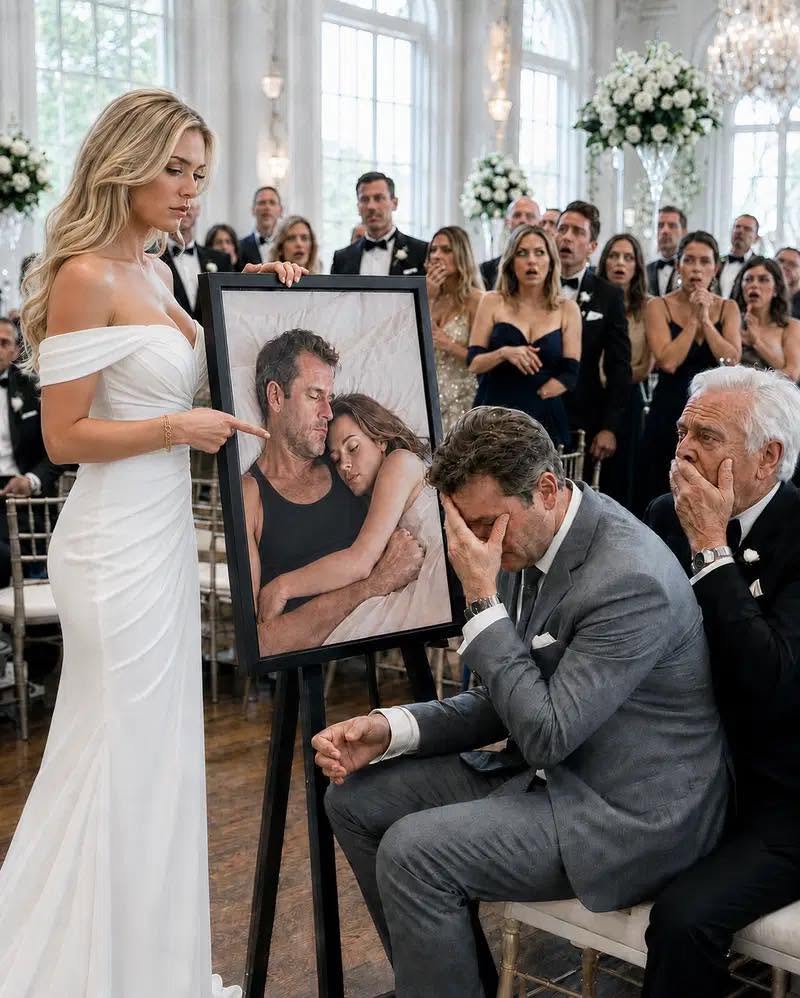
Brooke sounded completely convinced that once my father’s will was officially read, the family estate would pass into her hands.
What she had no idea about was that my father had left behind one last hidden truth.
And by the time she realized what she had set into motion, there would be no way to undo it.
I was in the garden trimming the white roses when her voice drifted across the yard.
“You may as well start packing,” she called out, every word dripping with confidence. “Tomorrow’s reading is only a formality. This house is going to belong to us.”
I didn’t respond immediately.
Instead, I continued cutting away the dead stems with the same calm discipline my father had taught me when I was young. Slowly. Carefully. Never letting anger rush your hands.
He always said roses endured because they understood how to protect themselves. They could blossom with elegance, certainly, but they also knew when it was time to reveal their thorns.
The thought nearly made me smile.
Those white roses had been planted during the summer Mason and I got married. Back then, he told me white blooms symbolized new beginnings. He said they were pure, full of hope, and untouched by time. I believed him because I was still young enough to confuse beautiful words with devotion.
Now those same roses stood quietly among the ruins of a fifteen-year marriage. Mason had left me for his assistant—the very woman now standing in my father’s garden wearing designer heels, staring at me as though I were a guest who had overstayed her invitation.
“Good morning, Brooke,” I said evenly.
She moved closer, her heels sinking slightly into the damp Savannah earth my father had spent four decades cultivating with his own hands.
“Mason and I thought we should talk before tomorrow becomes… uncomfortable,” she said with a sugary smile.
I straightened up, dusted soil from my gloves, and met her gaze.
“There is nothing to discuss,” I said. “This is my father’s home.”
Brooke smiled wider.
“Your father’s estate,” she corrected. “And Mason was part of this family for years. It’s only fair that he receives what he is owed.”
The pruning shears suddenly felt heavier in my grip.
“You mean the same Mason who cheated on his wife with his assistant?” I asked softly.
For a fraction of a second, her expression faltered.
Then she laughed.
“Oh, Hannah, don’t be dramatic. That was years ago. Your father forgave him. They still played golf together every Sunday, didn’t they?”
The remark landed harder than she could possibly understand.
My father, Robert Whitaker, had been gone only three weeks. Pancreatic cancer had taken him with shocking speed. One season he was still walking through these gardens wearing a straw hat, trimming roses and giving me lectures about soil acidity. The next, I was standing beside his grave trying desperately to hold onto the exact sound of his laughter.
And somewhere during those painful final months, my younger brother Tyler had begun taking Mason and Brooke’s side instead of mine.
That betrayal still sat inside me like shards of glass.
“My father was not foolish,” I said carefully. “He would never leave anything to Mason.”
Brooke lowered her voice.
“Tyler doesn’t seem to agree.”
A chill slid down my spine.
“You’ve been speaking with my brother?”
“Let’s just say he helped us understand your father’s condition near the end.”
My fingers tightened around the shears.
Dad’s voice echoed through my memory.
Handle roses firmly, sweetheart. Never cruelly. Even thorns exist for a reason.
“Leave,” I said quietly. “Before I forget my manners.”
Brooke let out a soft laugh.
“You honestly think you’re keeping all of this?”
Her gaze swept across the estate—the broad wraparound porch, the weathered brick chimneys, the massive oak trees draped with moss, the endless flower beds my mother once designed in a notebook before she passed away. It was more than land. It was memory given shape. It was my childhood, my grief, my father’s hands working the soil, my mother’s voice drifting through open summer windows.
“This place is worth millions, Hannah,” Brooke said. “Did you really think nobody would come after it?”
“This is not about money,” I snapped. “My father built this home with his own hands. Every room, every stone pathway, every tree on this property carries a piece of his life.”
Brooke rolled her eyes.
“Everything is about money. Tomorrow, reality finally catches up with you.”
She turned toward the garden gate, then paused just long enough to toss one final insult over her shoulder.
“Oh, and when Mason and I move in, those old rose bushes will be the first thing to go. The whole property needs to feel younger.”
I watched her disappear down the stone walkway, her pale dress standing out against the green hedges.
The anger inside me burned so intensely I could barely breathe.
Then something beneath the roses caught my attention.
A small envelope.
My heart seemed to stop.
The paper was damp with morning dew, but I recognized the handwriting immediately.
HANNAH.
My father’s handwriting.
For a moment, I couldn’t move. The entire garden seemed to fall silent. Even the cicadas in the live oaks faded into the background.
My hands shook as I bent down and picked it up.
Suddenly every threat Brooke had made sounded different. Every smirk. Every warning. Every quiet meeting she claimed to have shared with Tyler.
Because if my father had hidden this beneath the roses, then he had known something was coming.
I pulled out my phone and called our attorney.
“Eleanor,” I whispered the instant she answered. “Brooke just threatened me.”
Eleanor Brooks had been my father’s attorney for nearly three decades. She was composed, intelligent, and almost impossible to rattle.
But her tone changed immediately.
“What exactly did she say?”
I stared at the envelope resting in my hand.
“She said tomorrow’s reading is a formality. She said Mason and she are taking the house. She said Tyler helped them understand Dad’s condition near the end.”
There was a brief silence.
Then Eleanor lowered her voice.
“Hannah, listen carefully. Do not open anything else you find. Bring that envelope to my office immediately. And do not speak to Mason, Brooke, or Tyler alone.”
My mouth went dry.
“Eleanor… what did my father do?”
“He protected you,” she said. “And I think tomorrow, they’re going to find out how much.”
I drove to her office with the envelope on the passenger seat, glancing at it every few seconds as though it might vanish. Eleanor’s office sat above an old bank building downtown, overlooking a square shaded by ancient oaks. When I arrived, she was already waiting in the doorway.
She took the envelope carefully, almost reverently, and opened it with a silver letter knife.
Inside were two pages.
The first was a handwritten letter.
The second was a notarized statement.
Eleanor read silently, and as she did, the expression on her face hardened.
“What is it?” I asked.
She looked up slowly.
“Your father suspected Mason and Brooke were trying to influence Tyler. He also suspected Tyler had allowed them access to certain medical and financial documents during Robert’s final weeks.”
My knees felt weak.
“Tyler would not do that.”
Even as I said it, I heard how uncertain I sounded.
Eleanor slid the handwritten letter toward me.
My darling Hannah,
If you are reading this, then I was right to be afraid.
I have watched people circle this house like vultures, pretending grief while measuring windows, counting acres, and imagining themselves sitting in chairs they did not earn. I have made mistakes in my life, but one thing I will not do is allow the home your mother and I built to become a prize for those who betrayed you.
Do not let them shame you into silence.
Do not let your brother’s weakness become your burden.
And do not forget what I taught you in the garden: roses bloom softly, but they survive because they have thorns.
Trust Eleanor.
Trust the second will.
I read the last line three times.
“The second will?” I whispered.
Eleanor opened the notarized statement and placed it beside the letter.
“Your father executed a revised estate plan six months before he died,” she said. “He left the house, the gardens, the surrounding land, and controlling interest in the family trust to you.”
My breath caught.
“And Tyler?”
“He receives a separate financial inheritance, but only if he does not contest the will and does not assist any outside party in challenging your claim.”
Outside party.
Mason and Brooke.
I sat down slowly.
“Why hide it?”
“Because your father believed someone was trying to prove he was mentally incompetent near the end,” Eleanor said. “He wanted tomorrow’s reading to expose who came expecting to benefit from that claim.”
My father had always been quiet when he was angriest. I could see him now, frail from illness but still sharp behind his tired eyes, planning one final defense for the daughter he knew would be outnumbered.
The next afternoon, the official reading took place in the library of the estate.
It had always been my father’s favorite room. Dark walnut shelves rose from floor to ceiling, filled with old legal books, family photographs, and the journals he had kept for most of his life. Sunlight fell through the tall windows onto the worn leather chair where he had read to me as a child.
I arrived early.
Eleanor sat at the desk with a sealed folder in front of her.
Tyler came next, pale and restless, avoiding my eyes. Then Mason entered with Brooke on his arm. He wore the same navy suit he had worn to my father’s funeral. Brooke wore cream silk and a small smile she tried to hide.
“Hannah,” Mason said gently, as though we were still people who spoke kindly to each other. “I hope we can all be civil today.”
I looked at him and saw the man I had loved for fifteen years. Then I saw the man who had walked out of our marriage and still believed he had the right to walk back into my inheritance.
“I intend to be honest,” I said. “Civil will depend on the rest of you.”
Brooke’s smile tightened.
Eleanor began by reading the first will.
It was older, written years before my father became ill. In it, the estate was divided evenly between Tyler and me. Mason’s name appeared nowhere, of course, but Tyler’s share would have given him enough influence to force a sale if he chose.
Brooke relaxed visibly.
Mason leaned back.
Tyler stared at his hands.
Then Eleanor closed the folder.
“That concludes the reading of Robert Whitaker’s prior will,” she said.
Brooke blinked.
“Prior?”
Eleanor reached for the second sealed envelope.
“This is the final will and testament of Robert Whitaker, executed six months before his passing, witnessed by two independent physicians and notarized under video supervision.”
Mason sat forward.
“What does that mean?”
“It means,” Eleanor said, “that Mr. Whitaker anticipated a challenge to his capacity and took steps to prevent one.”
Brooke’s face paled.
Eleanor read the revised terms.
The estate. The house. The gardens. The land. The family trust.
All of it was mine.
Tyler received a fixed inheritance, generous but conditional. If he contested the will, cooperated with Mason, or attempted to force liquidation of estate assets, his inheritance would be redirected to the Whitaker Cancer Foundation.
Brooke stood up.
“This is absurd. He was dying. He didn’t know what he was signing.”
Eleanor looked at her coolly.
“That accusation was also anticipated.”
She opened a laptop and turned it toward us.
On the screen was my father, thin and pale but unmistakably himself, sitting in this same library. His voice filled the room.
“My name is Robert James Whitaker. I am of sound mind. I understand the nature of my assets and the individuals who may expect to benefit from them. I am making these changes freely because my daughter Hannah has protected this home, this family, and my dignity. I am also aware that certain individuals may attempt to use my illness to enrich themselves.”
Brooke slowly lowered herself back into her chair.
My father continued.
“Mason Whitaker is to receive nothing. He ceased being my son-in-law when he broke my daughter’s trust. Brooke Ellis is to receive nothing. If either of them attempts to occupy, sell, damage, or interfere with this property, I instruct my attorney to pursue the full protection of the court.”
Mason’s face turned red.
“Robert and I were friends,” he said sharply.
On the screen, my father gave a faint, tired smile, as if he had heard him.
“And Mason, if you are sitting there pretending friendship now, understand this: I played golf with you because I wanted to know what kind of man had hurt my daughter. You were never forgiven. You were observed.”
The room went dead silent.
I pressed one hand over my mouth.
Tears blurred my vision, but for the first time in weeks, they were not helpless tears.
They were relief.
Brooke turned on Tyler.
“You said he barely knew what was happening.”
Tyler flinched.
Eleanor’s eyes moved to my brother.
“Mr. Whitaker, before you answer, you should know your father also left documentation regarding unauthorized access to his medical files and communications with Mr. Mason Whitaker.”
Tyler’s face crumpled.
“I didn’t think they would actually hurt Hannah,” he whispered. “They said the estate would be better managed if Mason handled the sale. They said Hannah was too emotional.”
“Too emotional,” I repeated.
My voice cracked, but I did not look away.
“I was the one sitting beside Dad during chemo. I was the one changing his sheets when he couldn’t get out of bed. I was the one holding his hand at three in the morning while he apologized for leaving me. And you called me too emotional?”
Tyler began to cry.
“I’m sorry.”
But apologies do not erase betrayal. They only mark the moment betrayal can no longer hide.
Mason stood abruptly.
“This is a setup.”
“No,” Eleanor said. “This is a will reading.”
Brooke’s composure finally broke.
“You think you’ve won?” she snapped at me. “You’re alone in this huge house. You’re a divorced woman clinging to dead people’s furniture and dead flowers.”
The insult landed, but it did not wound me the way she hoped.
I looked through the window at the white roses moving gently in the afternoon breeze.
“No,” I said. “I’m a daughter standing in the home her father protected for her.”
Eleanor closed the folder.
“Mr. Whitaker, Ms. Ellis, you are both required to leave the property immediately. Any further contact regarding this estate should go through my office.”
Mason stared at me one last time. There was anger in his eyes, but beneath it I saw something weaker.
Embarrassment.
He had expected me to break.
Instead, my father had spoken for me from beyond the grave.
Brooke left first, her heels striking the floor like small acts of violence. Mason followed. Tyler remained behind, sitting in the chair like a boy waiting for punishment.
“Hannah,” he said quietly. “I was scared. Mason said if the estate was sold, I could finally pay off everything I owed. I thought Dad would have wanted both of us taken care of.”
“Dad did take care of you,” I said. “You just let them convince you that taking care of you meant taking from me.”
He lowered his head.
I did not forgive him that day.
Forgiveness, I had learned, was not a door people could kick open because they regretted being caught. It was a bridge built slowly, plank by plank, if the other person was willing to carry wood.
After everyone left, I walked back into the garden.
The sun was sinking behind the oaks, turning the roses gold at the edges. I knelt where I had found the envelope and pressed my hand to the soil.
For three weeks, grief had made the world feel empty. I had thought my father was gone from every room, every hallway, every shaded corner of the garden.
But he had not left me defenseless.
He had left me truth.
He had left me thorns.
The next morning, I found workers at the front gate. For one terrifying second, I thought Mason had sent them. Then I saw Eleanor stepping out of her car with a rolled blueprint in her hand.
“Your father arranged one more thing,” she said.
The workers removed the old rusted sign at the entrance and lifted a new one into place.
Whitaker Rose House.
Beneath it, in smaller iron letters, was a line from my father’s letter.
Roses bloom softly, but they survive because they have thorns.
I stood there in the morning light, crying without shame.
Not because everything was fixed.
It wasn’t.
My marriage was still gone. My brother had still betrayed me. My father was still buried beneath the magnolia tree he loved.
But the house was safe.
The roses were safe.
And for the first time since the funeral, so was I.
That afternoon, I trimmed the white roses again. Slowly. Precisely. The way my father taught me.
When a thorn caught my glove, I did not pull away.
I smiled.
Because some pain is not there to destroy you.
Some pain is there to remind you where your strength begins.

