
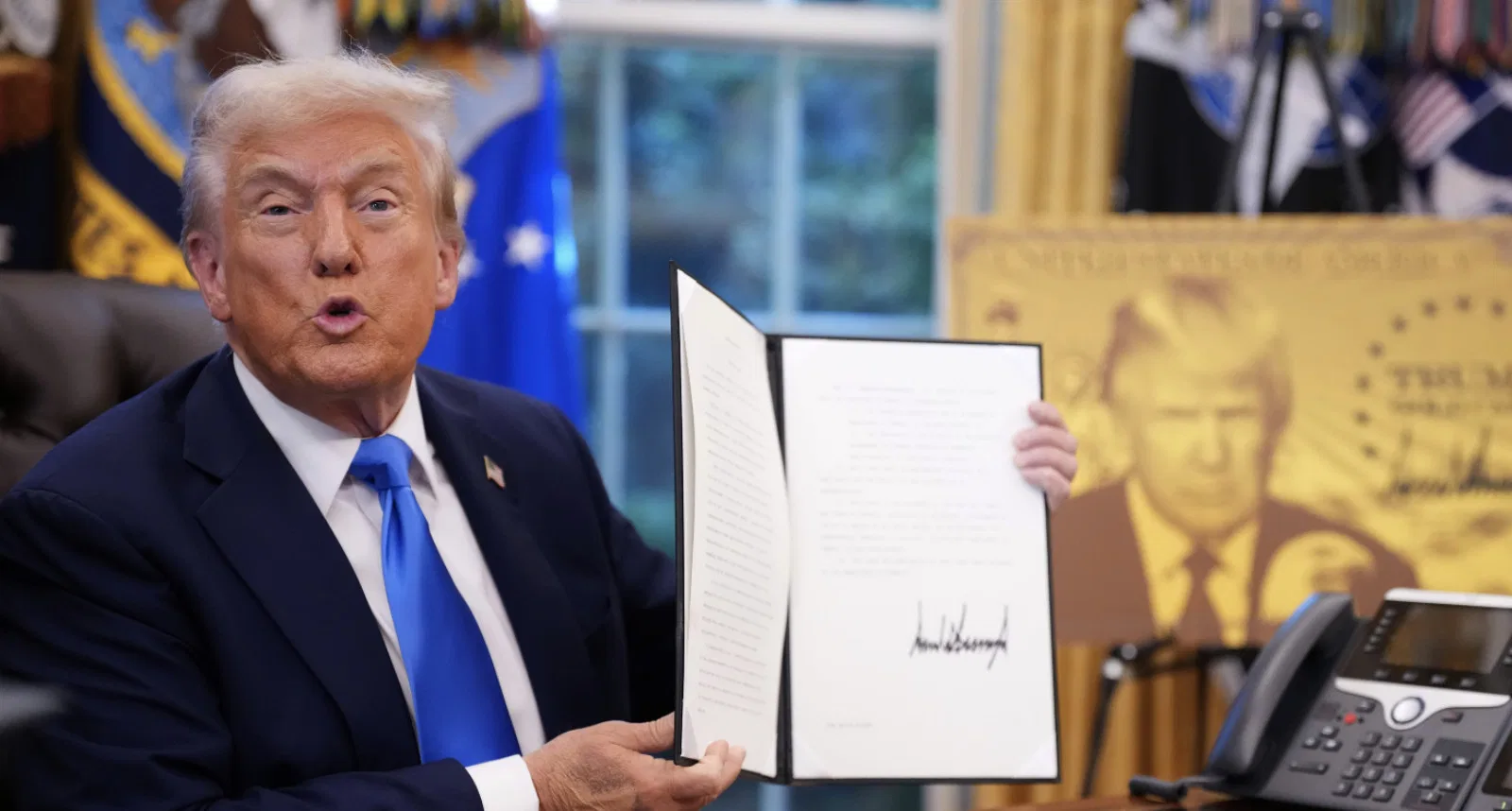
President Donald Trump on Tuesday signed a sweeping executive order aimed at tightening federal oversight of election integrity, directing multiple agencies to expand voter eligibility verification and impose new controls on mail-in ballots.
The order, titled “Ensuring Citizenship Verification and Integrity in Federal Elections,” outlines a series of measures that would increase coordination between federal agencies and state election officials, while also establishing new procedures for how ballots are distributed and tracked through the mail system.
At the core of the directive is a requirement that the Department of Homeland Security (DHS), working with the Social Security Administration (SSA), compile and transmit lists of individuals confirmed to be U.S. citizens to state election authorities. These “State Citizenship Lists” would be generated using federal databases, including immigration and Social Security records, and updated regularly ahead of federal elections.
According to the order, the lists are intended to help states verify voter eligibility, though inclusion on the list would not automatically register an individual to vote. State laws and procedures would still govern registration requirements.
The order also calls for the Department of Justice (DOJ) to prioritize investigations and potential prosecutions related to election law violations. This includes cases involving the distribution of ballots to individuals deemed ineligible to vote, as well as any actors—public or private—who may be involved in producing or sending such ballots.
In a significant expansion of federal involvement in mail voting procedures, the directive instructs the U.S. Postal Service (USPS) to develop new rules governing the handling of mail-in and absentee ballots. Within 60 days, the Postmaster General is required to initiate a rulemaking process that would standardize ballot tracking and verification measures nationwide.
Under the proposed framework, all mail-in ballots would be required to use specially marked envelopes designated as official election mail. These envelopes must include unique tracking barcodes and meet specific design standards set by USPS to ensure compatibility with automated processing systems.
The order further proposes that states provide USPS with lists of voters eligible to receive mail-in ballots. In turn, USPS would maintain its own participation lists and only deliver ballots to individuals included in those records. Completed ballots would also be subject to verification procedures to ensure they are returned by eligible voters.
Additionally, the directive emphasizes coordination between USPS, its Office of Inspector General, and the DOJ to investigate potential misuse of the mail system in connection with federal elections.
The administration frames the order as a response to longstanding concerns about election integrity and public confidence in voting systems. It cites existing federal laws that prohibit non-citizens from voting and argues that enhanced verification measures are necessary to enforce those statutes and prevent fraud.
The order also introduces potential enforcement mechanisms, including the possibility of withholding federal funds from states or localities found to be noncompliant with applicable federal election laws, where such action is legally authorized.
States and local election officials would be required to preserve records related to voter participation—such as ballot envelopes—for a period of five years, though the directive specifies that actual ballots cast are excluded from this requirement.
Implementation timelines vary across provisions. DHS is tasked with establishing the infrastructure for citizenship list compilation within 90 days, while USPS is expected to finalize its rulemaking process within 120 days of the order’s issuance.
Legal and political reactions are likely to follow, as election administration has traditionally been handled primarily at the state level. The expanded federal role outlined in the order could prompt scrutiny over issues such as data sharing, privacy protections, and the balance of authority between federal and state governments.
The order states that all actions must comply with existing laws, including the Privacy Act, and emphasizes that it does not create new legal rights enforceable against the federal government.
As implementation begins, the practical impact of the measures—and the extent to which states adopt or challenge them—will likely shape the broader national debate over election security and access in the lead-up to future federal elections.

