
Every October, for six years now, my two brothers and I have each sent our sister Pam two hundred and fifty dollars for Mom’s propane.
It was a simple system. Mom lives alone on the farm east of Harvey, North Dakota, where she and Dad farmed for forty-four years. Pam lives closest, twenty minutes down the highway. So Pam handled the deliveries and the bills, Rob and Dean and I sent our share, Pam put in hers, and Mom stayed warm through the winter.
Or so we thought.
The worst cold spell of the year came in the third week of January. Out at Mom’s place, the overnight temperature dropped to thirty-one below.
And for two nights, Mom didn’t answer her phone.
The roads were bad, and nobody else could get away, so I drove the three hours from Bismarck by myself, white-knuckled the whole way.
The kitchen door was unlocked, the way it’s been my entire life.
The first thing I noticed was the silence. Just the old clock on the wall, ticking.
The furnace wasn’t running.
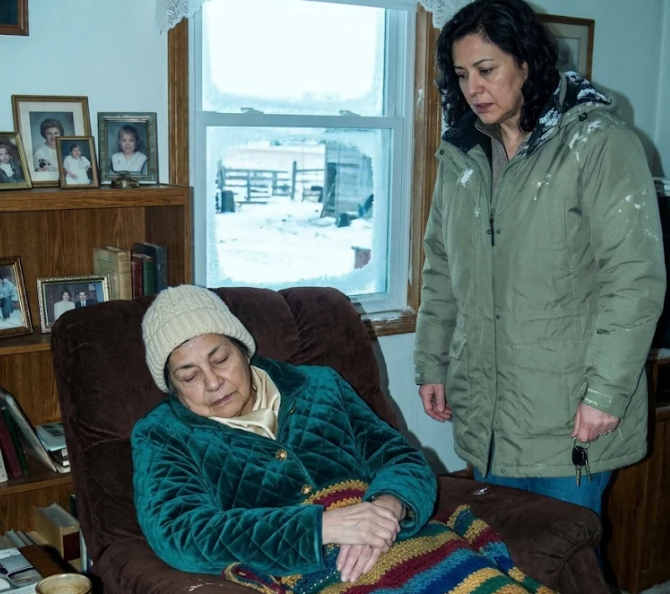
I found Mom in the living room, curled up asleep in Dad’s old recliner. She was wearing her long brown winter coat, buttoned to the neck, with a knitted cap pulled down over her white hair. The afghan she crocheted the winter Dad died was tucked across her lap.
There was frost on the inside of the windows.
I just stood there in my red parka with my car keys still in my hand, snow melting off my shoulders and dripping on her rug.
The thermostat said fifty-eight degrees. Inside the house.
Mom is eighty-two years old. She’s lived alone since Dad passed.
My first instinct was to call Pam and scream. But I didn’t. Mom had told me more than once, very firmly, not to involve my sister in things. And the propane company only needed one name on the account.
So I decided it was going to be mine.
I went outside and brushed the snow off the propane gauge.
Five percent.
Back in the kitchen, stuck to the refrigerator under a seed corn magnet, I found a delivery slip from October. Two hundred gallons.
Mom’s tank holds five hundred gallons, which means about four hundred when it’s full. With Pam’s share, the four of us had put in a thousand dollars. That was enough for a full fill in October and a second delivery after Christmas.
The October fill had been half a tank. And nobody had ordered the second one.
Mom woke up while I was standing there holding the slip. She saw my face and knew immediately.
“Please don’t start trouble with Pam,” she said. “She’s got enough worries of her own.”
Pam’s husband Mark had back surgery in September and still wasn’t back at work.
“She told me propane’s more expensive this year,” Mom said. “I don’t mind keeping the house a little cooler.”
I took her hands. They were ice cold.
At 10:40 that morning, I called the co-op in Harvey. The truck was in the yard before two. The driver pumped in three hundred and seventy-five gallons, which brought the tank up to eighty percent, at $2.09 a gallon.
Seven hundred and eighty-four dollars. I paid with my card.
Then I had them move the account into my name and sign Mom up for automatic keep-full delivery. They’d watch the tank remotely and send a truck whenever it got low. Nobody would ever have to remember again.
I turned the thermostat up to seventy. The furnace came on with that low thump under the floorboards that I remember from every winter of my childhood.
About an hour later, Mom stood up, unbuttoned her coat, and hung it on the hook by the kitchen door.
“I almost forgot what a warm house feels like,” she said quietly.
I had to go out to the porch for a minute.
I texted my brothers: “Mom’s tank is full. Starting next October, send the propane money to me. We’ll talk about the rest at Easter.”
Dean called within five minutes. Rob was out with his cattle and didn’t call until that night. I told them both the same thing. Mom was warm and safe. The rest could wait until we were all in the same room.
Pam found out on Thursday, when the co-op told her she’d been taken off the account.
She called me.
“You went behind my back.”
“I got Mom’s furnace running,” I said.
She hung up on me. We didn’t speak for eleven weeks.
Then Easter came.
We all gathered at the farmhouse, the way we always do. Ham in the oven. Mom’s kuchen cooling on the counter. Rob and Dean at the kitchen table with their coffee. Mom in her chair by the window, in a cardigan, no coat, no hat.
Pam came last.
And she wasn’t empty-handed.
She walked straight to the kitchen table and set down a thick manila folder, stuffed so full it was held shut with a rubber band. She put it right in the middle, where all of us could see it.
Every conversation stopped.
Rob slowly set down his coffee cup.
Pam looked at Mom first. Then at me.
And she took a long breath.
“Before anybody says anything,” Pam said, “I want you to read what’s in there. All of it. Then you can say whatever you want to me.”
Mom closed her eyes. “Pammy, you don’t have to.”
“Yes, I do, Mom. I’m done carrying this by myself.”
I pulled off the rubber band.
The first thing on top was a letter from the Wells County Treasurer, dated the previous August. I read the first line and felt the floor tilt.
NOTICE OF PENDING TAX SALE.
Mom’s property taxes on the farm hadn’t been paid in two years. With penalties and interest, she owed $3,412. If it wasn’t paid by October 31st, the county would put the home quarter, the house and the yard and the shelterbelt Dad planted, up for public auction.
Underneath it were receipts. Stamped PAID. October 28th. October 30th. October 31st, at 4:55 p.m., five minutes before the treasurer’s office closed.
Three payments. $3,412 in total.
All in Pam’s handwriting.
Rob picked up the tax notice. Dean leaned over to read it with him. Nobody said a word.
“How?” I finally managed. “How did Mom get two years behind on her taxes?”
Mom answered before Pam could.
“Because I’m a proud old fool,” she said.
She told us the whole thing. After Dad died, she’d kept renting out the cropland to the Hendricksons, and the rent check covered the taxes every year. But two years ago, old Walt Hendrickson retired, and his son took over and dropped the lease. Mom didn’t tell any of us. She thought she could manage on her Social Security. She thought she’d find a new renter. She put the tax bills in a drawer.
“I couldn’t stand the thought of you kids paying my bills,” she said. “Your father always paid our bills.”
Pam found the drawer last August, when she came out to help Mom clean. Mom begged her, actually begged her, not to tell the rest of us.
“So I didn’t,” Pam said. Her voice was shaking. “I promised her.”
Then she pulled a single sheet of notebook paper out of the back of the folder. A handwritten ledger.
Mark’s back surgery in September. Mark’s disability check, delayed for three months because of a paperwork error. Pam working extra shifts at the nursing home in Harvey. The propane money we’d sent in October: $1,000.
She’d spent $418 on the first two hundred gallons. Everything else, the rest of our money and every dime she could scrape together from her own paychecks, had gone to the county treasurer to keep Mom’s farm from being auctioned.
“I was going to order the second load in January,” she said. “Mark’s back pay was supposed to come at Christmas. Then it got delayed again. And then the cold came early, and I kept thinking, just one more week, one more week.”
She looked right at me, and her eyes were full.
“I didn’t steal Mom’s heat. I swear to God I didn’t. I just couldn’t save the farm and the furnace at the same time. And I was too ashamed to ask any of you for help, because I’d promised Mom.”
The kitchen was so quiet I could hear the ham sizzling.
Then Dean, the youngest, the one who never says anything at family dinners, put his hand flat on the folder.
“Pam,” he said. “Why didn’t you just tell us?”
“Because she asked me not to.”
Everyone looked at Mom. She was crying, quietly, the way she does, looking out the window toward the shelterbelt Dad planted in 1971.
“I’m sorry,” she said. “To all of you. But mostly to Pam. I made her carry that alone. I made her choose between me and my pride. And then I let all of you think she was the one who let me down.”
I stood up and went around the table and put my arms around my sister. She held on to me like she was drowning.
“I’m sorry I called you a thief in my head for eleven weeks,” I said into her hair.
“I’m sorry Mom slept in her coat,” she said. “I’ll never forgive myself for that.”
“Yes, you will,” Mom said firmly from her chair. “Because I already have.”
We worked it all out right there at the kitchen table, before the ham even came out of the oven.
Rob and Dean and I paid Pam back every dollar she’d spent from her own pocket on the taxes. Rob found a young couple from Fessenden who wanted to rent Mom’s cropland, and he had the lease signed by the first of May. The rent goes straight to an account that only pays the county. Mom gets a copy of every receipt. No more drawers.
The propane stays on automatic delivery in my name. Pam handles Mom’s doctor’s appointments. Dean drives up once a month to check the furnace. Rob does the snow.
We have a group text now. It’s called “Mom’s Farm.” Mom isn’t on it. She says she doesn’t need to read four children arguing about her.
She’s not entirely wrong.
Mark went back to work in June. Pam paid for Mom’s Thanksgiving turkey this year and wouldn’t let any of us chip in.
And every time I walk into that farmhouse now, the first thing I hear is the furnace humming under the floorboards. The second thing is the old clock.
Mom’s brown winter coat still hangs on the hook by the kitchen door.
She only wears it outside now.