
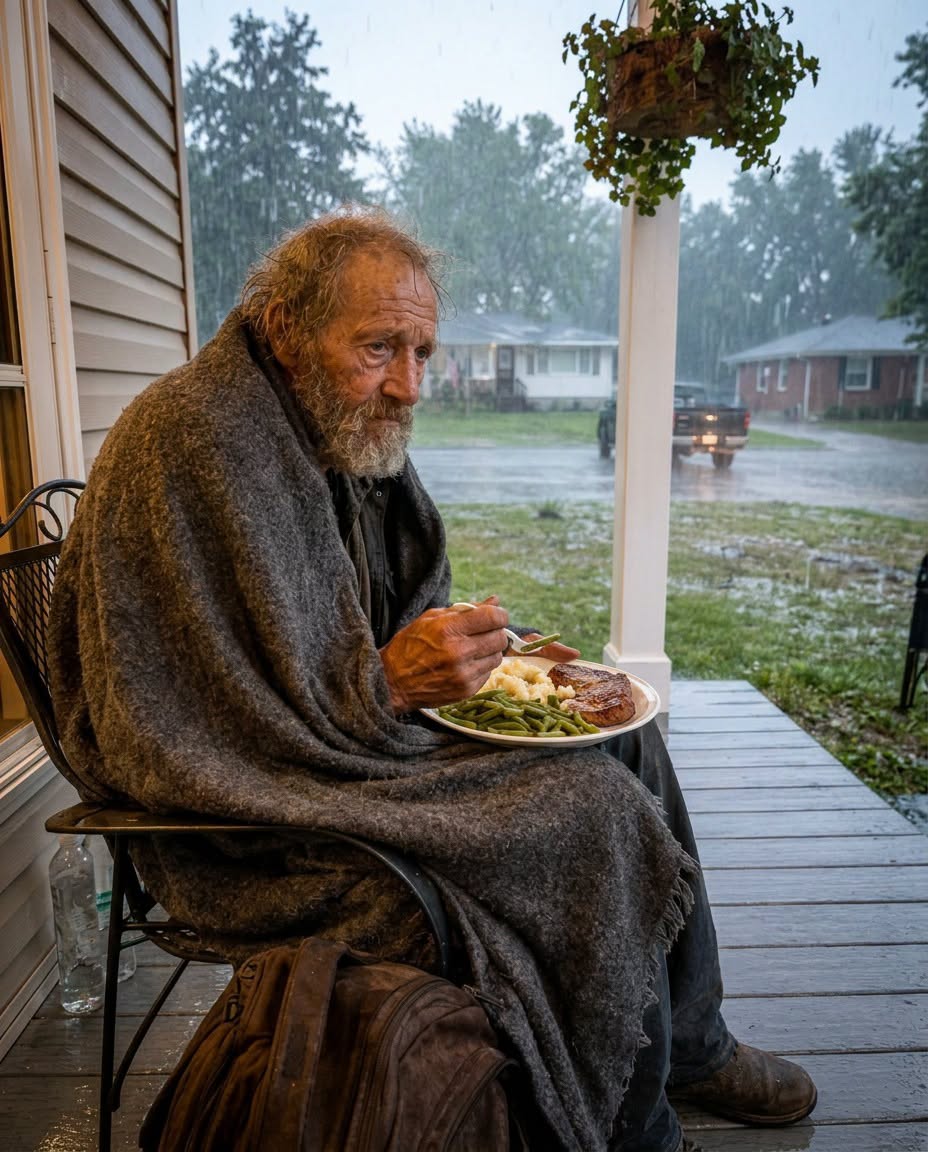
Martha opened her front door the morning after the storm expecting to find an elderly homeless man still sleeping beneath the quilt she had given him. Instead, the porch was empty, the blanket had been folded neatly on the doormat, and beneath it was an envelope with her name written across the front. Inside was a brass key attached to a cardboard tag bearing an address forty minutes away and the words, “the small box, bottom shelf.” The man, Albert, had spent the previous night on her covered porch after refusing her offer of a couch, accepting only chicken soup, a towel, and shelter from the rain. Martha had little herself—a modest duplex, a car payment, rent always approaching, and a ten-year-old daughter to support after a devastating divorce—but she had told him, “Tonight I have enough for both of us.” Now Albert’s letter explained that he had been homeless for eight months, after his daughter-in-law changed the locks and his son failed to stop her. He had once owned a hardware store, spent forty-three years with his wife Estelle, and sold the business when she became ill because insurance would not cover everything she needed.
The key belonged to a storage unit Albert had continued paying for after Estelle died, even while sleeping in shelters and beneath trees. He wrote that he had never been ready to sort through what remained of their life—until the night on Martha’s porch. At the unit, Martha found old chairs, books, a sewing machine, family boxes, and, exactly where Albert promised, a small wooden box containing Estelle’s burgundy leather notebook. It looked like a recipe book, but it was really a forty-year record of survival. There were recipes for bread, soup, and meals made from whatever happened to be available, but also practical notes about money, hardship, parenting, and endurance. One passage stopped Martha completely: the things that belong to you remain yours because of the work you put into them; someone may take the object, but they cannot take the work that made it possible to build again. After twenty-one years of trusting her former husband Daniel with their finances, Martha had walked out of the divorce with roughly $800, no house, and years of rebuilding ahead of her. Estelle’s words felt less like advice from a stranger than recognition from someone who had already crossed difficult ground.
Martha brought the notebook home and showed it to Lily, who immediately understood that Estelle had written everything down so it would not disappear. When Lily read the first page—an invitation for future readers to add their own notes in the margins—she suggested they continue the chain of kindness Albert had begun. Together they made Estelle’s chicken soup and delivered it to a local shelter, then returned again. Martha eventually wrote her first addition beneath one of Estelle’s recipes: a ten-year-old had made the bread, knew when it smelled right, and Albert had left them the book. Six weeks later, the shelter called with unexpected news. Albert had arrived there, found Martha’s message, and written back that he was staying for a while and helping in the kitchen. “Ruth says I make a decent stock,” his note said. The man Martha had imagined wandering alone was now feeding other people, while Estelle’s old instructions were teaching Martha and Lily to do the same.
Over the following months, Martha sorted the rest of the storage unit carefully. The table and chairs went to a family moving into their first apartment; books went to the shelter; photographs and private letters were returned to Albert rather than opened. She kept the old sewing machine, partly because Estelle had written about the difference between things worth mending and things better replaced. At home, Martha began rebuilding in similarly practical ways. The threatened school-district job remained secure. She managed the rent. She found Lily’s school clothes on sale. Most importantly, she opened a savings account solely in her own name—the first she had possessed independently in twenty-one years—and began placing small amounts in it. None of these changes were miraculous. They were the financial equivalent of mending: restoring control through documentation, budgeting, ownership, and small reserves rather than waiting for one dramatic rescue.
By winter, Estelle’s notebook lived on Martha’s nightstand, its margins now carrying two generations of new handwriting. Lily sometimes wrote notes before her mother could, having started spending Fridays at the shelter learning how Albert made stock. Martha’s worries had not vanished; they had simply become weights she had grown stronger enough to carry. She still thought often about that storm, the soaked old man holding a backpack beneath an elm tree, and the small decision to offer him a porch when she barely felt capable of protecting her own life. Albert had left behind no fortune, no inheritance, and nothing that could erase the years Martha had lost. What he left was more useful: the recorded wisdom of a woman who knew how to turn very little into enough, and the reminder that being barely able to hold on still means you are holding on. When the elm trees went bare, Martha found herself trusting that they would turn green again. After everything, that modest expectation felt like abundance.

