
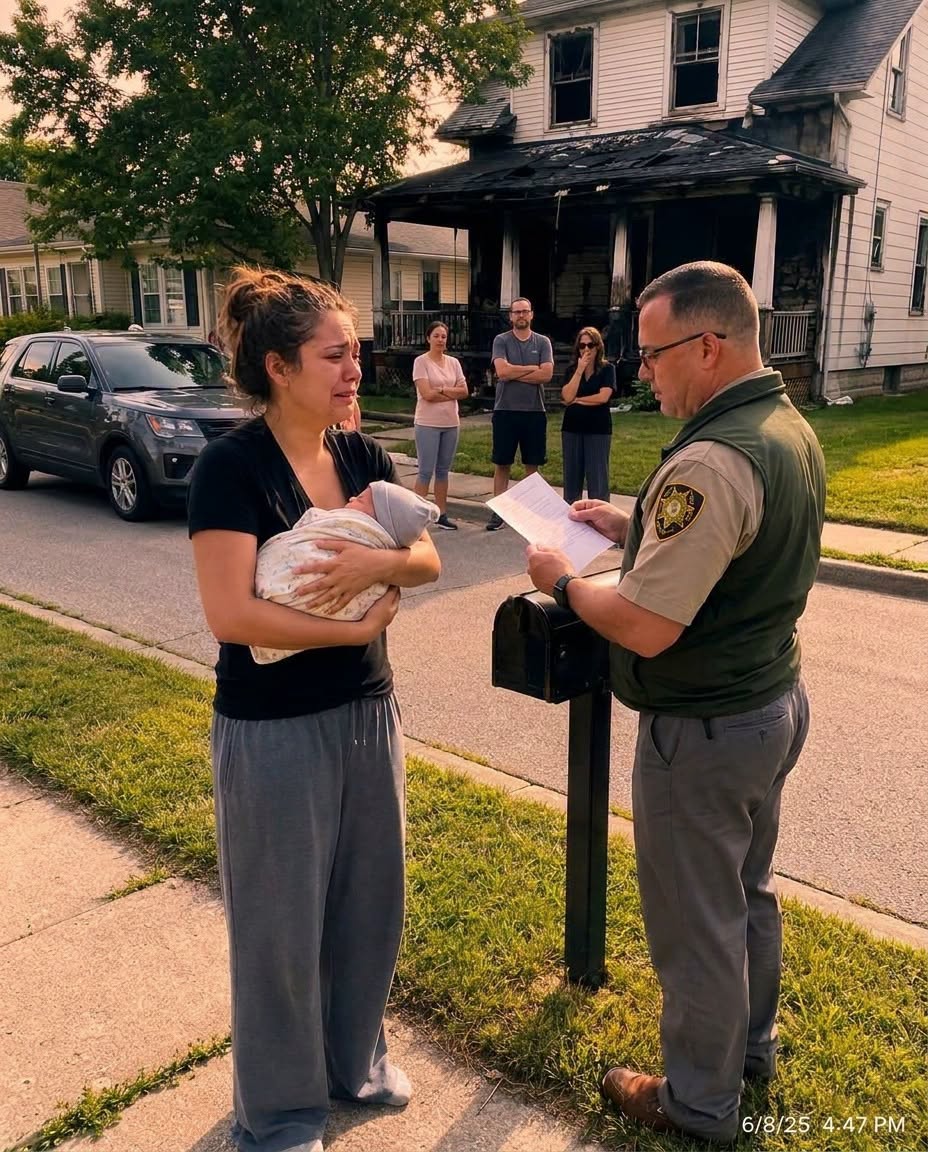
The first thing I saw when we turned onto my street was black. My porch, front door, railings, even the white columns Daniel had spent an entire summer restoring had been covered in thick black paint overnight. I was three days postpartum, holding my newborn daughter Nora against my chest, and for several seconds I could not understand what I was looking at. Neighbors stood outside watching, police were already on the way, and nothing had been stolen or broken—someone had simply transformed the front of my home into something that looked almost like a warning. Then an officer stopped at the mailbox and found a white envelope with one word written across the front: Nora. Almost no one knew the name I had chosen for my three-day-old daughter. Inside was a note that began with an apology for the paint and ended with a sentence that turned my grief into fear: Daniel did not die in an accident.
The note told me not to sign anything, warned me about a man who would arrive carrying papers, and said the black paint had been intended to draw the entire neighborhood outside so he would not find me alone. Two months earlier, while I was seven months pregnant, Daniel had supposedly died after his car left a rural road late at night and struck a tree. His older brother Marcus had taken control of everything afterward—funeral arrangements, insurance paperwork, estate documents, bank forms—while repeatedly telling me to concentrate on the baby. Exhausted and grieving, I had signed papers without studying all of them. Officer Reyes pulled Daniel’s accident report and immediately noticed unresolved questions. Daniel had carried a substantial life-insurance policy naming me as beneficiary and Nora after me; if something happened to me before the estate was settled, Marcus was positioned to control funds on Nora’s behalf. Hours after the note was found, Marcus arrived exactly as predicted, carrying a leather folder and insisting I needed to sign “time-sensitive” documents that day. Detective Alvarez glimpsed the top page before he left with them: a designation of guardianship and financial authority naming Marcus.
The police moved Nora and me to a hotel under another name, and Daniel’s death investigation was reopened. Months of forensic work began undoing the story I had accepted in grief. Accident reconstruction showed that Daniel’s vehicle had been struck from behind before leaving the road; overlooked paint transfer supported the collision, and phone records revealed that Marcus had asked Daniel to meet him there shortly before he died to discuss money. Investigators discovered that Marcus was deeply in debt, that Daniel had recently refused to keep rescuing him financially, and that Marcus knew exactly how Daniel’s life-insurance proceeds and estate would pass. After Daniel’s death, he had deliberately inserted himself into every part of my financial life while moving toward one final goal: legal authority over Nora and her inheritance. The anonymous warning had said he would not do in front of witnesses what he intended to do privately. Suddenly, the vandalized house made terrible sense. Someone had not been trying to frighten me. Someone had been making it impossible for Marcus to act unnoticed.
Marcus was eventually arrested and prosecuted using phone records, financial evidence, vehicle damage, accident reconstruction, and the guardianship paperwork he had tried to make me sign. The person who set everything in motion turned out to be my eighty-year-old neighbor Eleanor, a woman I had known mostly through waves across the street and brief conversations about flowers. Insomnia kept her awake at night, and after Daniel died she began seeing Marcus arrive at strange hours, including one night when he entered my house while I was away at the hospital and left carrying a box. Three nights before I brought Nora home, Eleanor saw him sitting in his car across from my house at two in the morning, simply watching. She had no proof strong enough to take to police, so she created witnesses instead. Working through the night with cans of black paint, she covered my porch, door, railings, and Daniel’s beloved columns, then left the note in Nora’s name because she knew a new mother would open it immediately. Detective Alvarez later told me that Eleanor’s desperate plan probably saved both my life and my daughter’s.
Years later, the house is white again, although for a long time I kept one narrow strip of black paint on the porch railing as a reminder. Eleanor became Nora’s godmother, and Nora still crosses the street to sit beside the same window where Eleanor once watched Marcus in the darkness. I never forgave Marcus, but I eventually stopped spending energy hating him; raising Nora required more of me than anger deserved. What stayed with me instead was the strange reversal of that first day home. Daniel had painted those columns white because he wanted the house beautiful when his daughter arrived. Eleanor painted them black because she wanted to make sure that daughter survived. One act built the home we hoped Nora would grow up in. The other made certain she actually could.

