
The hostess looked my seventy-eight-year-old mother up and down, paused at her cane and worn handbag, and said we looked “too cheap” for the restaurant. Behind her, candlelit tables sat empty beneath warm amber lights while garlic, butter, and tomato drifted from the kitchen. My mother’s hand went slack inside mine. She had dressed carefully for her birthday in the navy floral dress she had owned for decades because one of her church friends had told her the gnocchi at this Italian bistro tasted like home. We had made the reservation three weeks earlier, but the hostess, Chloe, refused even to check the screen. Instead, she suggested there were cheaper diners nearby with bigger portions. When my mother whispered that she wanted to leave, I realized the humiliation had already cost her more than dinner ever could.
Mom’s name was Maria, and she had come to America from Italy long before I was born. She rarely spoke in detail about the life she left behind, though sometimes she mentioned a village square, a bakery on the corner, and someone from those years whose story always seemed to stop before the ending. My father had been gone nineteen years, and on this birthday all she wanted was one familiar meal in a place her friends loved. I tried once more to make Chloe honor the reservation, but she laughed when I objected and said her own grandmother would never look like “some beggar.” That was enough. I wrapped Mom’s shawl around her shoulders, told her we were leaving, and turned toward the door. We had taken only three steps when something heavy crashed in the kitchen. Through the service window, an elderly man in a white chef’s jacket stood frozen, staring directly at my mother as if he had just seen a ghost.
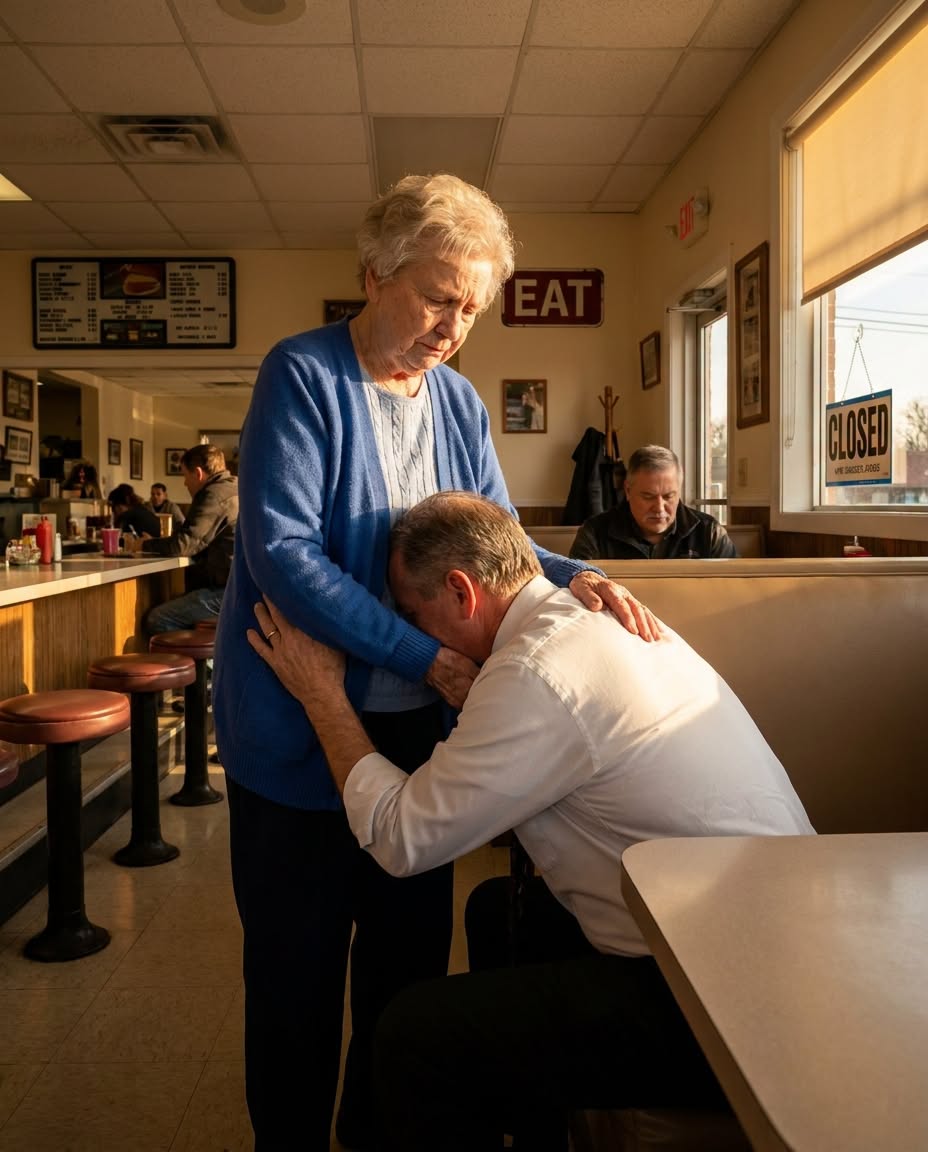
Seconds later, the kitchen doors flew open and the man hurried toward us. Chloe tried to intercept him, saying the “guests” were already leaving, but he walked straight past her. Three feet from Mom, he stopped with tears in his eyes and whispered, “Maria?” Her cane slipped from her hand. “Giovanni?” she said. Then the restaurant owner sank to his knees and told her he had searched for her for years after coming to America, and that he had built the restaurant while carrying the hope that one day she might somehow walk through its doors. My mother’s face changed in a way I had never seen before—seventy-eight years seemed to fall away from it. She told him she had thought he had forgotten her. “Never,” he said. “Not one single day.” The entire dining room had gone silent, but the silence that mattered most came from the woman behind the hostess stand.
Giovanni stood, took my mother’s hand, and turned toward Chloe. He had heard everything from the kitchen. When she tried to explain that she “didn’t know” who Maria was, he stopped her with the only point that mattered: she should not have needed to know. Then he checked the reservation system himself and found our booking exactly where I had said it was. Chloe had deliberately refused to seat a confirmed guest based on appearance alone. Giovanni dismissed her on the spot and told the staff that no customer would ever again be treated according to what they wore, how they walked, or what someone guessed they could afford. Then he guided Mom to the best table in the room and told her he would cook for her personally. Around us, diners began to applaud—not because they suddenly knew who my mother was, but because someone had finally said aloud what should never have required proof in the first place: basic dignity is not something a guest earns by looking expensive.
Dinner lasted nearly three hours. Giovanni brought dishes my mother remembered from childhood and others he said he had spent years perfecting from the same region she once called home. They talked softly across the table about people I had never heard of, roads that no longer existed, and choices made when they were both young enough to believe time would always give them another chance. I did not interrupt. Near dessert, Mom squeezed my hand and smiled through tears. “I told you,” she whispered, “I only wanted to feel at home again.” That night she got more than the birthday dinner she had asked for, but what stayed with me afterward was not the coincidence of finding Giovanni. It was how quickly one stranger had made an elderly woman feel invisible—and how completely another reminded her that she had never been invisible at all.

