
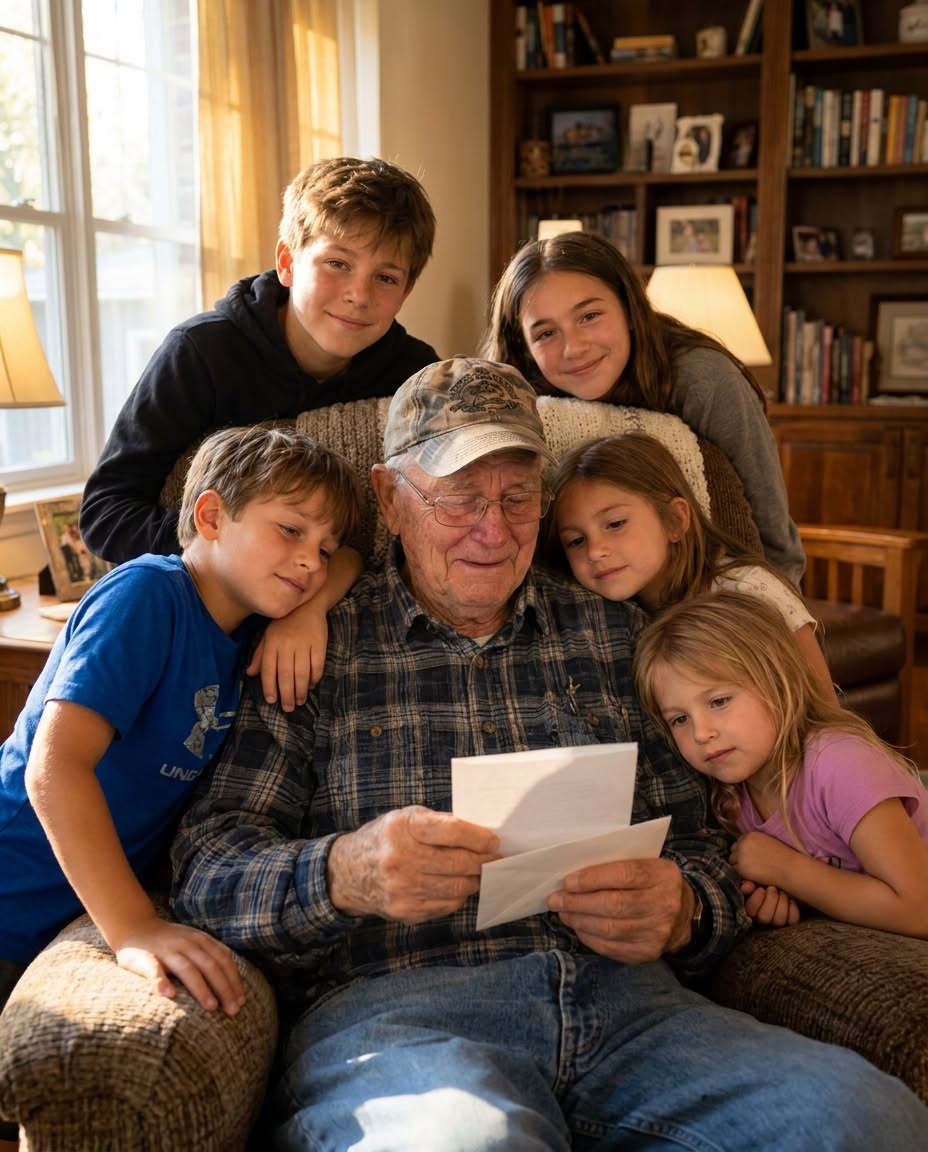
Walter went pale when I placed the adult-adoption papers in front of him on his eighty-eighth birthday. For two years he had eaten at our table, repaired bicycles in our driveway, helped with homework, and answered to “Grandpa” whenever one of my five children yelled for him from another room. I expected tears, maybe a joke about finally getting paperwork for a job he was already doing. Instead, he lowered the folder as though it contained something dangerous and asked if the children could finish their cake elsewhere. My husband looked at me, and I felt the atmosphere in the room change. When the door closed behind the kids, Walter folded his hands and said, “I can’t let you make me family without telling you why I moved next door.” Then he looked straight at me. “Abby, I knew who you were before I bought that house.”
After his wife Margaret died, Walter had taken a commercial ancestry test not because he cared about percentages or distant cousins, but because he was searching for one specific person: the granddaughter his nineteen-year-old daughter Kate had placed for adoption more than four decades earlier. That granddaughter was me. I had grown up knowing I was adopted, but the first placement failed and I spent years moving through foster homes with my belongings packed in bags because permanence was something other children seemed to get. By adulthood, I had mostly stopped imagining some lost family arriving to explain where I came from. I had even taken an ancestry test years earlier, checked it for a while, then abandoned the account after nothing meaningful appeared. Walter asked me to log in. There, buried among old notifications, was a close-family DNA match bearing his name, dated two years before he ever introduced himself across our fence. Every cup of coffee, every dinner, every birthday, every time my youngest climbed into his lap and called him Grandpa suddenly felt different. “You knew,” I said. Walter nodded. The question that came out of me next had been waiting since childhood: “Where were you when I was eight?”
Walter did not pretend the past had been kinder than it was. He and Margaret had begged Kate to keep me or let them raise me, but Kate believed a closed adoption would give me two prepared parents, stability, and the sort of home she could not provide at nineteen. None of them learned that the placement later failed or that I entered foster care. Kate searched when I was older, Margaret searched after her, but sealed records, changed names, and dead ends kept them from reaching me. Kate died nine years before Walter finally found me. At his house next door, he opened a faded cardboard box containing photographs, a hospital bracelet, search notes in Margaret’s handwriting, and letters Kate had written to a daughter she could not locate. In one, written when I was six, she wondered whether I liked books, what color my bedroom was, whether my parents celebrated birthdays properly, and whether somebody was always waiting when I came home. At six, I had already lost the home she imagined I still had. The letters did not excuse the adoption or give me back my childhood, but they changed one thing I had believed almost my entire life: being given away and being unwanted were not necessarily the same thing.
Then came the part Walter could not blame on closed records or bad luck. He had found me. He had known my address and deliberately bought the house next door. He could have written, called, or knocked and introduced himself, but during our first conversation I casually mentioned growing up in foster care and he panicked. He realized that everything Kate and Margaret had believed about my childhood was wrong, and he could not figure out how to tell me he belonged to the family that had lost me. So he postponed the truth one day, then another. The children began visiting. I invited him for coffee. Dinner became routine. One of the kids called him Grandpa, and fear replaced intention. “Every week I waited made it worse,” he admitted. “And every week I loved all of you more, which made me more afraid you’d send me away.” I was furious because he had found the child who had spent years wondering why nobody came, then made that child wait two more years without knowing. Walter did not defend himself. “Finding you late wasn’t my choice,” he said. “Not telling you once I did was.” That honesty did not earn instant forgiveness, but it was the first thing that made room for one.
For several days, I read Kate’s letters until the woman who had always existed only as an absence became a complicated, imperfect person with handwriting, worries, bad jobs, favorite songs, and birthdays when she wondered what kind of cake I liked. I was still angry that I could never meet her. I was still angry at Walter. But I was also glad he had found me. When we told the children, my eight-year-old immediately announced that everyone should apologize to him because he had apparently been correct to call Walter Grandpa from the beginning; my husband explained that technically Walter was their great-grandfather, which Walter dismissed as unnecessary aging. Later I found the adoption folder still sitting on the dining table. Whether adult adoption was still legally useful no longer felt like the central question. For most of my life I had imagined only two possibilities: either somebody kept you, or they did not want you. Kate’s letters could not erase foster care, and blood could not excuse Walter’s silence, but they gave me something I had never known I needed—evidence that I had existed in somebody else’s mind all those years. I had not been forgotten. I had been lost. That evening Walter stood beside his usual chair as though he no longer knew whether he had permission to sit there. I set a plate in front of it. “Sit down, Grandpa,” I said. “Dinner’s getting cold.” He sat among five arguing children in the loudest room on the block, and for the first time, every person at the table knew exactly why he was there.

