
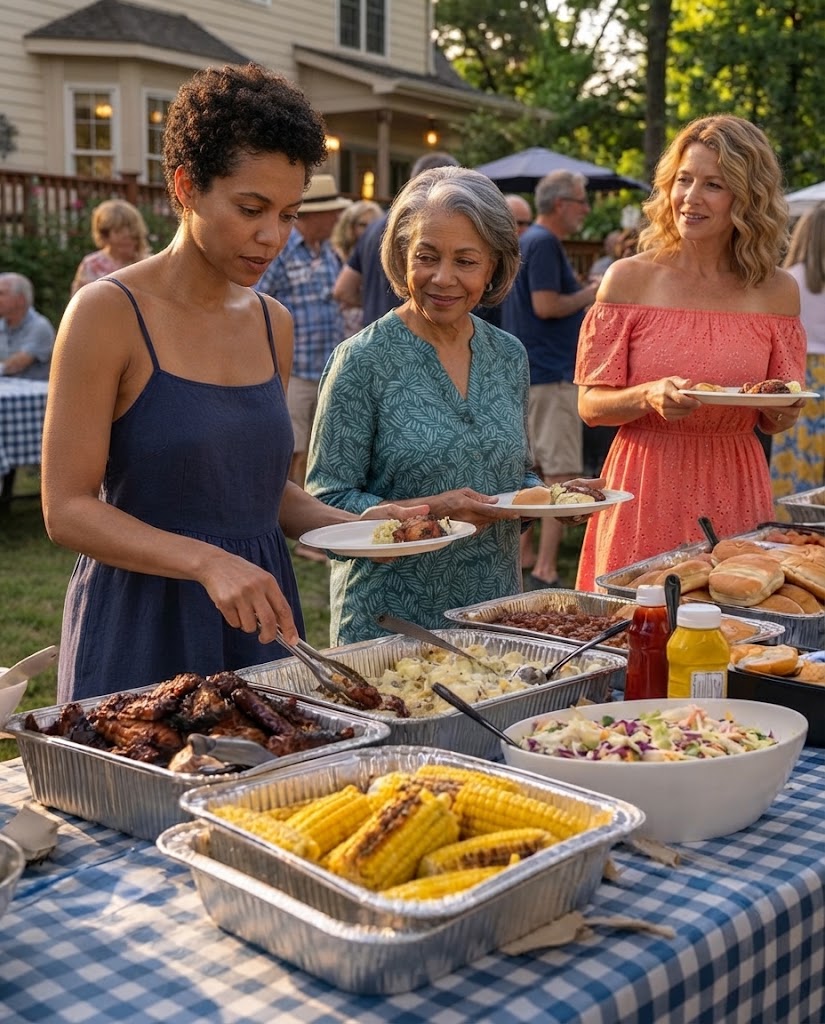
“Olivia, don’t fill your plate. You didn’t pay for this. Let the guests go first.” My mother said it loudly enough that conversations stopped across the private dining room while the string quartet kept playing beside the fireplace. I was standing at the buffet in a deep red dress with one spoonful of potatoes on a white plate; my sister Camille, two places ahead, had roast beef and shrimp piled to the rim. “Real family comes first, Liv,” she said with a smile. I looked around at the candles, white roses, pink peonies, prime rib, champagne, and sixty-two guests celebrating our parents’ fortieth anniversary. I had booked the room, paid the $2,500 deposit, spent another $1,100 on flowers, chosen the original menu, and left my credit card on file for the balance. Camille had expanded the guest list, upgraded the champagne, added a raw bar, and then spent the week online presenting herself as the daughter who had created the entire evening. I set my plate down, put on my coat, found the restaurant manager, and asked him to remove my card before the remaining $14,380 was charged.
Being the person who paid had become so ordinary in my family that even I had stopped noticing it. When I was nine, at my own birthday party, Mom stopped me from reaching for cake and told me not to be greedy because I “didn’t pay for that.” By the time she finally handed me a corner piece with no frosting rose, I had learned a lesson I carried for twenty-five years: belonging felt safer when I earned it. At twelve, I spent babysitting money on Camille’s dance shoes. As an adult, I covered Dad’s insulin, my parents’ property taxes, a new roof, Mom’s insurance, four family phone lines, Hannah’s braces, and emergency loans that never returned. Mom rarely demanded anything directly. She would simply describe a problem until I solved it, then tell me I was “so good at these things.” I mistook usefulness for affection because usefulness was when she sounded proudest of me. For the anniversary, I handled everything again while Camille gave the speeches, claimed the choices, seated herself with Mom and Dad, and told me I could “float” because I was good at checking on people. My great-aunt Ruth saw what no one else did. The afternoon before the party, she took my hand and said, “They’ve gotten so used to you carrying everything that they don’t even notice you’re carrying it anymore.” I did not understand what she was giving me until my mother reached for that plate.
The manager, Daniel, confirmed that the nonrefundable deposit and outside florist payment were already mine, but the restaurant had not yet settled the rest. I left those amounts as my anniversary gift and wrote Mom a short note: when I was nine, she had told me I had not paid for the cake; tonight she had told me I had not paid for dinner; in fact, I had paid for the room, deposit, flowers, and original menu, while Camille had publicly claimed responsibility for everything else. After I drove away, Daniel carried the bill to the head table and explained who had actually made the reservation. Camille tried two cards. Both were declined. Mom’s card did not have enough available credit. Dad finally used an emergency credit card he had kept for years, and the full $14,380 cleared. Then Ruth said aloud what our family had avoided saying for decades: I had been paying for everyone since adolescence, including Dad’s medication, which he had been told insurance covered. The following morning, I added up twelve years of financial support. The number was $102,600. I removed the adults from my phone plan, stopped automatic payments, and changed Dad’s insulin arrangement so I would be alerted if he genuinely could not afford it rather than silently paying by default. I did not cut off Hannah. She was twelve. She had also been the only person at the anniversary dinner who looked across the room and seemed to understand exactly who had made the night possible.
The reckoning exposed more than money. Camille arrived at my apartment furious about being humiliated, then admitted that her husband had left seven months earlier and she was nearly $20,000 in credit-card debt. She had taken credit for the party because she desperately wanted our mother to keep seeing her as the daughter who had everything together. Then Ruth told me something stranger: when Mom was ten, her own mother had stopped her from reaching for birthday cake with exactly the same words—“Don’t be greedy, Margaret. You didn’t pay for that.” Mom had grown up as the practical daughter beside a prettier, more celebrated sister and had once sworn she would never repeat that treatment. Instead, without recognizing it, she had assigned me her old role and Camille the role of the sister who came first. The pattern finally became undeniable at Thanksgiving. Hannah reached for pumpkin pie before Mom had served her, and Mom automatically put a hand on her wrist and said, “Don’t be greedy. You didn’t pay for that.” I stood before I even realized I was moving. “No,” I said. “Not her. Not ever again.” Camille cut Hannah the largest piece on the table. Mom heard her own mother’s voice coming out of her mouth and broke down. She apologized—not just for the anniversary party, but for the cake, the unpaid bills, the chair I never had, and every year she had made me feel as though I had to finance my place in the family.
Nothing became magically perfect afterward. Dad began paying for his own insulin and sent me a $300 check marked November insulin — I’ll take it from here, kiddo. Thank you for six years. Camille took a weekend job at a bakery and started paying down her debt. Mom began counseling and occasionally catches herself mid-sentence now, stops, and tries again. Then, on my thirty-fifth birthday, there was a knock at my apartment. Hannah stood outside holding a crooked homemade cake covered in badly piped pink frosting roses, with Camille, Dad, Ruth, and Mom behind her. After they sang, Mom picked up the knife and cut the first piece from the center—the one with the most roses—and handed it to me. Instinctively, I started to say the guests should go first. “No,” she said, pushing the plate gently into my hands. “You go first, Olivia. You didn’t pay for this. That’s the whole point.” The cake was too sweet, the frosting grainy, and one layer slightly underbaked. It was the best cake I had ever eaten. I had spent most of my life holding up the floor beneath my family and wondering why nobody saw me. The night I finally put it

