
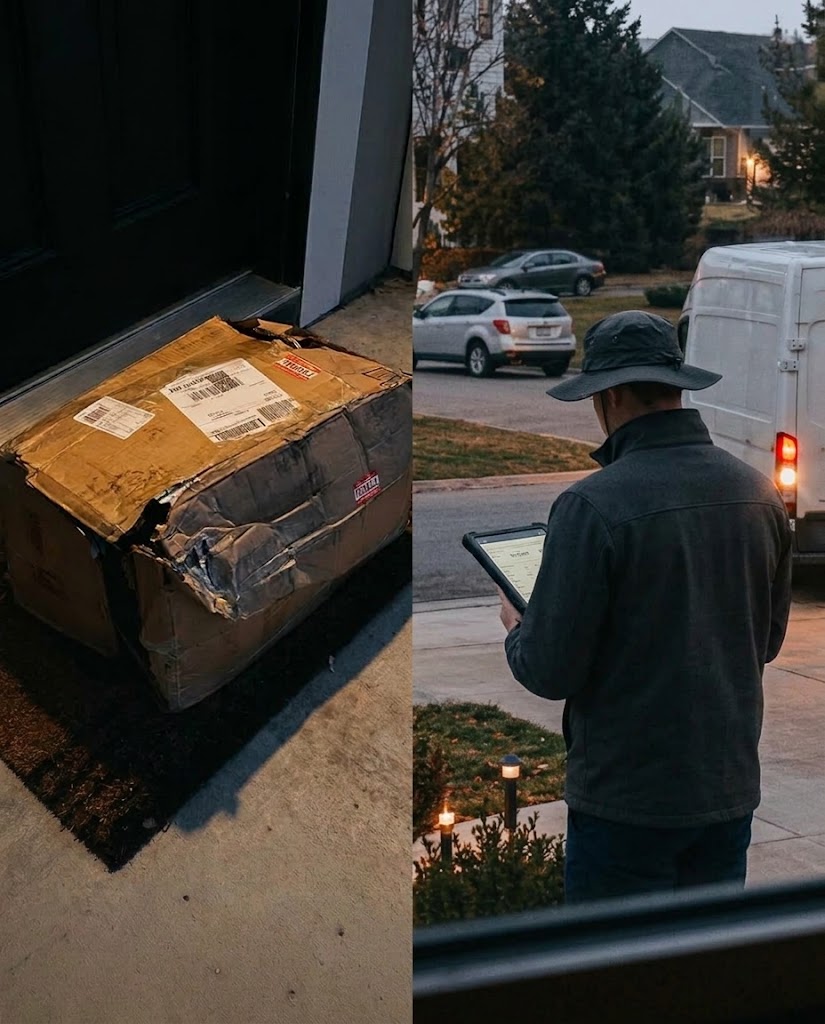
The driver stepped out of the van at 7:26 in the morning, and I immediately understood why every customer-service representative had become so careful whenever I mentioned him. His left sleeve was pinned neatly above the elbow. I stood at my kitchen window holding a mug of coffee and felt about three inches tall, replaying every call in which someone had reminded me that our route driver had an excellent record, was highly regarded, and should not be accused without evidence. I had assumed they were shielding a careless employee. Now I wondered whether they thought I was blaming a disabled man simply because he carried packages differently. Then Marcus opened the back of his van, stared inside, and swore. My large white box marked FRAGILE was lying underneath an enormous case of bottled water, its bottom already sagging before he touched it. He removed the water, set my package carefully on the pavement, photographed the damage, and called someone at the depot. “No,” I heard him say through the open kitchen window. “I’m not delivering this as clean. That’s the fifth one on this route.”
My name is Karen, I’m forty-two, and over six weeks four of my five fragile orders had arrived damaged: wine glasses, a framed print, a bathroom mirror, and ceramic dinner plates. Each time the company refunded me immediately, yet nobody would answer the question I was actually asking—why the damage kept happening. The moment I mentioned a pattern, customer service redirected the conversation toward Marcus’s spotless performance record. What I did not know was that Marcus had lost his arm in a motorcycle accident eight years earlier, returned to work after rehabilitation, passed every handling and driving assessment, and built one of the depot’s best delivery records. He had also spent years dealing with customers who saw him carrying a parcel one-handed and decided his disability explained any dent, crack, or crushed corner they discovered later. Once, someone had filmed him from across the street and posted the video online claiming the company was allowing a disabled driver to throw packages around; the parcel had not even been damaged. The company had become so defensive about protecting him from discriminatory assumptions that its employees stopped being transparent with customers who raised legitimate concerns. That explained their tone. It did not explain my shattered glass.
Marcus did. My street’s parcels were usually sorted overnight into the same rolling metal cage, and one of its wheels had failed, leaving the entire trolley leaning to one side. To keep packages from shifting, loaders packed it tightly, sometimes stacking heavy freight on fragile boxes despite the labels. Drivers did not control that stage of the process. Marcus had reported the defective cage three times, along with repeated damage from the same loading area, but his supervisor Terry had been pressuring staff to reduce damage reports because every flagged package required photographs, paperwork, and removal from the route—numbers that hurt the depot’s performance metrics. “When I deliver it anyway,” Marcus explained, “it becomes customer service’s problem.” I opened my box beside him and found one of two ceramic lamps cracked through the base. He photographed it, and so did I. Then I called the company again, this time without mentioning Marcus’s arm at all. I described the crushed carton under the bottled water, the leaning cage, the repeated route damage, and the reports Marcus said he had already submitted. That finally moved the complaint away from personal performance and into regional operations.
Within days, the review widened. Three defective rolling cages were pulled from service. Operations data showed an unusual concentration of claims involving glassware, electronics, ceramics, and framed items coming through the same overnight loading shift. The cage was only the first visible symptom. Investigators found fragile-handling procedures were being ignored, heavy items were being stacked wherever they fit, and some depot-caused damage had been reclassified as customer claims instead of handling incidents. Terry had been pushing the night crew to clear cages faster before the morning cutoff, creating an incentive to keep damaged packages moving rather than stop and document them. Marcus, meanwhile, had quietly been photographing damaged freight before loading it into his van for months because he was tired of being blamed after delivery. Those photographs became part of the evidence regional management used in its review. The company eventually sent me a written apology citing a “process failure” and “corrective action,” refunded the lamps, and issued a credit. More importantly, my replacement mirror, wine glasses, and later fragile orders began arriving intact.
A month later my nine-year-old son Max saw the van outside and shouted, “Mom, it’s the one-arm guy!” I corrected him immediately: “His name is Marcus.” Max ran outside, thanked him by name, then announced that I thought he was very good at his job. Marcus looked at me, smiled, and said something I have remembered ever since: “People usually see what confirms the explanation they already have.” If they assume his disability makes him careless, every dent proves it. I had assumed the depot was hiding something, and in a different way I had been right. The company’s instinct to protect Marcus was understandable; he had spent years being judged before anyone examined the evidence. But protecting him should never have required hiding the actual cause of repeated damage. These days, around seven-thirty, I still sometimes see his van stop outside. Marcus steps out, checks the package, carries it to my door, and hands it over intact. One arm. No problem. Which, in hindsight, was never the part of the delivery chain I should have been watching.

