
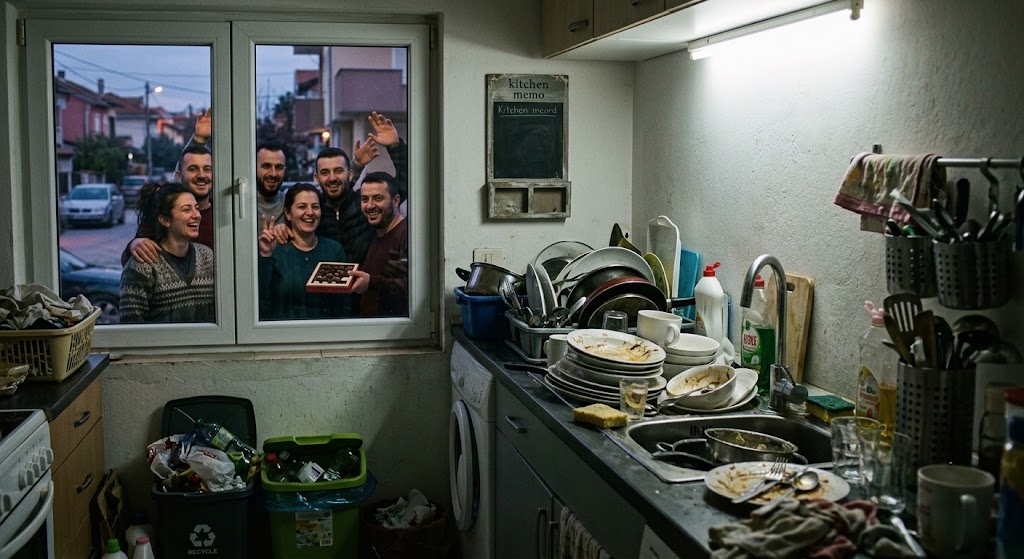
At six o’clock on a Saturday evening, three cars rolled into my gravel driveway and eight people climbed out. My sister Megan had texted only, We’ll be there around six, which I had foolishly assumed meant her and her husband Scott. Instead, she arrived in a white summer dress with six adult friends, two children, and the confidence of someone checking into a resort she believed she owned. Within minutes, one guest had opened my refrigerator, another was carrying grilling tools toward the patio, a child had trampled my lavender, and someone was reaching for a reserve cabernet I had been saving. Megan moved through my kitchen directing everyone toward bathrooms, drinks, and the lake as if she were the hostess. Then one of her coworkers smiled at me and said, “Megan told us you’re staying here while your townhouse is being renovated.” I looked at my sister. She leaned close and whispered, “Do not embarrass me.” After years of being told to relax because “we’re family,” I finally smiled and said, “Everyone, make yourselves comfortable. I need twenty minutes.”
The lake house had belonged to our grandparents for nearly fifty years before they left it to me. It was beautiful when I inherited it, but barely functional: leaking roof, tired plumbing, rotten porch boards, and decades of deferred repairs. My husband Daniel and I spent eight years restoring it with our own hands and savings. He rebuilt the dock; I stripped the kitchen cabinets; we postponed vacations so we could afford the roof. Daniel died of cancer three years before Megan’s dinner party, and afterward the house became the one place where I could still feel the life we had built together. Megan treated that history as irrelevant. She appeared without warning, brought friends for weekends, once hosted a birthday brunch while I was away, and posted photographs from my kitchen and dock captioned as though the property were hers. I had always asked only that she call first. She rarely did. That evening, however, her coworkers’ comments made the pattern suddenly obvious: she had been telling people the house belonged to her, that she had renovated it, and that I was merely staying there temporarily.
I went upstairs to my office and returned carrying a silver serving tray covered with a polished lid. Beneath it were the deed, my grandparents’ will, eight years of renovation invoices, and photographs of Daniel and me rebuilding the property. When I lifted the cover, conversation stopped. One guest read the deed and asked why my name was the only one on it. Another turned to Megan and said, “You told us you bought this place from your grandparents.” Scott went pale and admitted she had told him I had given her partial ownership. Megan’s defense was that it was still a “family house.” Then Aunt Linda, my grandmother’s seventy-eight-year-old sister, spoke from the doorway. She had been present when my grandparents revised their estate plan. The house, she revealed, had originally been intended for Megan and me equally—until our grandfather discovered that Megan had opened two credit cards using his personal information, taken out loans, and accumulated nearly $20,000 in unauthorized debt. When confronted, she lied and blamed a bank employee. My grandparents did not leave the property solely to me because they loved her less. Aunt Linda said it plainly: “They left it to Claire because they trusted her.”
The room emptied quickly after that. The coworkers apologized for believing Megan’s version, the children were made to apologize for the flower bed, furniture was put back, and the wine was recorked. Scott stayed long enough to ask his wife how much of their life together was true, then left to stay with his brother. Megan accused me of staging a humiliation, but I reminded her I had told her privately for years that the house was mine and that visitors required permission. The difference was that this time the truth had witnesses. I asked her to leave and later gave her the only terms under which she could return: she had to ask first, knock, bring no guests without permission, and stop presenting my home as her property. If she ignored those conditions, access ended. Four months passed before she appeared on the porch alone, carrying no luggage and making no assumption that she could enter. “Can I come in?” she asked. Inside, she told me she and Scott were in counseling, that she had corrected the story at work, and that for years she had confused my stability with favoritism. “I treated your kindness like something I was owed,” she said. “I’m sorry.”
Trust did not come back because of one apology, and I did not pretend it had. But the relationship changed because the rules did. Megan still visits the lake house now. She texts before coming, knocks at the door, brings groceries, and does not invite anyone unless I say yes. Before leaving, she washes her own dishes. The first time I caught her wiping down the kitchen counter, she looked over and said, with the old familiar grin, “Relax, Claire. We’re family.” Years earlier, that sentence made my shoulders tense because it meant my boundaries were about to be ignored. This time I smiled. “Exactly,” I said. “So clean the counter.” The lake house is still full of Daniel’s fingerprints, my grandparents’ memories, and the quiet we worked hard to preserve. Megan is welcome there again. The difference is that now she comes through the front door as my sister—not as someone who mistakes love for ownership.