
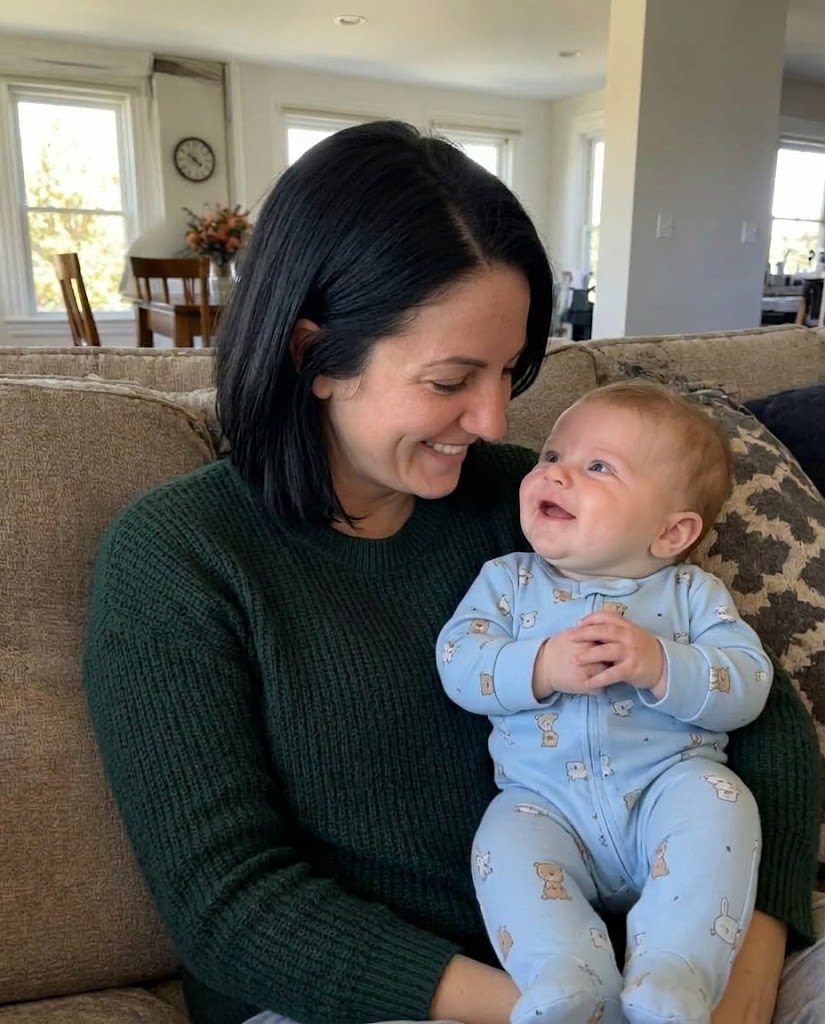
“Glen, give me my keys.” My husband sat on the couch with them dangling from two fingers while our four-month-old daughter slept in her bassinet beside him. I was already twenty minutes late to meet my best friend for coffee, and I had told Glen about the plan three days earlier. Ava was fed, changed, and sleeping; two bottles were in the refrigerator; Glen had the day off. Still, he shook his head and said, “You wanted a baby, Nicole.” When I reminded him that he had wanted one too, he looked toward the bassinet and said the sentence that changed the temperature in the room: “Moms don’t get free time.” I looked at the diaper bag I had packed for a baby who was not even leaving the house and realized I had prepared my husband to care for his own daughter as though he were a temporary employee. Instead of canceling on my friend, I called his mother.
Ellen arrived twenty-five minutes later and asked Glen to step outside. Less than a minute after that, I heard him protesting loudly. When I followed, Ellen was standing beside his car holding his keys. “Give them back,” Glen demanded. She held out her other hand and said, “Nicole’s.” When he argued, she raised an eyebrow and told him it was frustrating when someone else took your keys and decided whether you were allowed to leave. He went inside, returned mine, and expected his mother to stay with Ava so I could go. Ellen refused. “You are,” she told him. “She’s your daughter.” I started automatically explaining where the bottles were, then stopped. Everything he needed was already in the house he lived in. When Glen asked what he was supposed to do if Ava cried, I told him, “You’ll figure out why.” Then I took my purse, met my friend Sasha, and for nearly three hours resisted the urge to check my phone every few minutes and manage parenthood from another table.
When I returned, Glen was exhausted, but Ava was asleep against his chest and the house had survived. Over the following week he handled bath time, took a night feeding, packed the diaper bag, and began learning what Ava needed without waiting for instructions. Then work became busy, and the old pattern quietly returned. By Friday I had done bedtime three nights in a row, cooked every dinner, washed bottles, folded laundry, and even packed Glen’s lunches while he still found time to watch television and run. Saturday morning he put on his jacket and casually announced that he was meeting friends. That was when I finally put the problem into words. “You still get to be Glen,” I told him. “I love Ava more than anything, but I feel like every part of me has been folded into being her mother while you still get to be everything else.” He admitted he had assumed childcare was mostly my responsibility because I was home. I acknowledged something too: I often stepped in before he could learn. But my hovering did not excuse his withdrawal. He took off his jacket, stayed home because he chose to, and when Ava began crying, he said, “I’ll get her,” before I could move.
The practical change mattered more than the apology. Glen began taking regular responsibility rather than “helping” only when asked: bath time, a night feeding, Saturday walks, bottles, and stretches of solo care. We also started treating personal time as something both parents were entitled to negotiate, not something one spouse granted the other. A few weeks later, when Sasha invited me out again, I told Glen I would be gone from eleven until two. Ava was fussy that morning, and for one second he suggested I go another weekend. I nearly agreed out of habit. Instead, I settled her, handed her back, and said, “I’m not asking you to babysit. I’m leaving our daughter with her father.” This time I walked out with my own keys. Later, Ellen reminded me why she had intervened so strongly: taking someone’s keys to prevent them from leaving crossed a line beyond an ordinary disagreement about childcare. She loved her son, but she would not defend controlling behavior simply because he was her son. “I opened the door,” she told me. “You walked through it.”
When I came home that afternoon, Glen was sitting on the floor with Ava, holding a soft toy above her while she kicked happily at the air. He asked how coffee had been and seemed genuinely pleased when I told him I had stayed longer than planned. I set my keys in the bowl beside the door and noticed that such a small thing no longer felt small. Glen was not suddenly perfect, and neither was I; what mattered was that we had stopped pretending motherhood required one person to disappear so the other could keep living normally. We began planning time instead of assuming who owned it. I could take Saturday afternoon, he could see his friends Sunday, and neither of us had to manufacture guilt around the arrangement. For months, I had thought being a good mother meant giving Ava every piece of myself and then somehow finding more. I would still walk through fire for my daughter. But loving her did not require erasing Nicole. The next time I made plans, I kissed Ava goodbye, told Glen when I would be back, picked up my keys, and walked out the door. Nobody stopped me. More importantly, I didn’t stop myself.

